


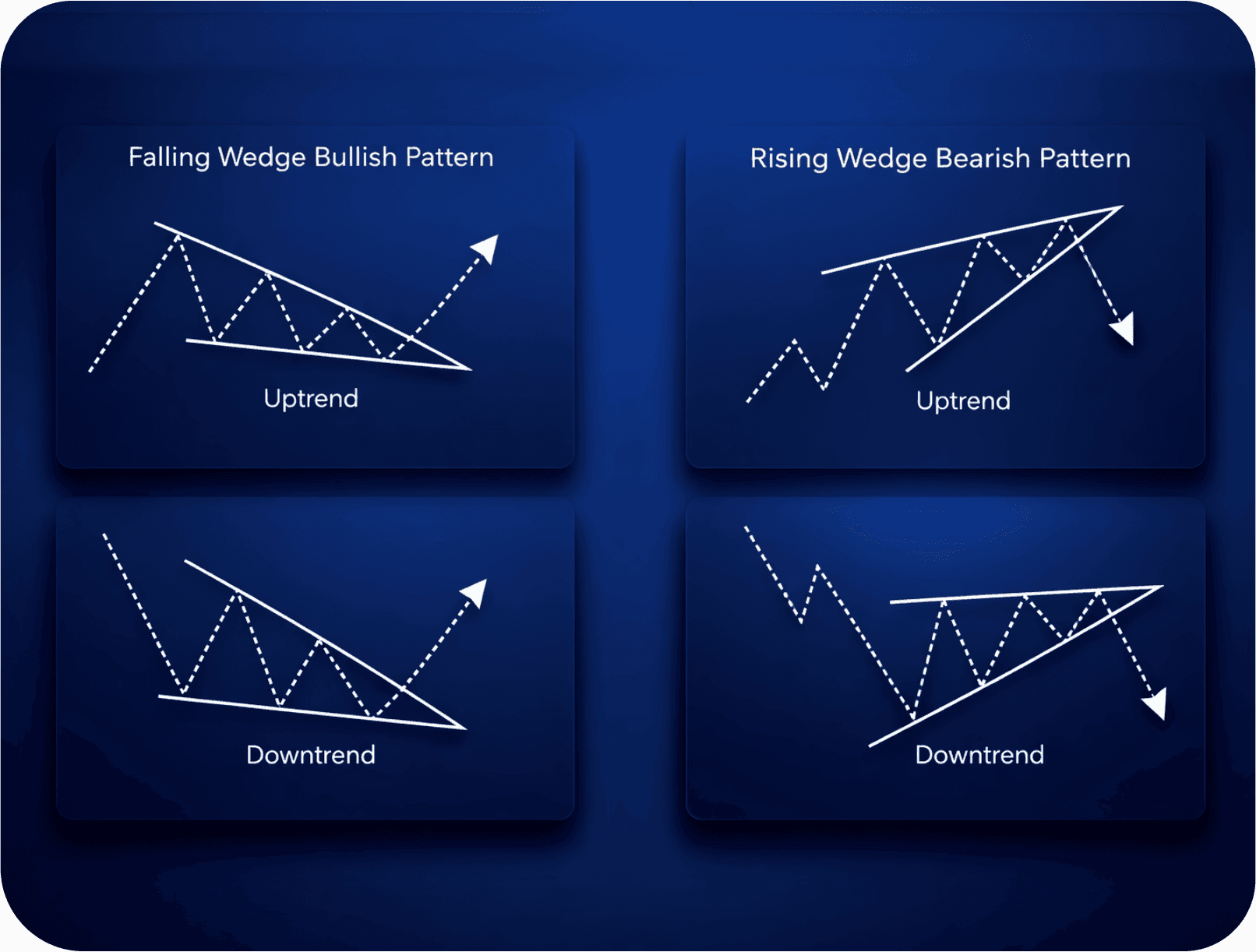
Chart patterns are visual representations of market psychology, formed by price action that reflects the ongoing battle between buyers and sellers. Recognizing these patterns can provide valuable insights into potential price movements and help traders identify high-probability setups.
Pattern Types
Head and shoulders patterns are reversal patterns that typically form at market tops. The pattern consists of three peaks, with the middle peak (head) higher than the two surrounding peaks (shoulders). A break below the "neckline" connecting the two troughs confirms the pattern and often leads to a decline equal to the distance from the head to the neckline.
Triangles are continuation patterns that form when price consolidates between converging trend lines. Ascending triangles have a flat top and rising bottom, suggesting buyers are becoming more aggressive. Descending triangles have a flat bottom and falling top, suggesting sellers are gaining control. Symmetrical triangles show balanced buying and selling pressure.
Double tops and bottoms are reversal patterns. A double top forms when price reaches a similar high twice, with a trough in between, suggesting resistance at that level. A break below the trough confirms the pattern. Double bottoms are the inverse, forming at market lows.
Flags and pennants are short-term continuation patterns that form after strong moves. Flags are rectangular consolidations, while pennants are small symmetrical triangles. Both typically resolve in the direction of the preceding trend, with the move often equaling the length of the initial move.
Trading Strategies
Pattern recognition requires practice and patience. Not all patterns complete successfully, so traders should wait for confirmation before entering. This might mean waiting for a breakout or breakdown, or for price to reach a specific level within the pattern.
Entry signals should be based on pattern completion. For reversal patterns like head and shoulders, entry might occur on the break of the neckline. For continuation patterns like triangles, entry might occur on the breakout in the direction of the trend.
Target projections can be estimated using the pattern's dimensions. For head and shoulders, the target is often the distance from the head to the neckline, projected downward from the neckline break. For triangles, the target is often the height of the triangle, projected from the breakout point.