


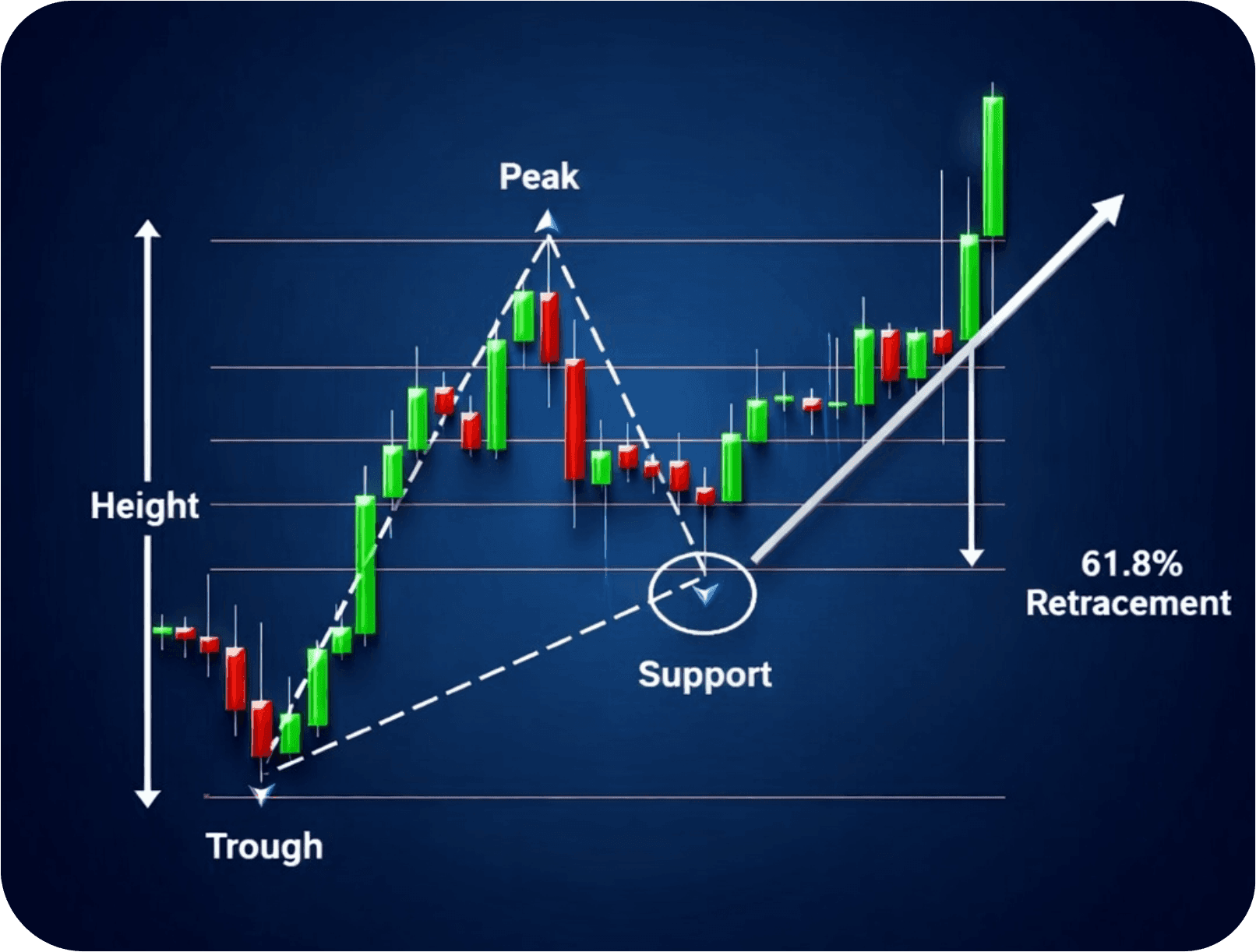
Fibonacci retracements are based on the mathematical relationships identified by Leonardo Fibonacci, which appear frequently in nature and financial markets. These retracement levels help identify potential support and resistance areas where price might reverse or consolidate.
Key Levels
The primary Fibonacci retracement levels are 23.6%, 38.2%, 50%, 61.8%, and 78.6%. These levels are drawn from a significant swing high to a swing low (in uptrends) or from a swing low to a swing high (in downtrends). The 50% level, while not a true Fibonacci number, is often included as it represents a natural psychological level.
The 38.2% and 61.8% levels are considered the most significant. The 38.2% level often acts as shallow retracement support in strong trends, while the 61.8% level (the golden ratio) often acts as deeper retracement support. If price breaks below 61.8%, it often continues to the 78.6% level or even the full 100% retracement.
Fibonacci extensions, which project beyond 100%, are also useful for identifying profit targets. Common extension levels include 127.2%, 161.8%, and 261.8%.
Trading Strategy
Level identification requires selecting the correct swing points. In an uptrend, draw from the swing low to the swing high. The retracement levels then show where price might find support during pullbacks. The quality of the swing points selected directly impacts the reliability of the Fibonacci levels.
Entry points can be identified when price approaches Fibonacci levels, particularly if these levels coincide with other technical factors like moving averages, trend lines, or previous support/resistance. Waiting for price action confirmation, such as a bullish or bearish reversal candle, increases the probability of success.
Stop loss placement should be beyond the Fibonacci level being traded. If buying at the 38.2% retracement, a stop might be placed below the 50% level. This allows for normal price fluctuations while protecting against a breakdown of the Fibonacci support.