

The market does not move randomly. It moves in a pattern that has been repeating since before most retail traders were born. Learning to read that pattern changes everything.
There is a wheat trader in Chicago, 1910, sitting in a wooden office with a telegraph machine and a chalkboard full of prices. He has spent six months quietly buying wheat contracts, never too many at once, never fast enough to spike the price. His brokers work through intermediaries. Nobody knows it is him. When he finally has enough, he leaks a rumour about drought conditions in Kansas. Prices jump. Panic buyers pile in. He sells everything into that frenzy at a premium, exits cleanly, and by Tuesday, he is flat while the market crashes back down and the panic buyers hold losses they do not understand. Over a century later, on a Tuesday morning in London, the EUR/USD chart tells the same story. The technology changed. The cycle did not.
Understanding accumulation, manipulation, and distribution in forex is not about uncovering a conspiracy. It is about understanding a structural reality: large participants cannot enter and exit positions the way small traders can. That constraint forces a specific sequence of behaviour, a cycle that leaves footprints on every chart, in every timeframe, across every liquid market on earth.
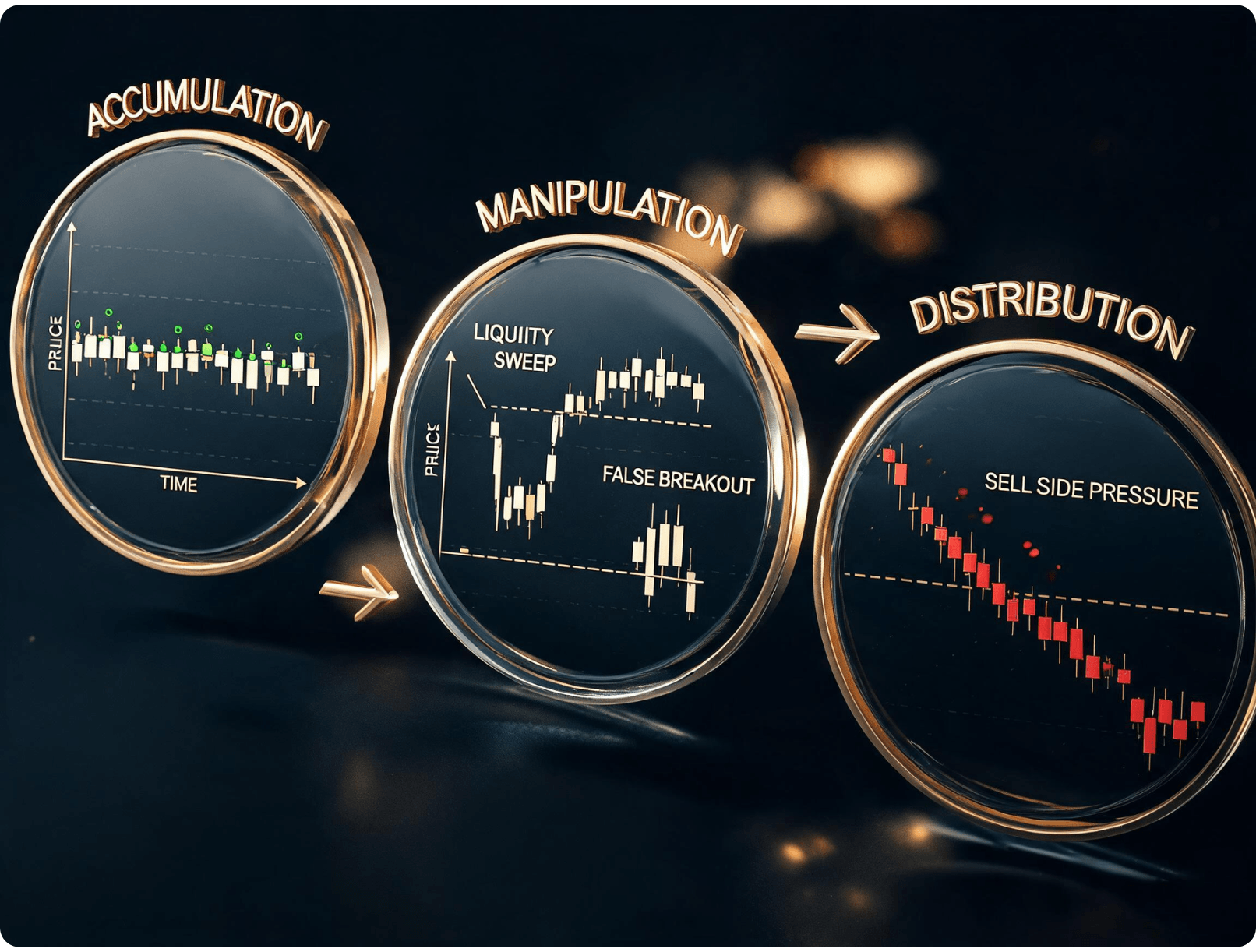
Phase 1 — Accumulation
Institutions build positions quietly within a range. Price looks boring. Retail loses interest. Volume is deceptive, high, but directionless.
Phase 2 — Manipulation
A false move triggers retail entries in the wrong direction and flushes stops. Institutions get the liquidity they need to finish loading.
Phase 3 — Distribution
The real move begins. Institutions unwind their position into retail demand as price delivers strongly in the intended direction.
Accumulation is the phase that kills patience.
Price moves sideways for what feels like forever, ranging between two levels, touching them repeatedly, failing to break either one convincingly. To a retail trader scanning for momentum, this looks like a dead chart. Close it. Move on. But this stillness is not an absence of activity. It is the most deliberate activity in the entire cycle.
What accumulation actually looks like
The signals most traders misread as "nothing happening."
A clearly defined range with a floor and a ceiling that have been tested multiple times, not once, not twice, but enough that every retail trader has drawn those lines on their chart.
Wicks that repeatedly reach just beyond the range boundaries and snap back, small liquidity sweeps happen throughout the accumulation, testing how many stops are available on each side.
Volume that seems elevated relative to the lack of price movement. The market is transacting heavily; it is just not moving directionally. Orders are changing hands from weaker participants to stronger ones.
Multiple failed breakout attempts in both directions. Retail traders get burned trying to trade these breaks, give up, and move their attention elsewhere. This is precisely the intended effect.
Then comes manipulation, the phase that is most misunderstood because it feels, in the moment, like the real move has finally started.
It is a Thursday morning. After three weeks of sideways price action on GBP/USD, the pair breaks sharply lower, clean, decisive, through the bottom of the range. Retail traders who have been waiting for a breakout go short. Their stops sit above the range. Price drops another 40 pips. Charts everywhere show the same breakdown candle, the same technical confirmation. Then, over the next 45 minutes, price reverses. Slowly at first, then with gathering momentum. By the end of the London session, GBP/USD has not only recovered the entire breakdown, it is also trading 80 pips above the range that held for three weeks. Every short entry from that morning is a loss. The breakout was the trap.
This is the manipulation phase doing its job. The false break downward served two purposes simultaneously: it triggered the stops of traders who were long from inside the range, generating buy orders at the bottom for institutions to sell against, and it pulled in fresh short positions whose stops sitting above the range highs now represent the liquidity institutions need to buy into as the price reverses upward. Manipulation is not gratuitous. It is functional. It is the mechanism by which large participants complete their accumulation at a price that retail just handed them.
"The breakout that feels most convincing is often the one designed to feel that way. Real moves tend to begin from places where nobody is watching anymore."
Distribution is the phase where the actual money gets made but not by the people who see it for the first time and jump in.
By the time price is trending cleanly and every indicator confirms the move, institutions are already unwinding. They sell into the buying pressure that retail FOMO creates. Every breakout trader entering long on confirmation is providing the exit liquidity for the position that was built during accumulation three weeks earlier.
Reading the distribution phase: What to watch as the cycle peaks
Momentum starts to deteriorate before price does. Each successive push upward makes a new high, but the move is smaller than the last. Institutional selling is absorbing retail buying at progressively lower volumes.
Long upper wicks begin appearing on daily candles. Price is pushing into highs and failing to hold them. Distribution is happening at those peaks as institutions sell into breakout attempts.
Retail sentiment reaches an extreme. Social media, news coverage, and amateur analysis all point in the same direction. This saturation of bullish opinion is the distribution signal. When everyone who could buy has bought, there are no buyers left to push price higher.
A sharp reversal often on no obvious news, signals that the institutional position has been fully distributed. The reversal candle is typically large, fast, and confusing to anyone still holding in the prior direction.
The cycle then resets
A new range forms. Accumulation begins again, in the opposite direction. This is not a metaphor or a model it is the operating logic of every liquid market that has ever existed, and it repeats on every timeframe from the one-minute chart to the monthly.
Knowing the cycle does not make trading simple.
The hard part is never understanding what accumulation, manipulation, and distribution are it is figuring out which phase you are currently inside. That requires patience in accumulation, discipline not to chase manipulation, and timing good enough to enter early in distribution rather than late. Three separate problems, each requiring a different skill. But the starting point is the same for all of them: stop looking at price as something random and start reading it as a sequence with logic, participants, and a repeating structure that was old long before the forex market existed.