

A trader's honest look at what moves the price and who is actually on the other side.
Every time you place a stop loss beneath a swing low, you are not protecting yourself. You are leaving a receipt. Someone with a far larger order book than yours knows that stop is sitting there, and they need the liquidity it creates to fill their position without moving the market against themselves. That is the basic mechanics of how the foreign exchange market functions at scale.
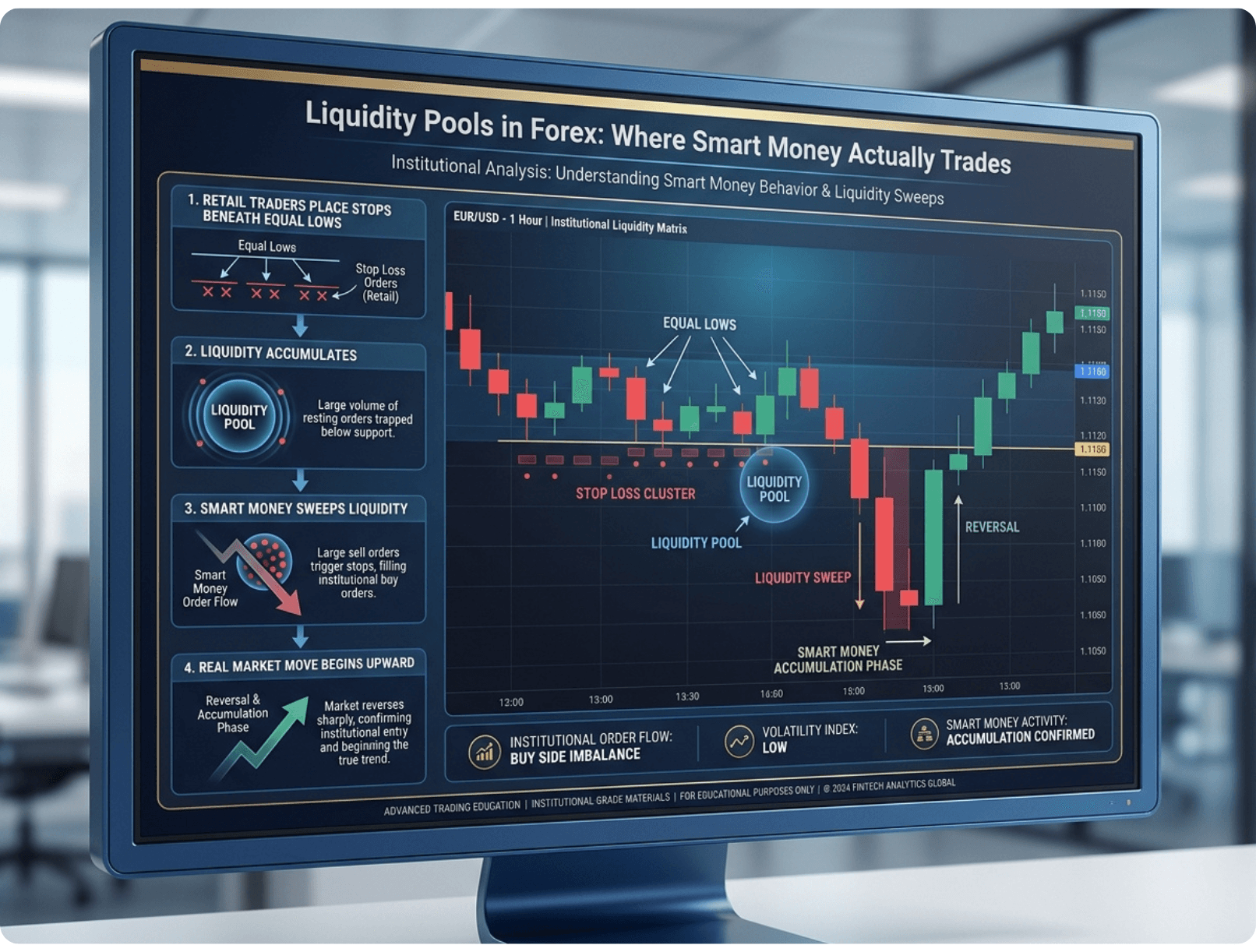
The concept of liquidity pools is not exotic. It describes something straightforward: price gravitates toward areas where a significant number of resting orders, limit entries, and take profit levels are clustered together. Banks and institutional desks require enormous transaction volumes. They cannot simply buy 500 million euros in one go without slippage destroying their own entry. So they hunt for concentrations of orders they can trade against. Retail clusters, sitting tidy and predictable just beyond obvious swing points, are exactly what they need.
Equal highs on a daily chart are not coincidental
When price makes two or three peaks at roughly the same level, the stop orders of traders short from those highs accumulate just above them. When a bank needs to sell aggressively into strength, it sweeps those stops, triggering a sharp move upward that sucks retail traders into chasing longs and then reverses hard once the liquidity is consumed. The candle often looks like a false breakout. From a mechanical standpoint, it was the point all along.
Retail traders typically learn to place stops at safe distances, but they tend to use the same reference points. Previous swing highs and lows, round numbers, psychological levels like 1.1000 or 1.2500. This uniformity is the problem. When everyone reads the same chart and reaches the same conclusions about where to protect a trade, the resulting stop clusters become the most liquid locations in the entire market. Institutions are not exploiting some secret. They are simply following the most rational path, going where the volume is.
Understanding this shifts the way you read price action
A sharp wick into a prior low that immediately reverses is often misread as a failed breakdown. Reframe it: that wick reached below the swing low where buy stops and sell stops had accumulated, filled institutional orders against that liquidity, and then the price moved in the direction of the larger participant's actual intent. The retail trader whose stop was hit at that wick low got taken out of a trade that, had they held, would have been correct.
This is not a reason to stop using stop losses.
It is a reason to place them somewhere less obvious. Just beyond the nearest swing low is where the herd parks. A few pips further, in clean space where no technical reason exists for the price to travel, is far less likely to be hunted. Thinking about why a price might want to reach a level rather than purely what level looks logical to you is a different cognitive task entirely and a more useful one.
The higher the timeframe, the more significant the liquidity pool
A cluster of stops beneath a weekly low carries far more weight than one beneath a five minute swing. Institutional desks are working on daily and weekly structures. When you see a clean, prolonged consolidation on a higher timeframe, price coiling between a narrow range for weeks, recognise that resting orders are stacking on both sides. The eventual break of that range is not random. Price is being delivered into liquidity. The question worth sitting with is not whether the break will happen, but which side gets hunted first before the real move begins.
None of this requires you to predict with certainty
It requires you to read accumulation, recognise where orders are stacked, and avoid being the one whose stop creates the fuel. Watch for the sweep. Wait for the reversal confirmation after that, liquidity is taken. Enter with the flow, not before it. Patience, in a market structured this way, is not a soft virtue. It is the actual edge.