


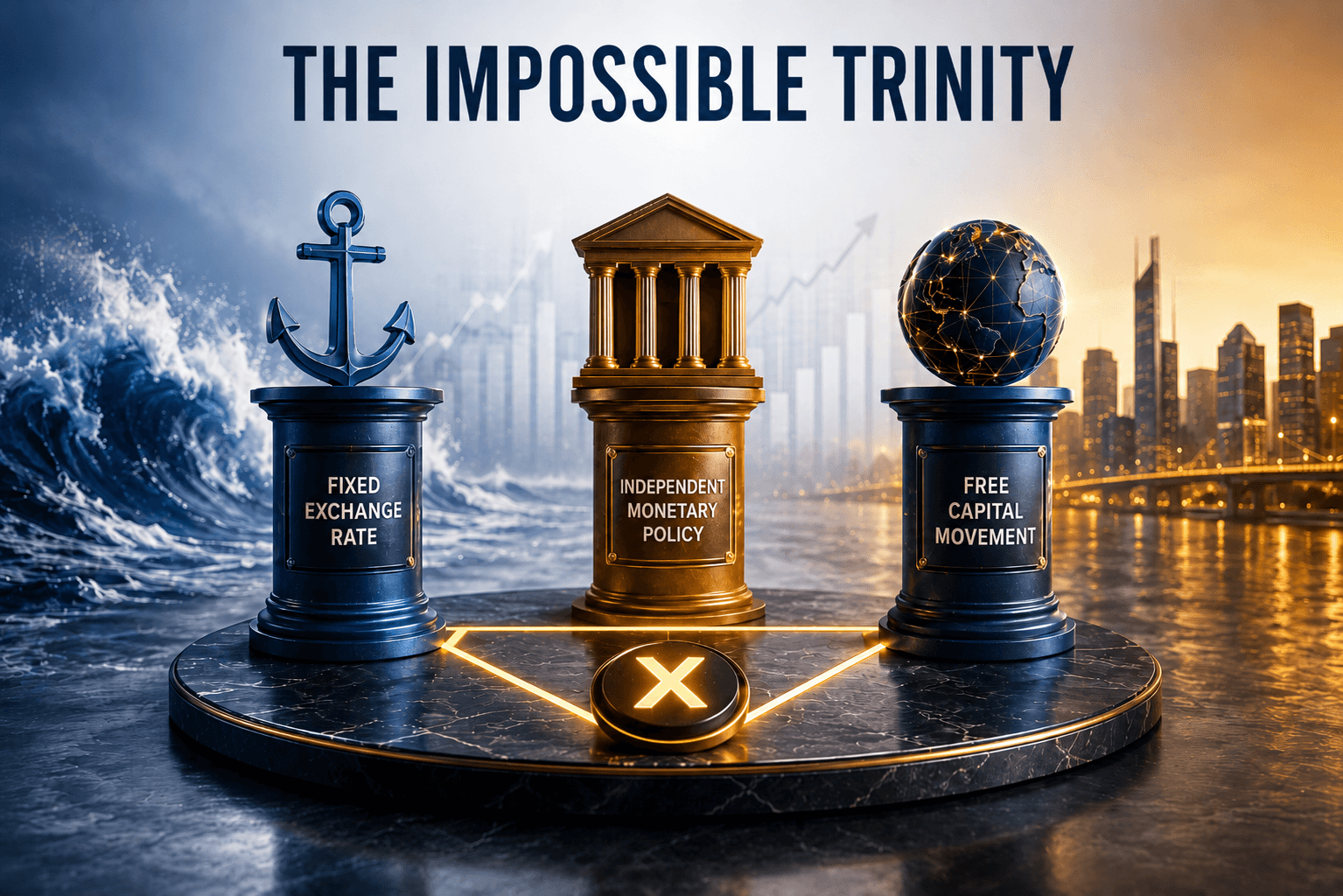
Every country in the world has made the same choice — whether they know it or not. They picked two of three things. The third one they gave up. And everything that happens to their currency flows from which two they chose.
In September 1992, George Soros became famous for breaking the Bank of England. The story is usually told as a triumph of speculative genius — one man and a trade that earned a billion pounds in a day. The part that gets skipped is why the Bank of England was so breakable in the first place. Britain at the time was trying to do three things simultaneously: keep the pound pegged to a fixed exchange rate within the European Exchange Rate Mechanism, allow capital to flow freely in and out of the country, and set its own interest rates according to domestic economic conditions. The problem, which Robert Mundell and Marcus Fleming had laid out mathematically three decades earlier, is that these three goals are mutually incompatible. A country cannot have all three at the same time. Soros did not break the pound through genius alone. He broke it because the UK had been violating a fundamental law of monetary economics and the market was eventually going to enforce that law whether Soros noticed or not. He just noticed first.
The Impossible Trinity
The Impossible Trinity also called the Mundell-Fleming Trilemma states that a country can choose at most two of the following three policy goals. Never all three. The laws of capital flows and exchange rate arithmetic make the combination of all three self-defeating.
- Fixed exchange rate
The currency is pegged to another at a set rate. The central bank commits to buying or selling its currency at that rate indefinitely, using reserves to defend it.
- Free capital movement
Money can flow freely in and out of the country no capital controls, no restrictions on foreign investment, no limits on citizens moving assets abroad.
- Independent monetary policy
The central bank sets interest rates based on domestic conditions, inflation, employment, growth without being constrained by the need to maintain a currency peg or attract foreign capital.
The trilemma works because of one iron rule: when capital moves freely, it flows toward higher interest rates. If a country has a fixed exchange rate and tries to set interest rates differently from the country it is pegged to, capital will flood in or out, creating pressure on the exchange rate that eventually overwhelms the central bank's reserves. The peg breaks. The only way to keep the peg is to match the anchor country's interest rates, surrendering monetary independence. The only way to keep both the peg and monetary independence is to stop capital from flowing. Every country picks a corner.
Corner 1
Free capital + independent policy — surrender the fixed rate
The United States, United Kingdom, eurozone, Japan, and Australia all sit here. Capital flows freely, interest rates are set independently for domestic conditions, and the exchange rate floats wherever the market takes it. The currency absorbs all the adjustments sometimes uncomfortably.
Gives up: exchange rate stability
Corner 2
Fixed rate + free capital — surrender monetary independence
GCC countries, Hong Kong, and pre-2015 Switzerland's EUR/CHF floor. The currency is pegged, capital flows freely, but interest rates must follow the anchor currency's lead — for GCC nations this means following the Federal Reserve regardless of local conditions. When the Fed hiked aggressively in 2022–23, GCC central banks hiked in lockstep even though Gulf economies had different inflation profiles.
Gives up: independent monetary policy
Corner 3
Fixed rate + independent policy — surrender free capital
China sits here. The yuan is managed against a basket, the PBOC sets rates according to domestic conditions, and capital controls prevent the unlimited arbitrage that would otherwise force a choice between the two. This is the most interventionist corner — it requires active, daily management of capital flows through regulatory restrictions and direct central bank involvement.
Gives up: free capital movement
Britain in 1992 was attempting corner two — fixed rate and free capital — which meant surrendering monetary independence. The pound was pegged to the Deutsche Mark within the ERM. To defend the peg, the UK had to keep interest rates aligned with Germany's, even though Germany had just reunified and was running tight policy to manage inflationary pressure from absorbing East Germany. Britain was in recession and needed lower rates. The trilemma said it could not have lower rates and a fixed exchange rate while capital moved freely. Soros, and eventually the entire market, simply bet that Britain would eventually choose its recession over its peg. They were right. On Black Wednesday, the UK raised rates to 15% in a single day in a futile attempt to hold the peg — then abandoned it hours later. The trilemma collected its debt.
"Every currency crisis in history is, at its core, a country discovering that it was trying to sit in all three corners of the trilemma simultaneously — and the market enforcing the mathematics that prevented it."
The GCC choice and its direct consequences for traders in Dubai
What corner two means for markets in the Gulf
GCC nations chose the peg specifically because oil revenues come in dollars. A fixed dollar rate eliminates the currency mismatch between what governments earn and what they spend domestically — a logical choice for resource-dependent economies whose export revenue is entirely dollar-denominated.
The cost of this choice became visible when the Federal Reserve hiked rates seventeen times between 2022 and 2024. GCC central banks followed every single move regardless of whether domestic economic conditions required tighter policy. Real estate, credit growth, and domestic demand in the Gulf were all affected by US monetary decisions that had nothing to do with Gulf economic conditions.
For forex traders operating from Dubai, this means the USD is not just a major trading currency; it is the monetary anchor of the domestic economy. Understanding Fed policy is not optional context. It is the primary driver of local borrowing costs, capital flows, and regional financial conditions.
Reading regimes
When a country announces it is pegging its currency or joining a currency board, the trilemma immediately tells you what it gave up: monetary independence. Watch for the consequences — particularly if the anchor economy's interest rate cycle diverges sharply from the pegged country's domestic needs. That divergence is where peg stress builds.
Watching for cracks
Countries attempting corner two fixed rates and free capital are the most vulnerable to speculative attack when domestic conditions require rates that conflict with the peg's maintenance. The signal is widening credit default swap spreads on sovereign debt, combined with declining foreign reserves. When reserves fall sharply while the exchange rate holds steady, the peg is being defended at increasing cost. The trilemma is collecting.
The GCC edge
The GCC peg to the dollar means these currencies cannot diverge from the dollar, regardless of local conditions. Speculating on a GCC currency revaluation is essentially betting that the region will abandon an arrangement that has been in place for thirty to forty years and is structurally reinforced by oil revenue accounting. The trilemma makes the peg costly during Fed tightening cycles but it also makes it enormously durable for reasons that go beyond monetary theory into political and economic survival logic.
Mundell and Fleming published their work in the early 1960s. The trilemma they described has been violated repeatedly by governments that either did not understand it or chose to pretend it did not apply to them. Every time, the market eventually enforced it — sometimes slowly through gradual reserve depletion, sometimes sharply through speculative crises. Soros did not invent the pressure that broke the pound. He recognised, faster than most, that the pressure had been building since the day Britain joined the ERM. The trilemma had been collecting its debt for two years. He just presented the invoice.