


The difference between a hobbyist and a professional trader isn't the size of their account—it's how they protect it. In the fast-moving world of global markets, the allure of high leverage and potential windfalls can be intoxicating.
Whether you are trading Forex majors, commodities like Gold, or volatile indices like the US100, the market offers endless opportunities. However, without a disciplined approach to risk management, those opportunities can quickly turn into liabilities.
At My Maa Markets, we have seen thousands of traders navigate the markets. The single most common denominator among those who sustain long-term success is not a "magic" strategy or a secret indicator. It is a strict, non-negotiable risk-per-trade rule.
Here is why establishing this rule is the most critical step you will take in your trading career.
1. It Removes Emotion from the Equation
Trading psychology is often the biggest hurdle for investors. When you enter a trade without a predefined risk limit, fear and greed take over. You might hold onto a losing position, hoping it will turn around, or close a winning trade too early out of anxiety.
A clear risk-per-trade rule—commonly set at 1% or 2% of your total account balance—acts as an emotional circuit breaker.
-
The Benefit: You know exactly how much you stand to lose before you even click "buy" or "sell."
-
The Result: You trade with confidence, not fear.
2. It Ensures Longevity (The "Risk of Ruin" Concept)
Mathematically, if you risk 10% or 20% of your account on a single trade, a short losing streak can wipe you out entirely. This is known as the "Risk of Ruin."
By capping your risk at a smaller percentage, you ensure that your account can survive a series of losses—which happens to even the best institutional traders.
-
Scenario A: Risking 10% per trade. Five consecutive losses reduce your capital by roughly 41%.
-
Scenario B: Risking 1% per trade. Five consecutive losses reduce your capital by roughly 4.9%.
Scenario B allows you to stay in the game long enough for your edge to play out.
3. It Forces You to Focus on High-Quality Setups
When you are strict about your risk, you become pickier about your trades. You stop "gambling" on low-probability setups and start looking for opportunities where the risk-to-reward ratio makes sense.
For example, on our MetaTrader 5 (MT5) platform, you can easily use the crosshair tool to measure pips and calculate your position size before entering the market. If a trade requires a stop-loss that exceeds your 1% or 2% rule, you simply skip the trade. This discipline naturally filters out lower-quality opportunities.
How to Implement Your Rule Today
Implementation is simple, but it requires consistency.
-
Determine Your Cap: Decide on a fixed percentage of your account equity to risk on any single trade (e.g., 1%).
-
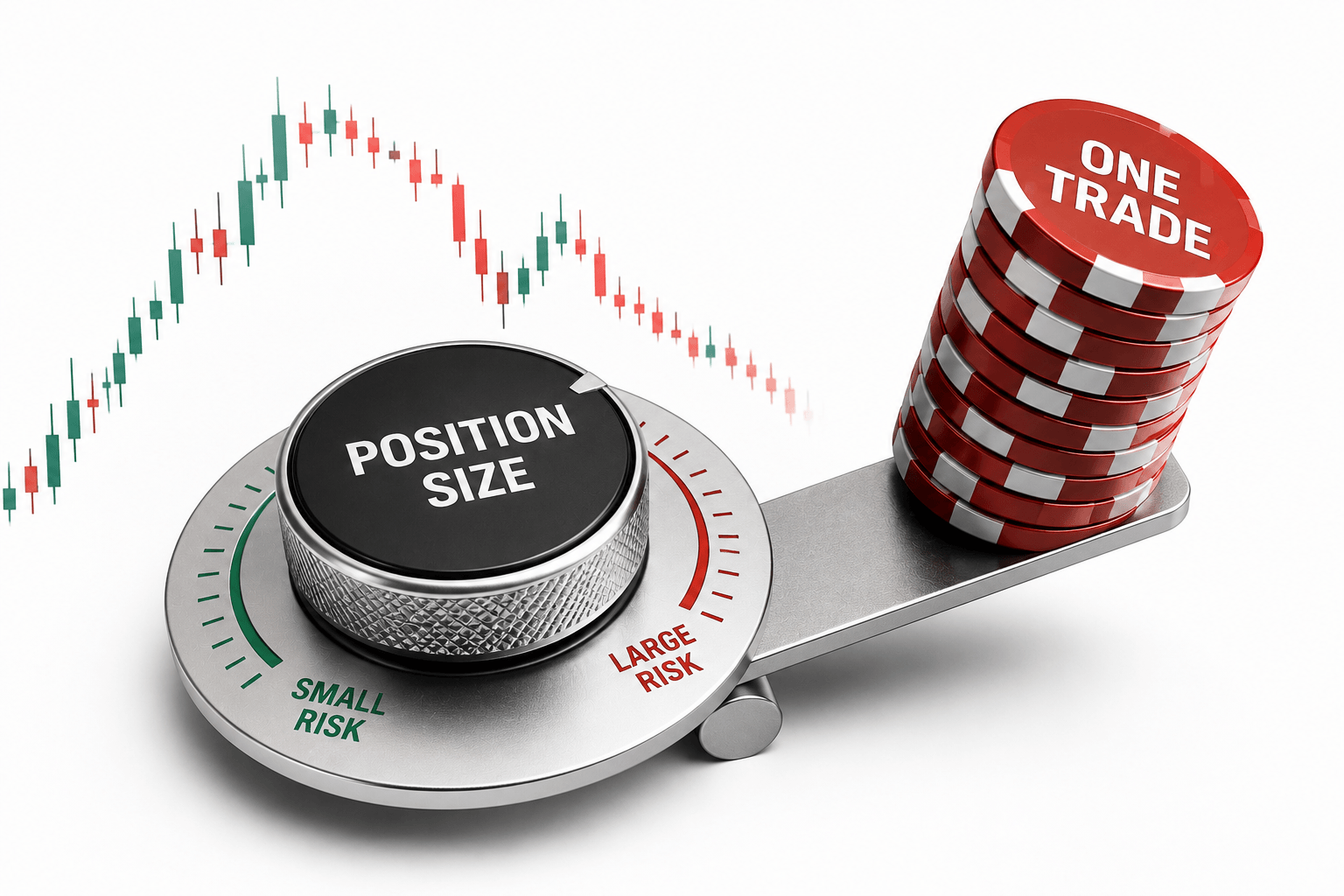
Use a Position Size Calculator: Never guess your lot size. Calculate it based on your stop-loss distance and account currency.
-
Stick to It: Whether you are trading on our Standard Account with a $250 deposit or a VIP Account with $10,000+, the percentage rule remains the same.
The Bottom Line
A risk-per-trade rule is not just a safety net; it is the foundation of a professional trading business. It transforms trading from a game of chance into a calculated endeavor of probability.
At My Maa Markets, we are committed to providing you with the tools you need to succeed—from educational webinars to advanced charting on MT5. But ultimately, the discipline to manage risk comes from you.
Do you have a strict risk percentage you stick to? Let us know in the comments below.
Ready to trade with a regulated broker that supports your growth?
-
Spreads from 0.0 pips
-
24/7 Expert Support
-
Fully Regulated by the FSC
Open your Live Account with My Maa Markets today.
Disclaimer: Trading involves significant risk and may not be suitable for all investors. You should carefully consider your investment objectives, experience level, and risk appetite. Only invest money you can afford to lose.