


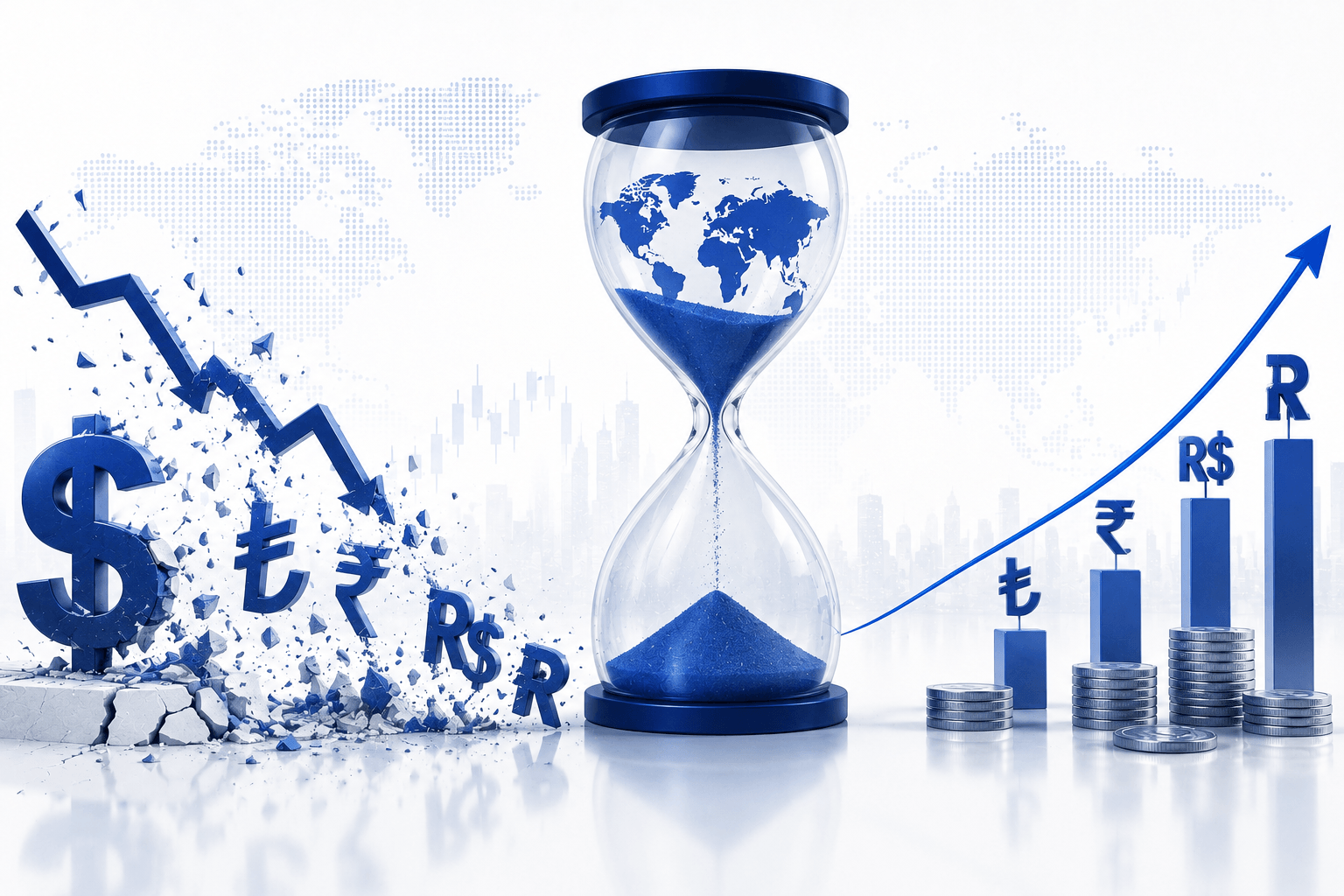
If you watch a developed market currency like the euro or the pound during a period of global stress, you will see it weaken. Sometimes significantly. But the move tends to be orderly. Liquidity stays reasonable. The recovery, when it comes, follows within weeks or months as conditions normalise. Emerging market currencies behave differently. When they fall, they fall faster, further, and more chaotically than developed market peers. And when the stress passes, they do not simply bounce back. The recovery is slow, grinding, and often incomplete. Understanding why this happens is useful for anyone trading or monitoring currencies from Turkey, South Africa, Brazil, India, Mexico, or the dozens of other economies that sit in the emerging market category.
Why emerging market currencies are more vulnerable to begin with
The starting position matters. Most emerging market economies share a set of structural characteristics that leave their currencies with less cushion when external conditions deteriorate.
Many run current account deficits, meaning they import more than they export and need continuous foreign capital inflows to fund the gap. When global risk appetite falls and those inflows slow or reverse, there is nothing underneath the currency to absorb the outflow. The dollar buying that was quietly funding the deficit stops, the local currency selling that was always there becomes suddenly visible, and the exchange rate moves quickly to find a new level. Most emerging market governments and companies have borrowed heavily in dollars. When the local currency weakens, the real cost of that dollar debt rises in local currency terms. A company that borrowed one hundred million dollars when the exchange rate was ten units to the dollar now owes the equivalent of one hundred and twenty million in local terms when the rate moves to twelve. That increased burden produces more local currency selling as companies rush to buy dollars to service debts, creating a feedback loop that amplifies the initial move.
Foreign exchange reserves in most emerging markets are modest relative to the scale of capital flows that can move against a currency during a stress period. The central bank can try to defend the exchange rate by selling reserves, but the defence is often brief. Once reserves fall below a level the market considers critical, the defence becomes counterproductive and the currency falls anyway, just more suddenly than if the defence had never been attempted.
The liquidity problem that makes the falls larger
Developed market currencies are traded in enormous volumes around the clock. EUR/USD trades trillions of dollars daily. GBP/USD and USD/JPY are similarly liquid. When a large seller hits the market, there are enough buyers on the other side that the price impact is manageable.
Most emerging market currency pairs are far less liquid. USD/TRY, USD/ZAR, and USD/BRL trade in volumes that are a small fraction of the major pairs. When stress hits and multiple participants try to exit simultaneously, there are not enough buyers on the other side to absorb the selling without significant price impact. The bid-ask spread widens sharply. Execution becomes difficult. The price falls faster than it would in a liquid market because the market simply does not have the depth to handle the order flow without large price moves.
This illiquidity is structural, not temporary. It reflects the smaller size of the underlying economies, the narrower investor base, and the fact that many global institutions have limits on how much emerging market currency exposure they can hold. Those limits mean that when conditions deteriorate, the institutions that were at their limit are forced sellers simultaneously, with limited buyers to take the other side.
Why the recovery is slower than the fall
When global stress passes and conditions normalise, the same structural vulnerabilities that caused the fall do not disappear overnight. The current account deficit is still there. The dollar debt is still there. The reserve levels, often depleted by the defence attempt, are lower than they were before the episode. The currency is starting the recovery from a weaker structural position than it entered the stress period.
Foreign investors who exited during the stress period do not return immediately when calm is restored. They watch from the sideline. They want evidence that the fiscal position has improved, that the central bank has rebuilt reserves, that inflation driven by the currency weakness has been brought under control, and that the political environment is stable enough to trust. Accumulating that evidence takes time, often months to years, and the currency stays below its pre-stress level throughout the period of observation.
Domestic inflation compounds the delay. When a currency falls sharply, the price of imported goods rises in local currency terms. That import inflation feeds into broader domestic inflation. The central bank raises interest rates to control inflation, which slows economic growth. Slower growth makes the fiscal deficit wider. A wider fiscal deficit requires more foreign financing, which keeps the currency under pressure. The full cycle from initial fall to genuine stabilisation can take two to three years in a significant episode.
What the pattern looks like from the outside
An emerging market currency under stress tends to follow a recognisable sequence. A gradual weakening phase as capital flows slow and the current account deficit becomes harder to fund. An acute phase triggered by a specific event, a Fed rate hike, a political shock, a credit rating downgrade, where the currency falls sharply and quickly. A stabilisation phase where the central bank raises rates aggressively, imposes capital controls, or secures an IMF programme. And then a long, slow recovery that never quite reaches the pre-crisis level before the next stress period begins.
The Turkish lira has followed this pattern multiple times in the past decade. The South African rand follows it with notable regularity around periods of global risk-off sentiment or domestic political uncertainty. The Argentine peso has gone through versions of this cycle repeatedly enough that Argentine businesses and households routinely hold dollars rather than pesos as a basic financial survival strategy.
Each episode is different in its trigger and its specifics. The underlying structure is the same.
What the economic calendar tells you about emerging market risk
The events that trigger emerging market currency stress are almost always on the economic calendar in advance. Federal Reserve meetings are scheduled months ahead. IMF programme review dates are published. Sovereign bond auction dates are known. Central bank meetings are announced in advance.
The stress itself is not predictable in precise timing. But the events that catalyse it are scheduled. A trader holding a position in an emerging market currency pair who checks the economic calendar and sees a Federal Reserve meeting in three days, a sovereign bond auction in the same week, and an IMF programme review the following week is looking at a cluster of risk events that could individually or collectively be the catalyst for the kind of acute stress episode described above.
MAA Markets provides a full economic calendar in the client platform covering Federal Reserve meetings, IMF scheduled reviews, major central bank decisions, and key economic data releases across emerging market economies. Building the habit of checking what is scheduled around any emerging market position before holding it through a risk event cluster is one of the more practical risk management habits available.
The Gulf angle
Gulf currencies are pegged to the dollar and do not face the same vulnerability pattern as freely floating emerging market currencies. The dollar peg, oil revenues, and sovereign wealth fund reserves provide structural insulation that most emerging market economies do not have.
But Gulf-based traders and businesses are not isolated from emerging market dynamics. Trade relationships with India, Pakistan, Bangladesh, Egypt, and other emerging market economies mean that currency stress in those countries affects the real value of commercial relationships. Gulf sovereign wealth funds hold significant emerging market investments that are affected by these stress cycles. And Gulf-based traders who trade USD/INR, USD/PKR, or other emerging market pairs are directly inside the mechanism every time global conditions tighten.
Understanding why emerging market currencies behave differently from developed market ones is not an academic exercise for traders operating in this region. It is context for managing real exposure to real risks that appear regularly and predictably in the economic calendar.