


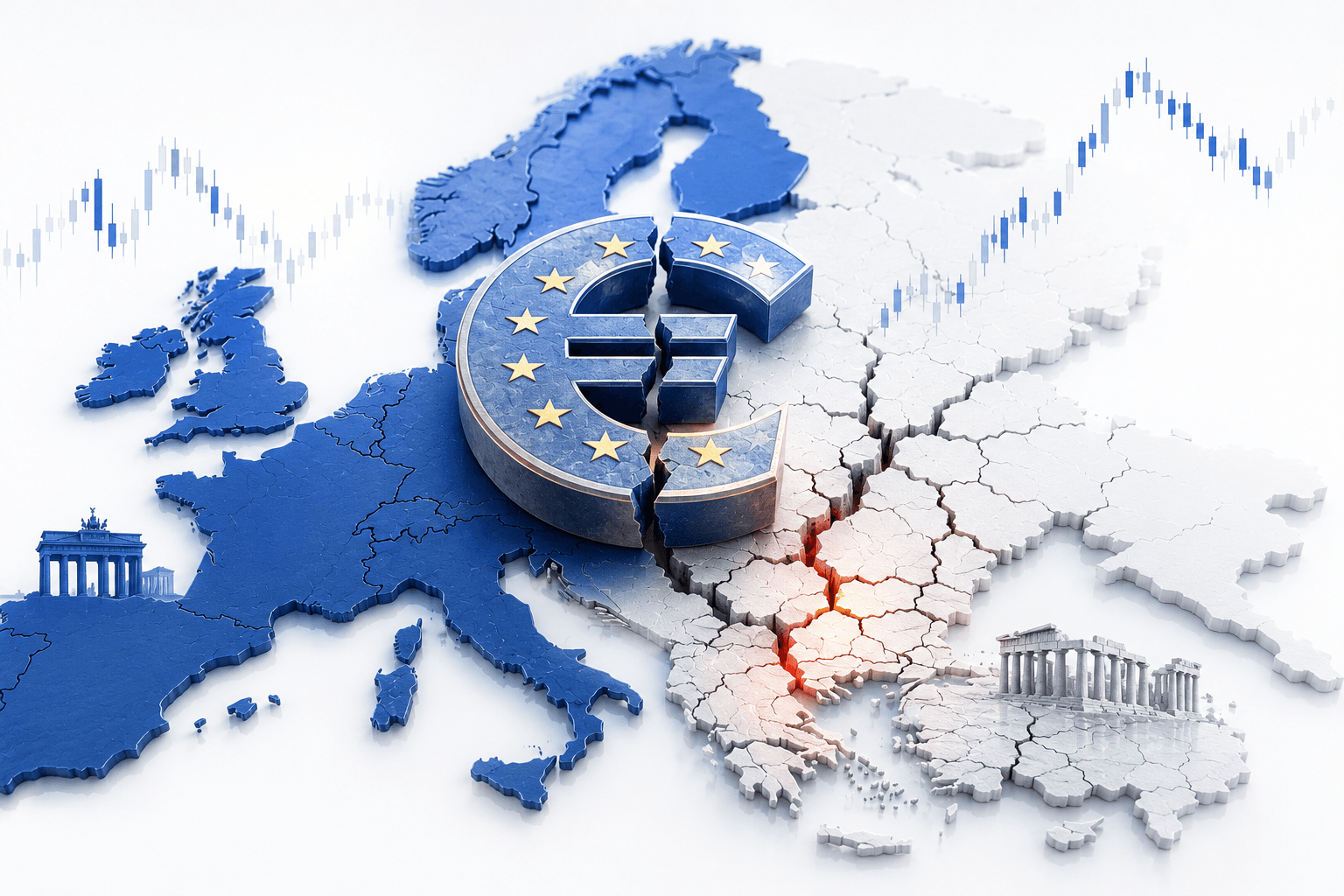
The euro is the world's second most traded currency. It has survived a sovereign debt crisis, a pandemic, an energy shock, and years of political turbulence across its member states. By most measures it has proven more durable than its critics expected when it launched in 1999. But the flaw that those critics identified has never actually been fixed. It has been managed, papered over, and occasionally bailed out, but never resolved. Understanding what that flaw is changes how you read the euro in every market condition.
One currency, twenty different economies
When you trade EUR/USD, you are not trading the German economy against the US economy. You are trading a currency that represents twenty countries simultaneously. Germany and Greece. France and Slovakia. The Netherlands and Portugal. These economies do not move in sync. They have different inflation rates, different unemployment levels, different growth trajectories, and different structural strengths. In any given year, some are booming while others are stagnating.
The problem is that they all share a single interest rate set by the European Central Bank in Frankfurt. The ECB cannot raise rates for Germany while cutting them for Italy. It sets one rate for all twenty and hopes it is not too wrong for too many of them simultaneously. In practice, the rate is almost always too tight for some members and too loose for others. The tension this creates never fully disappears because the economies never fully synchronise.
What countries normally do when this happens
When a country's economy is running too hot relative to its interest rate, it usually lets its currency appreciate. The stronger currency slows exports, reduces import costs, and naturally tightens financial conditions without the central bank having to do anything. When an economy is struggling and rates are too high for its conditions, the currency depreciates, exports become cheaper, and the economy gets a natural boost.
Eurozone members cannot do this. They gave up their individual exchange rates when they joined the euro. A struggling Greek economy cannot let the drachma depreciate to become more competitive. A booming German economy cannot let the deutschmark appreciate to cool things down. The adjustment mechanism that floating exchange rates provide automatically is simply not available inside the eurozone.
The adjustment still has to happen somehow. It just has to happen the hard way. Through wages falling in the struggling country, through businesses closing, through unemployment rising until costs fall enough that the economy becomes competitive again at the shared exchange rate. Economists call this internal devaluation. It is slower, more painful, and more politically difficult than the currency adjustment it replaces.
The 2010 to 2012 debt crisis made the flaw visible
For the first decade of the euro's existence, the flaw was hidden by the fact that cheap credit flowed everywhere. Interest rates converged across member states because markets treated eurozone sovereign debt as roughly equivalent. Greece, Portugal, and Spain could borrow at rates close to Germany's because the shared currency implied a shared creditworthiness that did not actually exist.
When the global financial crisis hit in 2008 and fiscal positions across Europe deteriorated, markets started looking more carefully at individual country finances. Greece had a debt-to-GDP ratio that was far higher than disclosed. Portugal and Ireland had banking systems with serious problems. Spain had a property bubble that was unwinding. Suddenly the markets that had been pricing eurozone debt as broadly equivalent started pricing it very differently.
Greek bond yields hit seven percent while German yields were below two percent. At those borrowing costs, Greece's debt was not sustainable. The bailout that followed required Greece to implement years of austerity, wage cuts, and spending reductions. The Greek economy contracted by about twenty-five percent over five years. The adjustment that a currency depreciation might have achieved in twelve to eighteen months took a decade of recession to partially accomplish through internal means.
Why the tension is permanent rather than fixable
The real solution to the eurozone's structural problem would be a fiscal union alongside the monetary union. If the eurozone had a shared treasury that automatically transferred resources from richer, stronger economies to weaker ones during downturns, the way the US federal government does across American states, the single interest rate problem would be much more manageable.
Germany and the northern European surplus countries have consistently resisted fiscal union because it would mean their taxpayers funding deficits in southern European countries they did not create. The political resistance is understandable from a domestic perspective. The economic consequence is that the eurozone remains a monetary union without the fiscal architecture that would make a monetary union fully functional.
So the tension persists. Every time the ECB raises rates aggressively to deal with eurozone-wide inflation, Italian and Greek debt servicing costs rise while German ones do too, but the spread between Italian and German bond yields, what markets call the BTP-Bund spread, widens. A wide spread is the market's way of saying it is not sure Italy can sustain its debt at these borrowing costs inside the shared currency. When the spread gets wide enough, it becomes a stability risk for the euro itself.
What this means for how the euro trades
The euro trades below what Germany's economic fundamentals alone would justify because the market prices in the structural risk of weaker member states. When eurozone stress rises, whether from Italian political uncertainty, Greek fiscal concerns, or a broader economic slowdown that hits peripheral economies harder than Germany, the euro weakens against the dollar and other safe-haven currencies beyond what interest rate differentials would predict. When stress is low and the eurozone is growing relatively evenly, the euro tends to trade closer to its interest rate differential value and the structural discount narrows. Traders who understand this dynamic read EUR/USD differently from those who only follow the Fed-ECB rate differential story.
The BTP-Bund spread is the single most useful real-time indicator of eurozone stress for EUR/USD traders. It is publicly available on any financial data platform. When it widens sharply above two hundred basis points, eurozone stress is building and the euro tends to underperform its rate differential position. When it narrows, stress is receding and the euro can recover.
Checking both the ECB rate outlook and the BTP-Bund spread together before forming a view on EUR/USD gives a more complete picture than following either signal alone. MAA Markets provides a real-time economic calendar covering all ECB meetings, eurozone inflation releases, and major member state data events in the client platform, so traders can stay on top of the scheduled inputs that regularly move the pair.
The euro is not going away
The euro has survived every crisis that was supposed to break it. Sceptics have been wrong about its survival repeatedly and will probably continue to be wrong. The political will to maintain the currency union among its core members is genuine and has proven stronger than the economic stress that would theoretically justify reconsidering the arrangement.
But surviving and thriving are different things. The euro will continue to trade with a structural discount to what its strongest member economies would command individually. It will continue to be vulnerable to periodic stress episodes when peripheral member states face fiscal difficulty. And it will continue to produce the specific price behaviour that comes from a currency representing twenty economies that never quite move together, which is a persistent underlying tension that appears in the chart as something that looks like fundamental weakness without a clear fundamental explanation.
That tension is the explanation.