


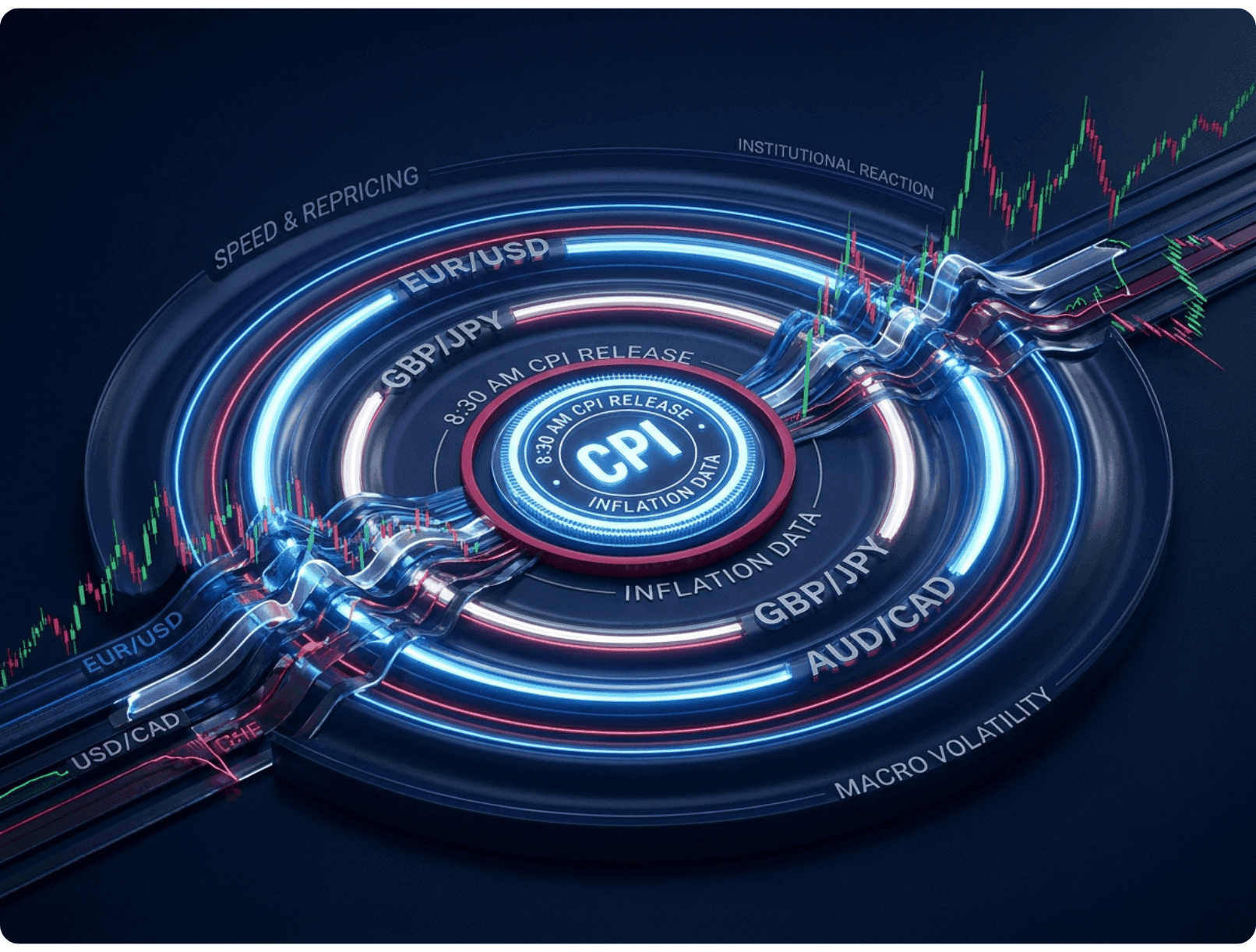
A single number, released at 8:30 in the morning, moves trillions of dollars in minutes. Understanding why it moves them and in which direction separates traders who guess from traders who think.
She did not check the price of the currency. She checked the price of bread. It was March 2022 in Buenos Aires, and a woman buying groceries watched the total at the register climb for the fifth consecutive week. Inflation in Argentina was running past 60% annually. The peso, already weakened by years of monetary dysfunction, was sliding again, not because of a geopolitical event, not because of a trade war, but because of bread. Eggs. Petrol. The accumulated weight of prices rising faster than trust could hold. What that woman experienced in a supermarket queue is precisely the same force that moves the EUR/USD chart on the morning of a US CPI release, compressed into a single number, delivered at a precise timestamp, and acted on within milliseconds by every major institution in the world.
Inflation data does not just influence currencies. At certain moments, it determines them entirely.
The relationship between inflation and currency value runs through a single institution: the central bank.
On its own, rising prices do not directly weaken or strengthen a currency. What rising prices do is force a response, and it is the anticipated response, priced across months of expectation, that moves exchange rates long before the inflation number itself is published.
CPI reading above forecast
Market reprices higher rate path. Currency typically strengthens in the short term.
CPI reading below forecast
Rate hike expectations ease. Currency typically weakens as the yield advantage erodes.
CPI reading meets forecast
No repricing required. Price often barely moves or snaps back from a pre release drift.
The logic behind this pattern is straightforward. Higher inflation generally pressures a central bank to raise interest rates to cool the economy. Higher rates attract foreign capital seeking better yields. That capital purchases the local currency to access those yields, increasing demand and pushing the exchange rate upward. In this sense, inflation, the thing that erodes the domestic purchasing power of a currency, can simultaneously make that currency more attractive to international investors. The contradiction is real. It is also one of the most misunderstood dynamics in forex.
It is November 2021. US CPI comes in at 6.2%, sharply above the 5.4% the market expected. The dollar surges within seconds. On the surface this makes no sense: a currency is losing purchasing power at the fastest rate in thirty years, and it is getting stronger. But institutional traders are not reacting to what inflation means for Americans buying groceries. They are reacting to what it means for the Federal Reserve's next move and the one after that. The market is not priced on today. It is priced on a forecast of the next eighteen months of policy.
The mechanics matter, but so does the context those mechanics operate inside. Inflation data does not produce the same currency response every time. The same number, say a 0.3% monthly rise in CPI, lands differently depending on where the market's expectations sat before it arrived, where rates currently are, and what the central bank has signalled about its future intentions.
**Why the same CPI number produces different currency moves? **
The four variables that change the impact of every inflation release
The forecast versus the actual, not the absolute level of inflation, but the gap between what the market anticipated and what was delivered. A 4% CPI print can strengthen a currency if the market expected 4.5%, and weaken it if the market expected 3.5%. The number itself is almost irrelevant without its context.
Where rates already sit, if a central bank has already hiked aggressively and signalled a pause, high inflation data may not trigger further currency strength because additional rate hikes are no longer on the table. The transmission mechanism from inflation to currency requires room for the central bank to act.
The trend in the data, not just the point, one month of rising inflation is noise. Three consecutive months of rising core CPI forces the market to revise its entire rate path expectation, producing a sustained currency trend rather than a short term spike.
Core versus headline, headline CPI includes food and energy, which are volatile. Central banks and sophisticated traders weight core CPI, which strips these out, more heavily when forming rate expectations, because it better reflects underlying price pressure that monetary policy can actually address.
The practical consequence is clear. Trading inflation releases on the number alone, buying the currency if CPI beats, selling if it misses, is one of the most expensive habits in retail forex. It ignores the existing pricing, the policy context, and the trend. The reaction to the number is usually priced within thirty seconds. The sustained move that follows comes from what the number implies about the next six months of central bank decisions, and that interpretation requires considerably more than a glance at a single data point.
Hot print
CPI beats but central bank already at terminal rate. Initial currency spike higher. Quickly fades. No more rate hikes available means the yield advantage cannot grow. Sophisticated money sells the spike within minutes.
Cold print
CPI misses but central bank still hawkish. Currency initially weakens. If the central bank has publicly committed to further hikes regardless of one month's data, the weakness is shallow and reverses as the session progresses.
In line print
CPI meets expectations precisely. The most dangerous scenario for impulsive traders. Price may not move at all or it moves sharply in a direction that appears random, driven by positioning unwind rather than the data itself. The inflation number is the event. The interest rate expectation it changes is the market. Trading the number without understanding the expectation is like reading the score without knowing which sport is being played.
There is a longer arc story underneath the release day mechanics. The sustained currency trend that builds across quarters as inflation trajectories diverge between two economies. When US inflation was running hot in 2022 while the ECB was still describing European price rises as transitory, the Fed was hiking aggressively while the ECB waited. The resulting rate differential drove the euro below dollar parity for the first time in twenty years. That trend did not begin on a CPI release day. It built across months of data, each print confirming the divergence, and the exchange rate tracked it, slowly and then all at once.
Trap
Trading the initial spike within the first sixty seconds of a CPI release is not analysis. It is gambling on a number whose impact is already being repriced by algorithms faster than any human can react.
Edge
Watch how price behaves fifteen to thirty minutes after the release, once the initial algo reaction settles. The direction it holds then reflects genuine repricing, and that direction tends to persist into the session close.
Context
Before each CPI release, know what the market has already priced in. If rate futures are pricing three more hikes and inflation comes in high, the currency may barely move, because three hikes were already the expectation. The surprise is the only thing that moves it.
Inflation, in the end, is a story about trust.
Trust in a currency's ability to hold its value over time, trust in the institution that manages it, trust in the policy decisions that number will trigger. When that trust frays, no chart pattern catches the fall. When it holds, no fundamental analysis is needed to justify the strength. The woman in Buenos Aires understood this without knowing the word forex. The currency she held was worth less every week because the trust was gone, and no CPI report was going to change that until the underlying reality did.