

Chart patterns last hours. Economic data lasts days. Interest rate differentials last months, sometimes years. The traders who grasp this distinction trade a fundamentally different market from everyone else.
In 2022, a retired schoolteacher in Osaka looked at her savings account and saw the same number she had seen for seven years. Japan's interest rate sat near zero. Her money was not earning, it was holding still while everything around it grew more expensive. Across the Pacific, a pension fund in Toronto was quietly moving billions of dollars into US Treasury bonds paying ovetwenty-fourhigher-yieldingper centr 5%. Same planet. A 5% gap in what money earns. That gap is not just a personal finance story. It is the single most powerful engine in the foreign exchange market, and it runs twenty four hours a day, whether you are watching the chart or not.
Every currency in the world has a price attached to borrowing it. That price is the interest rate set by its central bank. When two countries have different rates, which is almost always, a differential opens between them. Capital, by its nature, moves toward higher returns. It does not need a reason beyond the number. Five percent beats zero percent. Three percent beats one percent. The currency of the higher yielding country must be purchased to access those returns, and that demand pushes its price upward in the foreign exchange market. This is the mechanism in its simplest form. The complexity, and the real edge, lives in what happens around it.
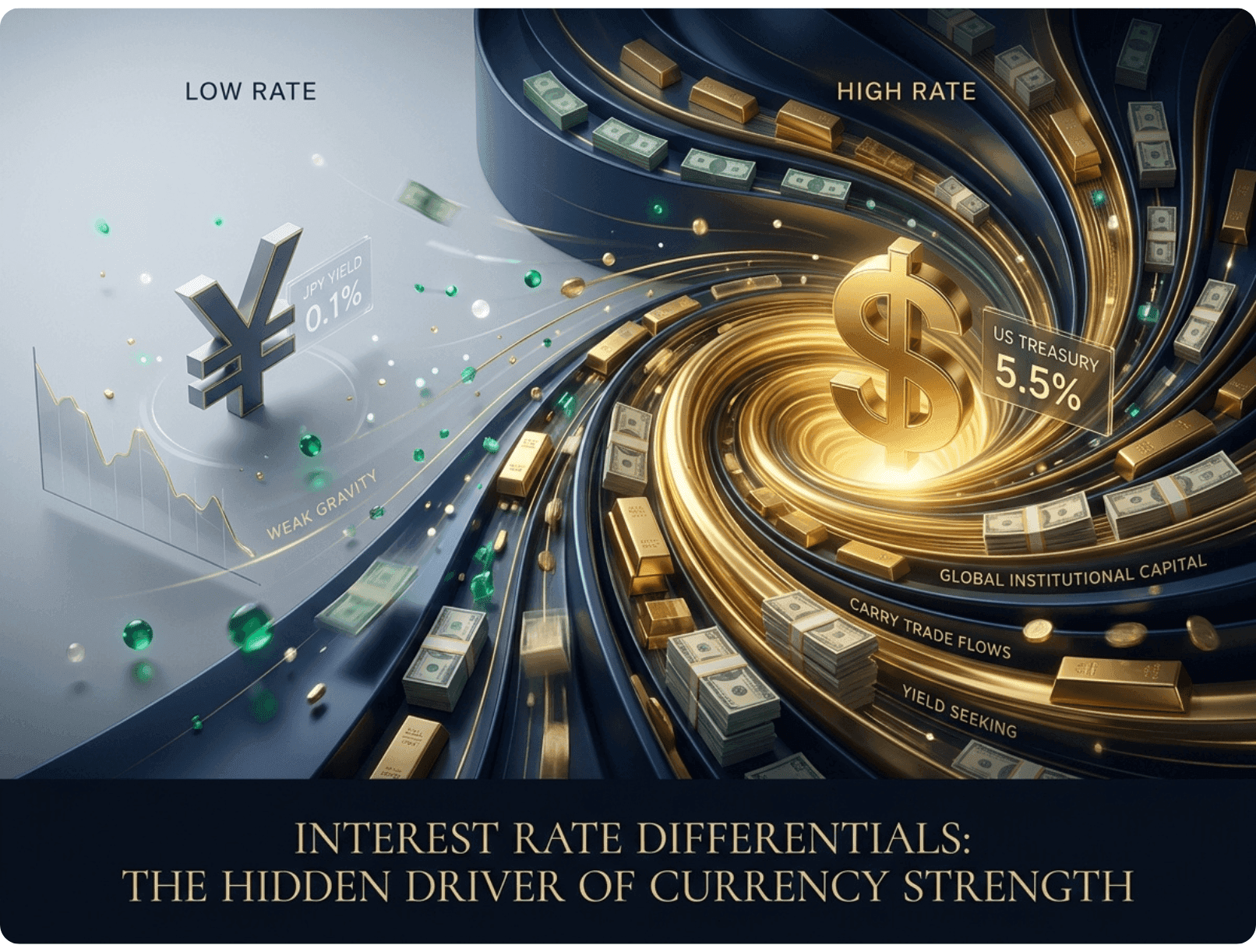
Low rate economy
0.1% Japan · Bank of Japan
Capital held in yen earns almost nothing. Institutional investors borrow cheaply in yen to fund positions in higher yielding assets elsewhere, the classic carry trade funding currency.
High rate economy
5.25% United States · Federal Reserve
Capital converted to dollars and placed in US instruments earns over 5%. The demand for dollars to execute this trade is structural, persistent, and enormous in scale, far beyond what chart patterns reflect.
The mechanism has a name in professional markets: the carry trade
A trader borrows in a low rate currency, converts the proceeds to a high rate currency, deposits them in that country's instruments, and collects the interest differential as daily profit, the carry. If the exchange rate holds steady, the carry accumulates silently. If the high rate currency also appreciates, the trade benefits twice, once from the interest differential, once from the price gain.
1. Borrow in the low rate currency
A hedge fund borrows ¥1 billion at 0.1% annual interest. The cost of borrowing is almost negligible, the yen becomes the funding vehicle.
2. Convert and deploy into the high rate currency
The yen are sold and converted to US dollars. Those dollars are placed in short term US Treasury bills yielding 5.25%. The fund is now short yen, long dollars.
3. Collect the differential daily
The 5.15% net carry (5.25% earned minus 0.1% cost) accumulates as income. On ¥1 billion, roughly $7 million, this generates approximately $360,000 per year with no price movement required.
4. Unwind when the differential narrows
When central bank policy shifts, rate cuts in the US or rate hikes in Japan, the trade reverses. The dollar is sold, yen repurchased. This unwind creates sharp, often violent currency moves.
August 2024 scenario
The Bank of Japan raises rates unexpectedly, a small move, just 0.25%, but enough. Carry traders who had borrowed trillions of yen to fund positions in higher yielding currencies worldwide began unwinding simultaneously. The yen surged 13% against the dollar in three weeks. Global equity markets dropped sharply. Assets with no obvious connection to Japanese monetary policy fell hard because the traders selling them needed yen to repay their loans. One small rate adjustment in Tokyo rippled across every asset class on earth. This is what interest rate differentials look like when they unwind.
The differential does not just influence currency direction. It sets the gravitational pull of the trend.
A currency pair with a strong, widening rate differential behind it tends to move in one direction for months, not days. The AUD/JPY carried Australian dollar strength against the yen for years during the period when Australian rates sat well above Japan's. The EUR/USD trend that drove the euro below parity with the dollar in 2022 was powered almost entirely by the aggressive rate divergence between the Fed and the ECB. These are not technical setups. They are macro forces expressed through price.
"Technical analysis shows you where price has been. Interest rate differentials show you where capital needs to go. Both matter, but they operate on entirely different timescales, and confusing those timescales is one of the most expensive mistakes a trader can make."
How differentials appear in price, day to day
The footprints that rate divergence leaves on every timeframe
Persistent trending behaviour on daily and weekly charts. Pairs driven by strong differentials rarely chop sideways for long. The carry is being collected continuously, and that collection creates directional bias that shows up as a sustained trend with shallow, short lived corrections.
Sensitivity to central bank language long before actual rate decisions. When a central bank governor shifts language from "patient" to "vigilant" on inflation, the market reprices the expected rate path immediately. Currency moves that appear to react to a speech are actually repricing a months long differential expectation in hours.
Sharp, disorderly reversals during risk off events. Carry trades are leveraged, and leverage unwinds fast when volatility spikes. A geopolitical shock or a surprise central bank move can trigger cascading carry unwinds that produce the largest, fastest currency moves in the market.
The practical implication is not that every trader needs to become a macro economist.
It is simpler than that: before placing a trade that runs against the prevailing interest rate differential, understand what force you are trading against. A short term technical setup pointing one direction while the differential points the other is not automatically wrong, but it requires a very specific kind of conviction, and a very specific exit plan, because the macro tide will keep pulling while the technical pattern plays out.
When differentials mislead, the exceptions worth knowing
Caution High inflation that erodes real returns can negate a nominal rate advantage. A currency paying 10% nominal but losing 12% to inflation is not attractive, it is losing purchasing power faster than the rate compensates. Real rates, not nominal ones, drive sophisticated capital flows.
Timing When the market has already fully priced in an expected rate path, the currency move happens before the actual decision, not after. Buy the rumour, sell the fact plays out repeatedly around central bank meetings precisely because the differential expectation was priced months in advance.
Signal Narrowing differentials, when the gap between two countries' rates begins shrinking, are often more powerful signals than the absolute level. A currency that benefited from a wide differential weakens structurally as that gap closes, regardless of whether absolute rates are still high.
The interest rate differential is not a trading signal in the narrow sense
It will not tell you where to place a stop or when to enter tomorrow morning. What it does is broader and more valuable: it tells you the direction in which the market's largest, most persistent forces are pulling. Trade with that pull and the market becomes an ally. Trade against it without understanding why and the losses that follow are not bad luck. They are physics.