


Navigating the financial markets can feel like setting sail on a vast ocean. The prices of assets like currencies, stocks, and metals are in constant motion, and for a beginner, this movement can seem chaotic and unpredictable. However, beneath the surface of daily fluctuations, there are broader, more sustained movements known as market trends. Understanding these trends is fundamental to successful trading, as it provides the context needed to make informed decisions.
A market trend is the general direction in which an asset's price is moving over a specific period. By identifying these trends, traders can align their strategies with the market's momentum, increasing their potential for success. For beginners, learning to spot and interpret trends is one of the most critical skills to develop. It transforms trading from a game of chance into a strategic discipline based on analysis and probability.
This guide will introduce you to the three primary market trends: the uptrend, the downtrend, and the sideways trend. We will explore how to identify each one, discuss effective trading strategies, and introduce the tools that can help you analyze market movements with greater confidence. Mastering trend identification is your first major step toward navigating the financial markets effectively.
Understanding Uptrends (Bullish Market)
An uptrend, often called a bullish market, is characterized by a sustained increase in an asset's price over time. This pattern indicates that buying pressure is stronger than selling pressure, pushing the price to successively higher levels. For traders, identifying an uptrend early can present significant opportunities.
How to Identify an Uptrend
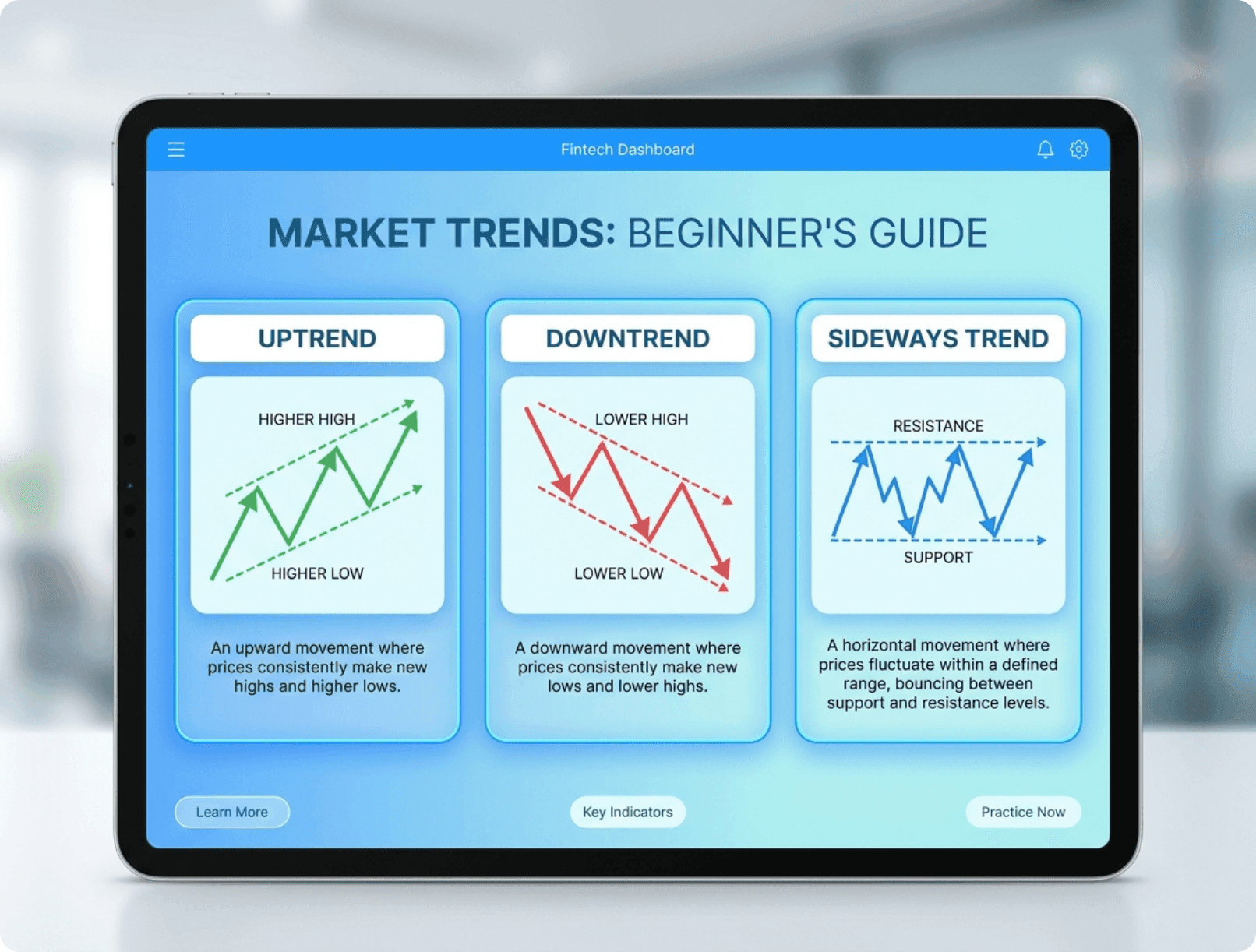
The classic sign of an uptrend is a series of "higher highs" and "higher lows." Let's break this down:
-
Higher Highs (HH): Each peak in price is higher than the previous peak. This shows that the market has enough bullish momentum to break through previous resistance levels.
-
Higher Lows (HL): Each trough, or dip, in price is higher than the previous trough. This signifies that even during periods of selling, buyers are stepping in at progressively higher prices, preventing the asset from falling to its previous low.
When you connect the higher lows with a line, you create an upward-sloping trendline. This line acts as a dynamic level of support. As long as the price remains above this trendline and continues to form higher highs and higher lows, the uptrend is considered intact.
Strategies for Trading Uptrends
The core principle of trading in an uptrend is to "buy the dip." This means entering a long (buy) position during a temporary price pullback toward the support trendline. This strategy allows you to enter the market at a more favorable price before the trend potentially resumes its upward climb.
Key strategies include:
-
Buying on Dips: Wait for the price to retrace to the ascending trendline or a key support level, like a moving average. This pullback offers a lower-risk entry point, as you are buying at a relative discount within an established uptrend.
-
Breakout Trading: Another strategy is to enter a trade when the price breaks above a key resistance level (a previous high). A decisive breakout can signal a continuation of the uptrend and attract more buyers, further fueling the upward momentum.
When trading uptrends, it's crucial to use risk management tools. Placing a stop-loss order below the most recent higher low can protect your capital if the trend unexpectedly reverses.
Understanding Downtrends (Bearish Market)
A downtrend, or a bearish market, is the opposite of an uptrend. It is characterized by a sustained decrease in an asset's price. This pattern indicates that selling pressure is overwhelming buying pressure, leading to a consistent decline. Recognizing a downtrend is essential for protecting capital and identifying opportunities to profit from falling prices.
How to Identify a Downtrend
A downtrend is identified by a series of "lower highs" and "lower lows":
-
Lower Lows (LL): Each trough in price is lower than the one before it, indicating that sellers are pushing the price to new lows.
-
Lower Highs (LH): Each peak, or rally, is lower than the previous peak. This shows that buyers are unable to push the price back up to its previous high before sellers regain control.
By connecting the lower highs with a line, you can draw a downward-sloping trendline. This line acts as a dynamic resistance level. The downtrend is considered active as long as the price stays below this trendline and continues to form lower highs and lower lows.
Strategies for Trading Downtrends
The primary strategy in a downtrend is to "sell the rally." This involves entering a short (sell) position when the price temporarily rallies toward the resistance trendline. This approach allows you to enter the market at a higher price before the trend continues its downward movement.
Effective strategies include:
-
Short Selling on Rallies: Wait for the price to pull back to the descending trendline or another resistance level. This provides a strategic entry point for a short position, allowing you to capitalize on the subsequent price decline.
-
Breakdown Trading: Enter a short trade when the price breaks below a significant support level (a previous low). A confirmed breakdown can indicate that the downtrend is gaining momentum, attracting more sellers.
Risk management is equally important in a downtrend. A stop-loss order should be placed above the most recent lower high to limit potential losses if the market unexpectedly reverses and starts to move upward.
Understanding Sideways Trends (Consolidation)
A sideways trend, also known as a ranging market or consolidation, occurs when an asset's price moves within a relatively narrow, horizontal channel. During this phase, buying and selling pressures are in equilibrium, resulting in no clear directional trend. The price oscillates between a defined support level (the floor) and a resistance level (the ceiling).
How to Identify a Sideways Trend
Identifying a sideways trend is straightforward. Look for a price pattern that is contained between two horizontal lines:
-
Resistance Level: A price level at the top of the range that the asset struggles to break through. Each time the price approaches this level, sellers tend to enter the market, pushing it back down.
-
Support Level: A price level at the bottom of the range where the asset finds buying interest, preventing it from falling further.
The price action will appear to bounce between these two levels. A sideways trend can last for a short period or extend for weeks or even months. It often represents a period of indecision in the market before a new uptrend or downtrend begins.
Strategies for Trading Sideways Trends
Trading in a sideways market requires a different approach. The most common strategy is range-bound trading.
-
Range-Bound Trading: This strategy involves buying near the support level and selling near the resistance level. Traders aim to profit from the predictable price oscillations within the defined range. A key risk is a "breakout," where the price moves decisively above resistance or below support, signaling the end of the sideways trend.
-
Waiting for a Breakout: Many traders prefer to stay on the sidelines during a sideways trend and wait for a breakout. A breakout above the resistance level may signal the start of a new uptrend, providing a buying opportunity. Conversely, a breakdown below the support level could indicate the beginning of a new downtrend, presenting a short-selling opportunity.
When range trading, stop-loss orders should be placed just outside the range—below support for a long position and above resistance for a short position.
Tools and Indicators for Trend Identification
Technical analysis offers a variety of tools to help traders identify and confirm market trends. Using these indicators can enhance your decision-making process and provide greater confidence in your trading strategies.
-
Moving Averages (MA): Moving averages smooth out price data to create a single flowing line, making it easier to see the underlying trend. A Simple Moving Average (SMA) gives equal weight to all data points, while an Exponential Moving Average (EMA) gives more weight to recent prices, making it more responsive. When the price is consistently above a moving average (like the 50-day or 200-day MA), it suggests an uptrend. When it's below, it suggests a downtrend.
-
Trendlines: As discussed, drawing trendlines by connecting higher lows in an uptrend or lower highs in a downtrend is a simple yet powerful way to visualize a trend. These lines act as dynamic support and resistance.
-
Relative Strength Index (RSI): The RSI is a momentum oscillator that measures the speed and change of price movements. It moves between 0 and 100. Traditionally, an RSI above 70 indicates an overbought condition (potential for a price drop), while an RSI below 30 suggests an oversold condition (potential for a price rise). In trend trading, the RSI can also confirm trend strength. For instance, in a strong uptrend, the RSI will tend to stay above 40-50.
-
Fibonacci Retracement: This tool identifies potential support and resistance levels based on key Fibonacci ratios (23.6%, 38.2%, 50%, 61.8%). During an uptrend, traders watch for prices to pull back to these Fibonacci levels to find buying opportunities. In a downtrend, these levels can indicate potential areas to enter a short position during a rally.
The Importance of Risk Management
No trading strategy is foolproof, and the market can be unpredictable. That's why effective risk management is the cornerstone of long-term trading success. It protects your capital and helps you stay in the game even when some trades don't go as planned.
-
Set Stop-Loss Orders: A stop-loss is an order placed with your broker to sell an asset when it reaches a certain price. It is your primary defense against significant losses. For example, in an uptrend, you might place a stop-loss just below the most recent higher low. This ensures that if the trend reverses, your loss is limited.
-
Determine Your Position Size: Never risk more than a small percentage of your trading capital on a single trade (a common rule is 1-2%). Position sizing ensures that a single losing trade won't wipe out your account, allowing you to recover and continue trading.
-
Avoid Common Mistakes: Beginners often make emotional decisions, such as holding onto losing trades for too long in the hope they will turn around ("revenge trading") or closing winning trades too early out of fear. A well-defined trading plan based on trend analysis and strict risk management rules helps to mitigate these emotional pitfalls.
Take the Next Step in Your Trading Journey
Understanding market trends is an essential skill that separates strategic traders from speculators. By learning to identify uptrends, downtrends, and sideways markets, you can develop trading strategies that align with the market's momentum. Using technical indicators will further refine your analysis, while disciplined risk management will protect your capital and foster longevity in your trading career.
Knowledge is your greatest trading asset. As you continue to learn and adapt, you will build the confidence needed to navigate the financial markets.
Ready to apply what you've learned? Start trading confidently with My Maa Markets.com's comprehensive suite of tools and live market analytics. Open an account today to take advantage of spreads from 0.0 pips, zero deposit fees, and withdrawals within 2 hours. With access to major markets across Forex, Indices, Metals, and Stocks, and leverage up to 1:500, you have the power to take control of your financial future on a platform regulated by the FSC (Financial Services Commission - Mauritius).