

You have never placed a trade directly with another trader. Every order you have ever sent passed through a structure so vast and so invisible that most people trade inside it for years without knowing its name.
The forex market has no building. No floor. No closing bell. No central address you could mail a letter to. It is not a place, it is a relationship. Specifically, a web of credit relationships between banks that agree to transact with each other at negotiated prices, around the clock, across every time zone on earth. That web is the interbank market, and without it, the chart you stare at every morning would not exist.
Strip away the trading platforms, the brokers, the retail interfaces, and the algorithmic overlays what remains underneath all of it is a network of roughly 20 major banks quoting prices to each other in enormous size. JPMorgan. Deutsche Bank. Citigroup. HSBC. Barclays. UBS. These institutions collectively handle the majority of global forex volume. When you place a buy order for EUR/USD with your broker, that order does not simply execute in a vacuum. It travels upward through a chain of counterparties until it reaches a price that originates from this interbank layer. The price your broker shows you on screen is a derivative of a price negotiated several levels above you, between parties who have never heard your name.
$7.5T Daily forex volume globally, the largest financial market in existence
~70% Of that volume flows through interbank relationships between major banks
Top 5 Banks alone account for nearly half of all global forex turnover
The interbank market operates on credit lines, not collateral.
Two banks that trust each other enough to extend mutual credit can trade in hundreds of millions of dollars without posting margin. This is what gives the market its extraordinary depth. It is also what makes it structurally inaccessible to anyone outside it, you cannot simply apply to trade in the interbank market. Access is extended through relationships built over decades, and the minimum transaction sizes involved make the concept of retail participation effectively meaningless at that level.
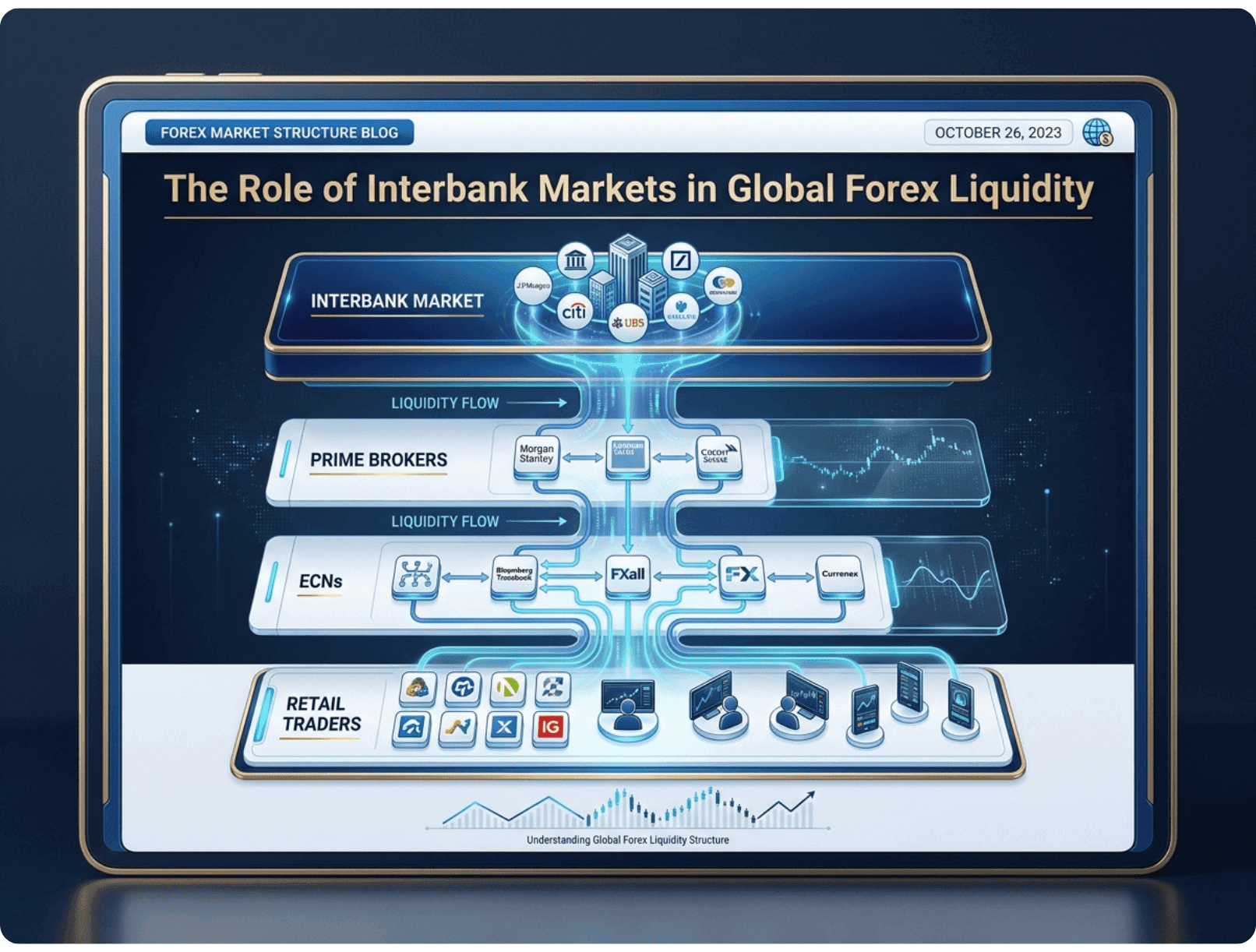
The architecture flows in distinct tiers, each with a specific function in delivering liquidity from the top of the market down to the individual trader at the bottom.
1. Top tier (Tier-one interbank market)
The 10–20 largest global banks quote prices directly to each other via platforms like EBS and Reuters Matching. Transaction sizes begin at $5–10 million. Spreads here are razor-thin fractions of a pip. This layer sets the true global price for every major currency pair.
2. Prime brokers
Hedge funds and large asset managers access interbank pricing through prime brokers typically tier-one banks that provide credit facilities and execution services. This is where institutional traders participate without being banks themselves.
3. ECNs & PTFs (Electronic networks and proprietary firms)
Aggregated liquidity from multiple interbank sources flows into electronic communication networks. High-frequency trading firms and prop shops operate here, adding volume and tightening spreads through arbitrage and market-making activity.
4. Retail brokers and traders
Your broker aggregates prices from tier three and marks them up. The EUR/USD price on your screen is real, but it has passed through multiple layers of intermediation before it reached you, and each layer has extracted something for the service of delivering it.
Imagine water flowing from a mountain glacier down through rivers, irrigation channels, and municipal pipes before reaching a tap in a household kitchen.
The water is real at every stage. The household tap does not question whether the glacier exists, they simply turn the handle. But the pressure at the tap, the minerals in the water, and the moment it runs dry in a drought all originate from conditions at the glacier, far upstream. The interbank market is the glacier. Your broker's platform is the tap.
What this structure means for price is more important than most traders ever consider.
When interbank liquidity is deep when tier-one banks are actively quoting and willing to transact in size spreads are tight, price movement is smooth, and large orders absorb into the market without dramatic slippage. When interbank liquidity thins, even modestly, everything downstream feels it immediately.
When interbank liquidity contracts and why it matters
The conditions that produce the price behaviour traders find most confusing
Public holidays in major banking centres Christmas Eve, New Year's Eve, and regional bank holidays drain interbank volume sharply. Price gaps on reopening and wild intraday spikes on these days are not random. Thin interbank participation means smaller orders move price more than they should.
The Asian session overlap gap between roughly 5 PM and 8 PM New York time, European banks are closed and US desks are winding down. Asian banks are not yet fully active. The interbank market does not close, but its depth reduces significantly. Retail traders who wonder why spreads widen and price behaves erratically in this window have their answer here.
Major risk events ahead of Federal Reserve decisions, NFP releases, and central bank press conferences, interbank traders reduce their quoting obligations. They widen their own spreads or withdraw temporarily. The price spikes you see during high-impact news are partly genuine reaction and partly the market structure's response to temporarily reduced liquidity depth.
Flash crash conditions, the most extreme version. When interbank liquidity vanishes simultaneously across multiple counterparties, price can move hundreds of pips in seconds with no fundamental news. The Swiss franc incident of January 2015 when CHF appreciated 30% in minutes after the SNB removed its floor — was in part a liquidity architecture failure as much as a policy shock.
"The price on your screen is not a fact about the world. It is a fact about what the nearest willing counterparty, at this exact moment, will accept. When there are fewer of those counterparties, that fact becomes far less stable."
Understanding the interbank market does not give retail traders direct access to it.
That is not the point. What it does and this is the genuine edge is explain the why behind price behaviour that otherwise looks arbitrary. Spreads widening at 5 PM EST are not your broker extracting more from you. Thin interbank volume is. A spike through a key level that immediately reverses is often a moment when thin interbank depth allowed a single large order to move price beyond where natural two-way flow would have kept it.
Reading price through the interbank lens
When Spreads widen suddenly with no news recognise it as an interbank liquidity event, not a signal. Do not trade in it.
What A sharp spike through a major level that snaps back within one or two candles — this is often a thin-market overshoot, not a genuine break. Treat the snap-back as the real price, not the spike.
Why The London-New York overlap produces the day's smoothest, most reliable price action because it is when interbank depth is at its absolute peak and two-way flow is most balanced.
The forex market is not a level playing field. It was never designed to be. It was built by banks, for banks, to solve the problems banks have when they need to move enormous amounts of currency across borders quickly and reliably. Everything else the brokers, the platforms, the retail participants grew around the edges of that original infrastructure like a city built around an ancient trade route.
Knowing the route exists, and where it runs, changes what you see when you look at a chart. Price is not generated by the chart. It is generated by the glacier. The chart is just where it finally becomes visible to you.