


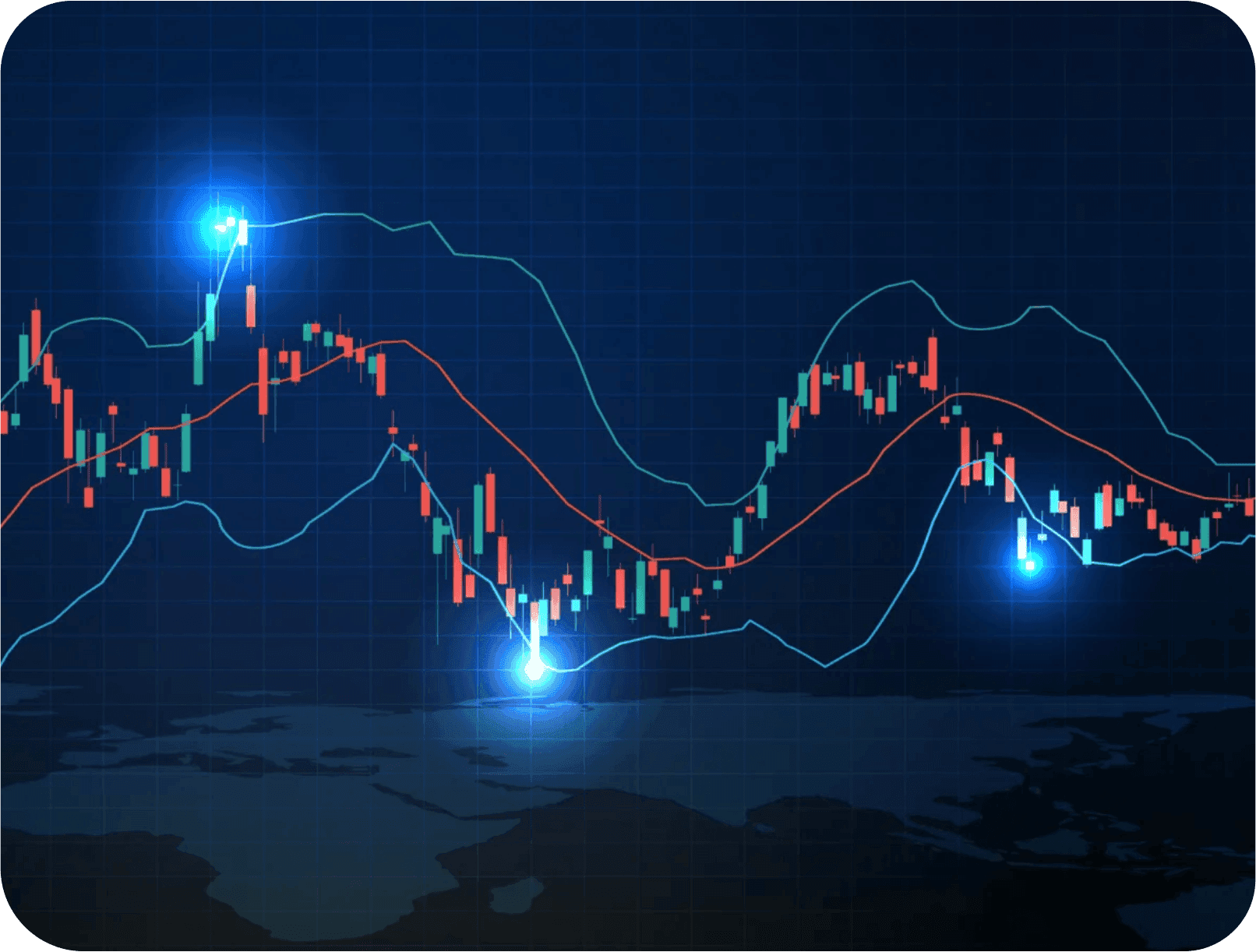
In the fast-paced world of technical analysis, few tools are as widely recognized and utilized as Bollinger Bands. Developed by John Bollinger in the 1980s, this versatile indicator has become a staple for traders looking to understand market volatility and identify potential price reversals.
Whether you are a retail trader just starting your journey or an experienced professional refining your strategy, understanding Bollinger Bands can provide critical insights into price action. This guide breaks down the essential components of Bollinger Bands, offering you actionable knowledge to enhance your trading decisions on the My Maa Markets platform.
1. Introduction to Bollinger Bands
At its core, the Bollinger Bands indicator consists of three lines plotted on a price chart. These bands adapt to market conditions, expanding during volatile periods and contracting during quieter times.
-
The Middle Band: This is simply a Simple Moving Average (SMA), typically set to a 20-day period. It serves as the baseline for the indicator.
-
The Upper Band: This line is calculated by adding two standard deviations to the Middle Band. It represents a level that is statistically high relative to recent price action.
-
The Lower Band: Conversely, this line is calculated by subtracting two standard deviations from the Middle Band, representing a statistically low level.
2. How Bollinger Bands are Calculated
While most modern trading platforms, including MetaTrader 5, calculate these bands automatically, understanding the math helps you trust the tool. The formula relies heavily on the concept of standard deviation, which measures how far numbers are spread out from an average value.
-
Middle Band: 20-day Simple Moving Average (SMA).
-
Upper Band: 20-day SMA + (20-day Standard Deviation x 2).
-
Lower Band: 20-day SMA - (20-day Standard Deviation x 2).
By using standard deviation, the bands ensure that approximately 95% of price action takes place within the upper and lower boundaries.
3. Interpreting Bollinger Bands
The primary use of Bollinger Bands is to determine if prices are high or low on a relative basis.
-
Overbought Conditions: When the price touches or breaks through the Upper Band, the asset may be considered overbought. This suggests the price might be due for a pullback or reversal.
-
Oversold Conditions: When the price touches or breaks through the Lower Band, the asset may be considered oversold. This often indicates a potential buying opportunity or a price bounce.
4. Bollinger Bands and Volatility
Bollinger Bands are a direct reflection of market volatility. The width of the channel—the distance between the upper and lower bands—tells you exactly how volatile the market is at any given moment.
-
Wide Bands: Indicate high volatility. This often happens during news events or rapid market moves.
-
Narrow Bands: Indicate low volatility. This suggests the market is in a consolidation phase.
5. The Bollinger Squeeze
One of the most popular strategies involving this indicator is identifying a "Squeeze." A Squeeze occurs when the bands tighten significantly, indicating that volatility has dropped to low levels.
Historically, periods of low volatility are often followed by periods of high volatility. Therefore, when you see the bands "squeeze" together tightly, it is often a precursor to a significant breakout in price, though it does not predict the direction of the move.
6. Confirming Breakouts
While a Squeeze signals a potential move, it doesn't tell you which way the market will go. Traders often wait for a breakout confirmation.
-
Bullish Breakout: If the price closes above the upper band after a squeeze, it is often interpreted as a buy signal.
-
Bearish Breakout: If the price closes below the lower band, it is generally seen as a sell signal.
7. Using Bollinger Bands with Other Indicators
No single indicator should be used in isolation. To increase the probability of success, seasoned traders combine Bollinger Bands with other technical tools.
-
RSI (Relative Strength Index): Combining Bollinger Bands with RSI can help confirm overbought or oversold conditions. For example, if price hits the lower band and RSI is below 30, the buy signal is stronger.
-
MACD (Moving Average Convergence Divergence): MACD can provide momentum confirmation for Bollinger Band breakouts.
8. Common Mistakes to Avoid
A common trap for beginners is assuming that touching a band is an automatic signal to trade.
-
Walking the Bands: In strong trends, price can "walk" up the upper band or down the lower band for extended periods. Selling simply because the price hit the upper band during a strong uptrend can lead to significant losses.
-
Ignoring Context: Always look at the broader market trend before placing a trade based solely on the bands.
9. Risk Management is Non-Negotiable
Trading CFDs and Margin FX involves leverage, which amplifies both gains and losses. While Bollinger Bands can help identify entry and exit points, they cannot prevent market volatility from moving against you.
-
Stop-Loss Orders: Always use stop-loss orders to define your maximum loss per trade.
-
Position Sizing: Ensure your trade size aligns with your account balance and risk tolerance. As stated in our risk disclosure, you should only trade with money you can afford to lose.
10. Continuous Learning
Mastering Bollinger Bands takes time and practice. Markets change, and adapting your strategy is key to longevity in trading. Use our educational resources to test different settings (like changing the standard deviation from 2 to 2.5) to see what works best for your specific trading style and asset class.
Ready to apply this knowledge? Open a live account with My Maa Markets today and access advanced charting tools on our MT5 platform.