


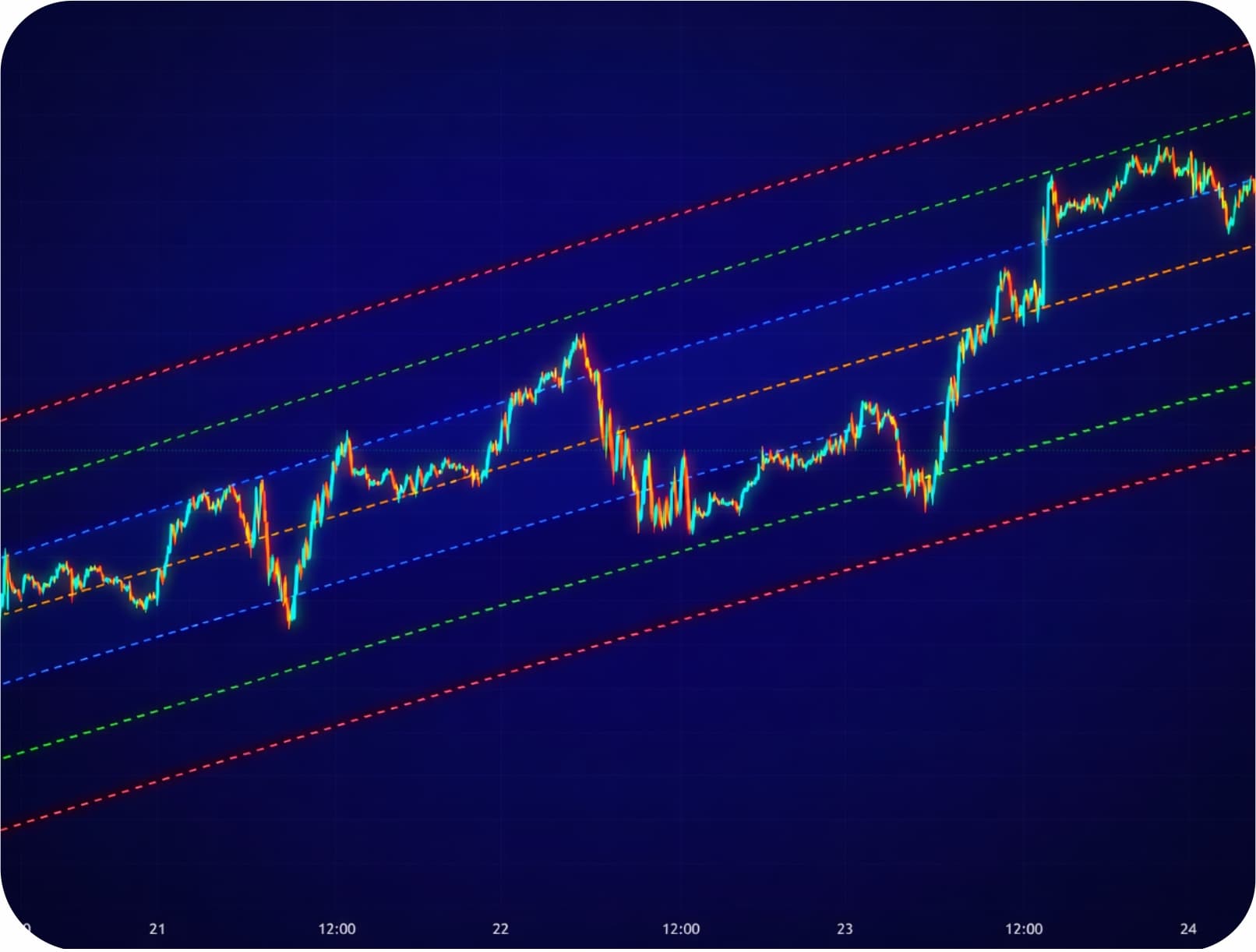
In the fast-paced world of trading, understanding market volatility is crucial for making informed decisions. One of the most reliable technical tools for this purpose is the Standard Deviation Indicator. Whether you are a beginner trader looking to navigate market fluctuations or an experienced investor refining your strategy, this indicator offers valuable insights into price movements.
This listicle explores the Standard Deviation Indicator in depth, explaining what it is, how it works, and how you can integrate it into your trading strategies on My Maa Markets.
1. What is the Standard Deviation Indicator?
The Standard Deviation Indicator is a technical analysis tool used to quantify the amount of variation or dispersion of a set of data values from its mean (average). In the context of financial markets, it measures volatility.
Unlike directional indicators that predict whether the price will go up or down, Standard Deviation purely measures how widely prices are dispersed from the average price. A high standard deviation signifies that the price is spread out over a wide range of values (high volatility), while a low standard deviation indicates that the price tends to be close to the mean (low volatility). This distinction is vital for risk management and strategy planning.
2. How to Calculate Standard Deviation
While the My Maa Markets MetaTrader 5 (MT5) platform calculates this automatically for you, understanding the mathematics behind it helps in interpreting the data correctly.
The calculation involves the following steps:
-
Calculate the Mean: Find the average price (usually the closing price) over a specific number of periods (e.g., 20 days).
-
Determine the Deviation: Subtract the mean from each data point to find the deviation for each period.
-
Square the Deviations: Square each deviation to ensure all numbers are positive.
-
Find the Variance: Calculate the average of these squared deviations.
-
Calculate the Standard Deviation: Take the square root of the variance.
This formula results in a value that traders plot as a line below the price chart, helping them visualise how "abnormal" current price moves are compared to the historical average.
3. Interpreting the Indicator: High vs. Low Readings
The key to using this indicator effectively lies in understanding the cyclical nature of volatility: periods of low volatility are often followed by periods of high volatility, and vice versa.
-
High Standard Deviation Readings: When the indicator line spikes or reaches high levels, it suggests that the market is experiencing significant price swings. While this implies opportunity, it also indicates higher risk. Traders often interpret extremely high readings as a sign that the current trend might be overheating and a correction or consolidation could be imminent.
-
Low Standard Deviation Readings: When the indicator falls to low levels, it signifies that the market is calm and prices are hovering near the average. This state is often described as "consolidation." Experienced traders watch for these low readings closely, as they frequently precede a breakout or a new trend formation.
4. Using Standard Deviation in Trading Strategies
Because Standard Deviation is a volatility indicator, it is rarely used in isolation. It is most powerful when combined with trend-following or momentum indicators.
-
Breakout Strategies: Traders identify periods of low standard deviation (consolidation) and place entry orders above and below the trading range. When volatility expands and the price breaks out, they enter the trade in the direction of the movement.
-
Trend Reversal Identification: If the Standard Deviation hits an extreme high while the price is trending strongly, it may indicate that the trend is becoming unsustainable. Traders might look for reversal patterns, such as a "double top," to time an exit or a counter-trend trade.
-
Bollinger Bands Integration: The famous Bollinger Bands indicator actually uses Standard Deviation to create its upper and lower bands. The bands widen during high volatility (high standard deviation) and contract during low volatility, offering a visual representation of the concept.
5. Advantages and Limitations
Like all technical analysis tools, the Standard Deviation Indicator has its strengths and weaknesses.
Advantages:
-
Objective Volatility Measure: It provides a clear, mathematical calculation of risk and volatility, removing emotional bias.
-
Versatility: It can be applied to any asset class available on MyMaaMarkets, from Forex and Indices to Metals and Stocks.
Limitations:
-
Lagging Indicator: It is based on past data. A spike in the indicator tells you volatility has increased, not necessarily that it will continue.
-
No Directional Bias: It does not tell you which way the market is going, only that it is moving.
Risk Warning: It is essential to remember that CFDs and Margin FX are leveraged products that carry a high level of risk to your capital. Trading is not suitable for everyone and may result in you losing substantially more than your initial investment. You should only trade with money you can afford to lose.
6. Integrating with MyMaaMarkets Tools
MyMaaMarkets offers a robust trading environment where you can easily apply the Standard Deviation Indicator.
-
Log in to your MyMaaMarkets MT5 platform.
-
Select 'Insert' > 'Indicators' > 'Trend' > 'Standard Deviation'.
-
Adjust the settings (the default is often a 20-period moving average) to suit your specific strategy.
-
Combine it with our advanced charting tools to identify potential entry and exit points.
By utilising our institutional-grade execution and spreads from 0.0 pips, you can test how this indicator works in real-time market conditions.
Ready to apply this knowledge to the live markets?
Open a live account with MyMaaMarkets today to access over 275 trading instruments and advanced analytical tools.