

Starting your trading journey can feel like stepping into uncharted territory. The potential for profit draws millions of new traders to the markets each year, but statistics show that 80-90% of beginner traders lose money within their first year. The difference between those who succeed and those who fail often comes down to avoiding common pitfalls that trap newcomers.
Understanding these mistakes before you make them can save you significant losses and accelerate your path to consistent profitability. Each mistake represents a learning opportunity that successful traders have already navigated, and their experiences can guide your own trading decisions.
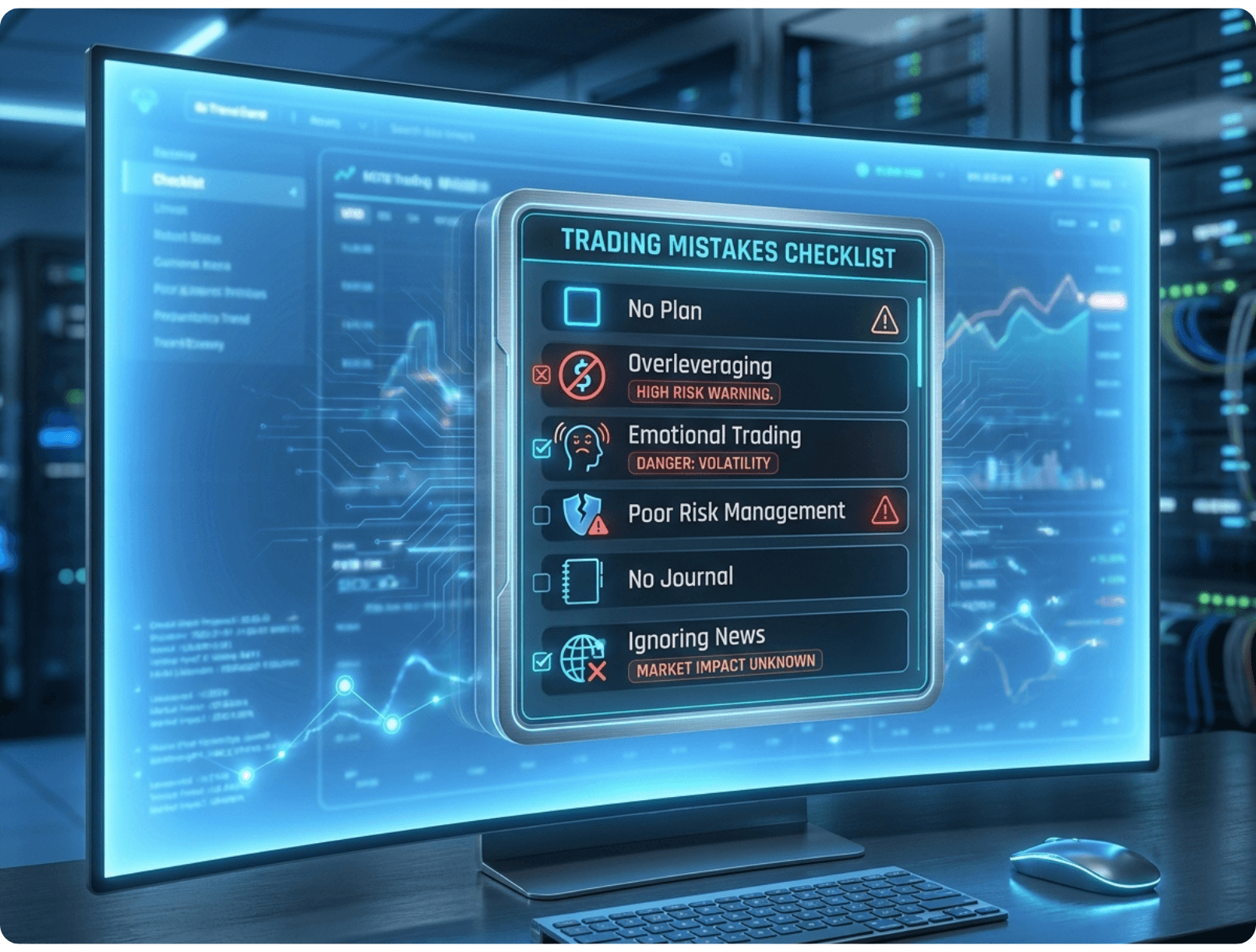
The good news? These mistakes are entirely preventable with proper preparation and discipline. Let's explore the six most costly errors new traders make and the specific strategies you can use to avoid them.
Mistake 1: Trading Without a Clear Plan
Many new traders approach the markets like a casino, making impulsive decisions based on gut feelings or hot tips from social media. This approach treats trading as gambling rather than a strategic business activity.
A trading plan serves as your roadmap, defining exactly when you'll enter trades, when you'll exit, and how much risk you're willing to accept. Without this structure, you're essentially flying blind through volatile markets.
How to Build Your Trading Plan:
-
Define your trading style (day trading, swing trading, or position trading)
-
Set specific entry and exit criteria for each trade
-
Determine your risk tolerance and position sizing rules
-
Establish daily, weekly, and monthly profit targets
-
Choose the markets and instruments you'll focus on
Your plan should be detailed enough that another person could execute your trades based on your written criteria. This level of specificity removes emotion from your decision-making process and creates consistency in your approach.
Mistake 2: Using Excessive Leverage
Leverage amplifies both profits and losses, making it a double-edged sword for inexperienced traders. While platforms may offer leverage ratios up to 1:500, using maximum leverage can wipe out your account with a single adverse price movement.
New traders often view leverage as "free money" to increase their position sizes, but this perspective ignores the mathematical reality of leveraged losses. A 2% price move against a highly leveraged position can result in a 100% account loss.
Smart Leverage Management:
-
Start with low leverage ratios (1:10 or less) while learning
-
Never risk more than you can afford to lose on a single trade
-
Calculate your potential loss before entering any leveraged position
-
Understand how leverage affects your required margin
-
Practice with different leverage levels on a demo account first
Remember that professional traders often use much lower leverage than what's available to them. Their focus is on consistent profits over time, not maximum position sizes.
Mistake 3: Letting Emotions Drive Trading Decisions
Fear and greed are the two emotions that destroy more trading accounts than any technical factor. Fear causes traders to exit profitable positions too early or avoid taking trades altogether. Greed leads to holding losing positions too long or risking too much on "sure thing" opportunities.
Emotional trading creates a destructive cycle: losses lead to revenge trading, which leads to bigger losses, which creates more emotional stress. Breaking this cycle requires developing strict discipline and following your predetermined rules regardless of how you feel.
Strategies for Emotional Control:
-
Set stop-loss orders immediately after entering trades
-
Take profits according to your plan, not your emotions
-
Never increase position sizes after a series of losses
-
Take breaks from trading when feeling overwhelmed
-
Keep a trading journal to identify emotional patterns
The most successful traders treat each trade as one in a series of hundreds or thousands. Individual results matter less than the overall statistical edge of their strategy.
Mistake 4: Ignoring Risk Management
Risk management isn't just about using stop-loss orders—it's a comprehensive approach to protecting your trading capital. Many beginners focus exclusively on finding winning trades while ignoring the mathematics of position sizing and portfolio protection.
Professional risk management involves determining how much of your account you'll risk on each trade, diversifying across different markets, and maintaining proper position sizes relative to your account balance.
Essential Risk Management Tools:
-
Stop-loss orders to limit maximum loss per trade
-
Position sizing based on account percentage (typically 1-2% risk per trade)
-
Diversification across different currency pairs or asset classes
-
Regular account balance assessments and adjustments
-
Maximum daily loss limits to prevent catastrophic drawdowns
Your risk management strategy should ensure that you can survive a series of losing trades while maintaining enough capital to continue trading when conditions improve.
Mistake 5: Failing to Keep a Trading Journal
Most new traders focus on their wins and conveniently forget their losses, creating a distorted view of their actual performance. Without detailed records, it's impossible to identify which strategies work and which ones drain your account.
A comprehensive trading journal captures not just the financial results of each trade, but also the reasoning behind your decisions and the market conditions at the time. This information becomes invaluable for improving your strategy over time.
What to Track in Your Journal:
-
Entry and exit points with timestamps
-
Reason for entering the trade
-
Market conditions and news events
-
Emotional state before and after the trade
-
What you learned from each trade outcome
-
Screenshots of chart setups for future reference
Review your journal weekly to identify patterns in your successful and unsuccessful trades. This analysis often reveals that your best trades share common characteristics that you can replicate.
Mistake 6: Trading in an Information Vacuum
Financial markets don't operate in isolation—they respond to economic events, policy changes, and global developments. Traders who ignore fundamental analysis and market news often find themselves on the wrong side of major price movements.
This doesn't mean you need to become an economist, but understanding the basic drivers of currency movements can help you avoid trading against major trends or during high-impact news events.
Staying Informed Effectively:
-
Follow an economic calendar for scheduled news releases
-
Understand how different economic indicators affect currency prices
-
Monitor central bank communications and policy changes
-
Use multiple news sources to avoid bias
-
Learn to distinguish between market-moving news and noise
Consider both technical and fundamental analysis when making trading decisions. Technical analysis shows you what price is doing, while fundamental analysis helps explain why.
Building Your Foundation for Trading Success
Avoiding these common mistakes requires more than just awareness—it demands consistent application of proven principles and continuous learning. Successful trading is built on a foundation of proper education, disciplined execution, and realistic expectations about the time required to develop profitable skills.
The markets will always be there, but your trading capital is finite. Protecting it while you learn should be your highest priority. Start with a solid educational foundation, practice on demo accounts, and gradually increase your risk as your skills improve.
Consider working with regulated brokers that offer educational resources and risk management tools. Platforms that provide comprehensive learning materials, demo accounts, and professional support can significantly accelerate your learning curve while protecting your initial investment.
Your trading journey doesn't have to follow the same path as the 80% who lose money. By understanding and avoiding these six critical mistakes, you're positioning yourself among the minority of traders who achieve long-term success. The key is implementing these lessons consistently, one trade at a time.