

Financial markets are in a constant state of flux, driven by a multitude of factors. Among the most powerful of these are news and economic events. A single headline or data release can send shockwaves through global markets, creating both significant opportunities and substantial risks for traders. For anyone looking to achieve consistent success, understanding how to interpret and react to this information is not just an advantage—it's a necessity.
This guide will provide a clear overview of how major economic events influence market behavior and introduce the fundamental concepts of news trading. By mastering these principles, you can learn to navigate market volatility with greater confidence, turning breaking news into actionable trading strategies. With the right knowledge and tools, you can position yourself to capitalize on short-term market movements and make more informed decisions.
Understanding Key Economic Events
To trade the news effectively, you must first understand the economic indicators that move markets. These data points provide a snapshot of a country's economic health and can significantly influence currency values, stock prices, and commodity markets.
Here are some of the most critical economic indicators to watch:
-
Gross Domestic Product (GDP): This is the broadest measure of a nation's economic activity, representing the total value of all goods and services produced over a specific time period. A higher-than-expected GDP reading often signals economic strength, which can boost the country's currency and stock market. Conversely, a lower reading can lead to a sell-off.
-
Inflation (Consumer Price Index - CPI): Inflation measures the rate at which the general level of prices for goods and services is rising, and subsequently, purchasing power is falling. Central banks often raise interest rates to combat high inflation, which can strengthen a currency. The CPI report is a key gauge of inflation and is closely monitored by traders.
-
Employment Data: Reports like the U.S. Non-Farm Payrolls (NFP) are crucial. Strong employment numbers suggest a healthy, growing economy, which is typically positive for the stock market and the national currency. Weak employment data can signal an economic slowdown.
-
Interest Rate Decisions: Central bank announcements on interest rates are among the most impactful events. Higher interest rates tend to attract foreign investment, increasing demand for and value of a country's currency. Lower rates can have the opposite effect. Traders watch these announcements for clues about future monetary policy.
These indicators shape market sentiment by providing a basis for what traders believe will happen next. A strong economic report can create a bullish sentiment, encouraging buying, while a weak report can trigger bearish sentiment and selling pressure.
Basic Concepts of News Trading
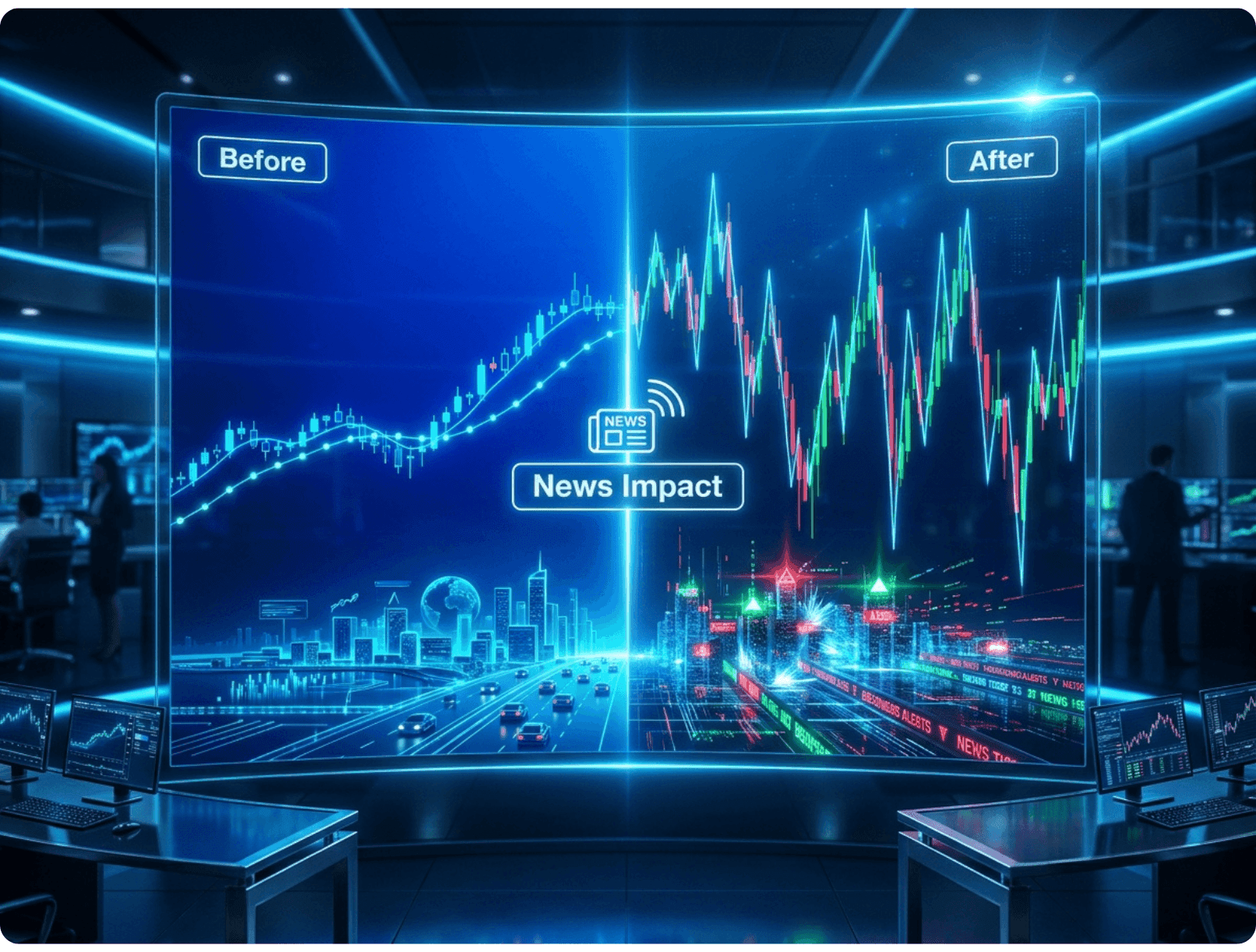
News trading, or event-driven trading, is a strategy that involves making trades based on the market's reaction to economic news and other significant events. The goal is to capitalize on the short-term volatility that these announcements create.
Event-Driven Trading
This approach focuses on capturing price movements immediately before and after a major news release. Markets can move dramatically in a matter of seconds. For example, if a central bank unexpectedly cuts interest rates, the country's currency is likely to fall sharply against others. A trader who anticipates this move or reacts quickly can profit from the sudden price change.
Anticipating Market Moves
Successful news trading is not just about reacting quickly; it's also about preparation. Before a major announcement, markets often form a consensus forecast. This is the expected outcome based on expert analysis and prior data. The actual market reaction often depends on how the real data compares to these expectations.
-
If the actual data is better than expected: The asset (e.g., currency, stock) is likely to rise in value.
-
If the actual data is worse than expected: The asset is likely to fall.
-
If the actual data matches expectations: The market reaction may be muted, as the news has already been "priced in."
Analyzing forecasts and expert opinions from reliable financial news sources can help you form a trading plan before the event occurs.
Risk Management in News Trading
The high volatility associated with news events also brings significant risk. Prices can move against your position just as quickly as they can move in your favor. Effective risk management is therefore non-negotiable.
-
Use Stop-Loss Orders: A stop-loss order automatically closes your position if the price reaches a predetermined level. This helps you limit potential losses if the market moves against you.
-
Manage Leverage: While leverage can amplify your profits, it can also magnify your losses. During highly volatile news events, it is wise to use lower leverage to protect your capital.
-
Avoid Over-Trading: It can be tempting to trade every news release, but it's more effective to focus on high-impact events that you have thoroughly researched.
Strategies for Trading the News
A structured approach is essential for navigating the fast-paced environment of news trading. Your strategy should cover actions before, during, and after the event.
Pre-Event Analysis
Preparation is the foundation of a successful news trade. Before a major announcement, you should:
- Identify Key Events: Use an economic calendar to know exactly when important data will be released. Focus on events marked as "high impact."
- Research Forecasts: Understand the market consensus and what analysts are predicting.
- Define Your Strategy: Decide on your entry and exit points. Will you trade directionally based on the outcome, or will you use a strategy that profits from volatility regardless of direction (like a straddle)? Set your stop-loss and take-profit levels in advance.
During-Event Execution
When the news is released, market conditions can change in an instant. Spreads may widen, and liquidity can decrease.
- Be Ready to Act: Have your trading platform open and be prepared to execute your plan as soon as the data is released.
- Stay Disciplined: Emotional decisions are the enemy of successful trading. Stick to the plan you developed during your pre-event analysis. Do not chase the market if you miss your initial entry point.
- Monitor Your Position: Keep a close eye on your trade and be prepared to adjust your stop-loss or take-profit orders if market conditions change unexpectedly.
Post-Event Assessment
After the trade is closed, the work isn't over.
- Analyze the Outcome: Review your trade. What went well? What could have been improved?
- Study the Market Reaction: How did the market behave compared to your expectations? Understanding these patterns will help you refine your strategy for future events.
- Keep a Trading Journal: Document your research, your trade plan, and the results. This journal will become an invaluable tool for learning and improvement.
Tools and Resources for Success
To effectively trade the news, you need access to reliable tools and a robust trading platform. At MY MAA MARKETS, we provide our clients with the resources needed to turn market data into actionable opportunities.
-
Live Market Analytics: Our platform offers real-time financial news and an economic calendar to keep you informed of upcoming events.
-
Comprehensive Trading Tools: With the advanced features of MetaTrader 5, you can perform in-depth technical analysis and execute trades with precision.
-
Competitive Platform Features: We offer tight spreads starting from 0.0 pips, access to extensive leverage, and a wide range of asset classes, including Forex, indices, and metals.
Master Your Trading Strategy
News and economic events are fundamental drivers of financial markets. By understanding how key indicators influence market sentiment and by developing a disciplined trading strategy, you can learn to navigate the volatility and uncover new trading opportunities. The journey to mastering news trading requires preparation, precision, and continuous learning.
As an FSC-regulated broker, MY MAA MARKETS is committed to providing a secure and efficient trading environment. We empower you with the educational tools and advanced platform features needed to trade with confidence. Explore our resources, practice with a demo account, and take the first step toward achieving your financial goals.