

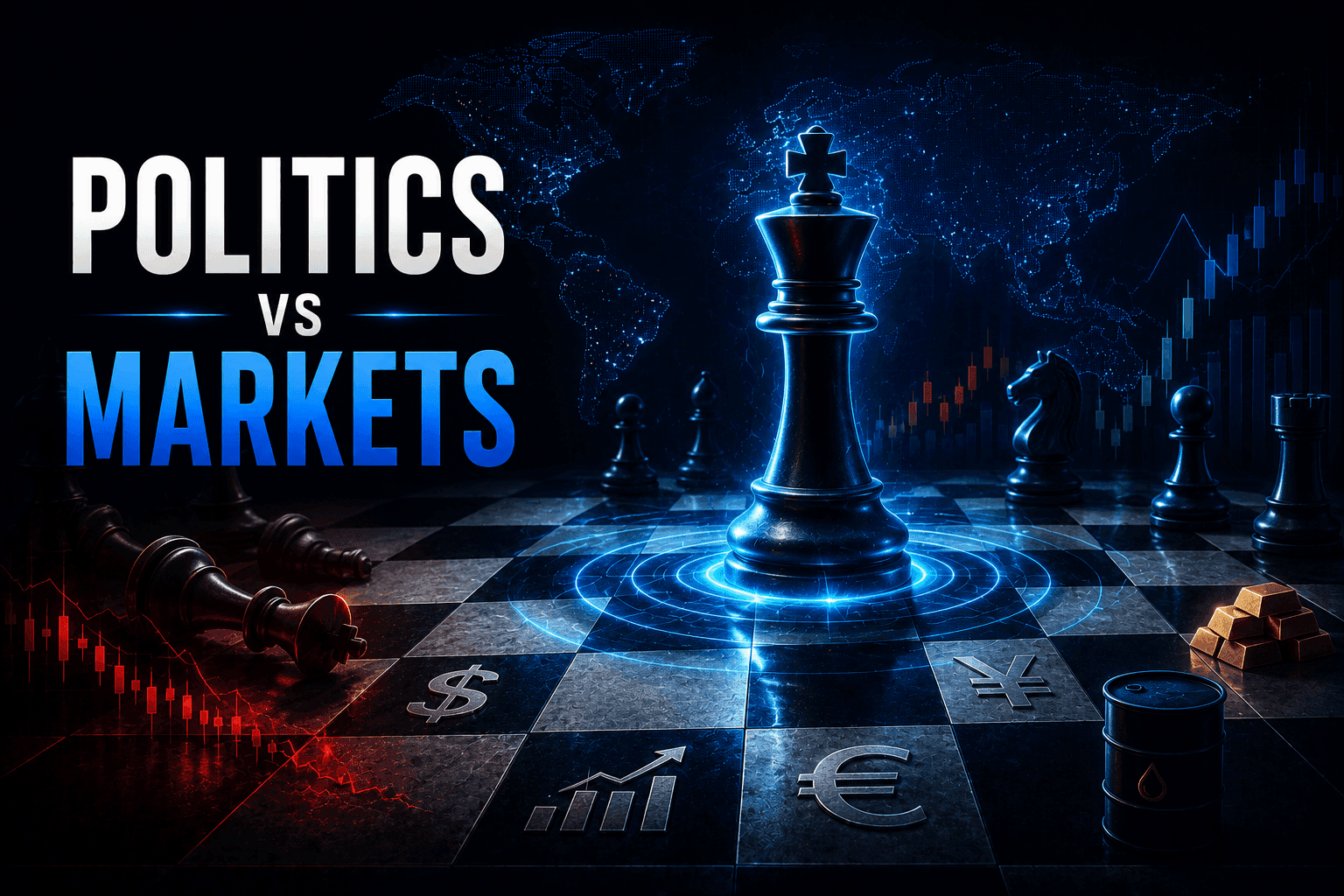
Political events have an undeniable impact on financial markets. Elections, policy announcements, and geopolitical tensions can send shockwaves through trading floors worldwide, creating both opportunities and risks for traders and investors.
Understanding this relationship between politics and markets is essential for anyone looking to navigate today's complex financial landscape. When political uncertainty rises, market volatility often follows, affecting everything from currency pairs to commodity prices. Smart traders recognize these patterns and position themselves accordingly.
This comprehensive guide examines how political developments influence market behavior, explores historical examples of significant market reactions, and provides practical strategies for trading during periods of political uncertainty.
Understanding the Politics-Market Connection
Political events affect markets through several key mechanisms. Policy uncertainty creates hesitation among investors, leading to reduced trading volumes and increased price swings. When governments announce new regulations or economic policies, markets react as traders reassess asset valuations based on potential impacts.
Investor sentiment plays a crucial role in amplifying political effects on markets. Fear and optimism drive buying and selling decisions, often creating price movements that exceed what fundamental analysis might suggest. During election periods, this sentiment-driven volatility becomes particularly pronounced.
Currency markets show some of the strongest reactions to political developments. Central bank policies, trade agreements, and fiscal spending decisions directly impact exchange rates. The EUR/USD pair, for example, frequently experiences heightened volatility during European political events or U.S. policy announcements.
Historical Examples of Political Market Impact
The 2016 Brexit referendum serves as a prime example of political events creating market turbulence. The British pound experienced its largest single-day decline in decades following the unexpected vote results. Currency traders who understood the potential outcomes positioned themselves to profit from this historic volatility.
Presidential elections consistently generate market uncertainty. The 2020 U.S. election saw significant movements across multiple asset classes as traders speculated about policy changes under different scenarios. Technology stocks, healthcare companies, and energy commodities all experienced notable price swings based on anticipated regulatory shifts.
Trade war developments between major economies have repeatedly demonstrated politics' market impact. Tariff announcements, negotiation updates, and diplomatic tensions create immediate reactions in affected sectors. Agricultural commodities, manufacturing stocks, and currency pairs involving the affected nations typically see the most dramatic movements.
Central bank appointments and policy changes represent another category of political events with direct market consequences. When new leadership takes control of major central banks, traders closely monitor initial statements and policy directions for clues about future monetary policy.
Asset Classes Most Affected by Political Events
Currency markets remain the most sensitive to political developments. Exchange rates reflect economic confidence, trade relationships, and monetary policy expectations. Major currency pairs like EUR/USD, GBP/USD, and USD/JPY often experience their highest volatility during significant political events.
Government bonds respond quickly to political uncertainty as investors seek safe-haven assets or adjust expectations for interest rates and inflation. Bond yields can move dramatically when political events suggest changes to fiscal policy or economic stability.
Equity markets show varied responses depending on the specific political event and affected sectors. Defense contractors might benefit from geopolitical tensions, while healthcare stocks could react strongly to policy announcements affecting drug pricing or healthcare access.
Commodities frequently experience political volatility, particularly oil and precious metals. Energy prices respond to geopolitical tensions in oil-producing regions, while gold traditionally serves as a safe-haven asset during periods of political uncertainty.
Trading Strategies for Political Volatility
Risk management becomes paramount when trading around political events. Position sizing should reflect the increased uncertainty, and stop-losses need adjustment for potentially larger price movements. Successful traders often reduce their overall exposure leading up to major political announcements.
News trading strategies can capitalize on immediate market reactions to political developments. This approach requires quick execution and deep understanding of how different outcomes might affect various asset classes. However, the risks are substantial due to unpredictable market reactions.
Safe-haven positioning involves allocating capital to assets that typically perform well during uncertainty. Gold, government bonds from stable countries, and certain currencies like the Swiss franc often benefit when political tensions rise.
Sector rotation strategies focus on identifying industries likely to benefit or suffer from specific political outcomes. Healthcare, defense, energy, and financial sectors often show the clearest patterns during political events.
Risk Management During Political Uncertainty
Proper risk management requires adjusting trading approaches when political events create elevated market uncertainty. Volatility hedging through options strategies or volatility ETFs can protect portfolios from unexpected price movements while maintaining upside potential.
Correlation awareness helps traders understand how political events might affect multiple positions simultaneously. During crisis periods, correlations between different assets often increase, reducing the effectiveness of traditional diversification strategies.
Liquidity considerations become critical during high-impact political events. Some assets may experience reduced liquidity, making it difficult to exit positions at desired prices. Traders should factor this into their position sizing and exit strategies.
The Role of Central Banks and Monetary Policy
Central banks often respond to political developments through monetary policy adjustments. Interest rate decisions following political events can amplify or dampen initial market reactions. Traders need to consider both the immediate political impact and potential central bank responses.
Communication strategies from central banks during political uncertainty provide important trading signals. Forward guidance, emergency statements, and intervention policies all influence market behavior and create trading opportunities.
Technology's Impact on Political Market Reactions
High-frequency trading and algorithmic systems now process political news within milliseconds, creating faster and sometimes more extreme market reactions. This technological evolution has changed how political events affect markets, often amplifying initial movements.
Social media sentiment analysis has become a new factor in political market volatility. Platforms like Twitter and news aggregators can influence market sentiment before traditional media reports events, creating new dimensions for traders to monitor.
Building a Political Event Trading Framework
Successful trading during political volatility requires systematic preparation. Event calendars help traders identify potential market-moving political developments in advance. Elections, policy announcements, and diplomatic meetings should all factor into trading plans.
Scenario analysis involves considering multiple potential outcomes and their likely market impacts. This preparation allows traders to react quickly when events unfold, rather than scrambling to understand implications in real-time. Information sources matter significantly when trading political events. Reliable news services, economic calendars, and political analysis help traders make informed decisions quickly. Multiple source verification becomes essential given the speed required for political event trading.
Navigating Political Volatility Successfully
Political events will continue creating market volatility as global interconnectedness increases and policy decisions affect international trade and investment flows. Successful traders acknowledge this reality and develop skills to profit from political market movements while managing associated risks.
The key lies in preparation, risk management, and understanding the complex relationships between political developments and market reactions. Whether you're trading currencies, commodities, or equities, political awareness has become an essential component of comprehensive market analysis.
Ready to put these insights into practice? MY MAA MARKETS provides the advanced trading platform and expert support you need to navigate political market volatility successfully. With spreads starting from 0.0 pips and access to 275+ instruments across global markets, you'll have the tools to capitalize on political events while managing risk effectively.