


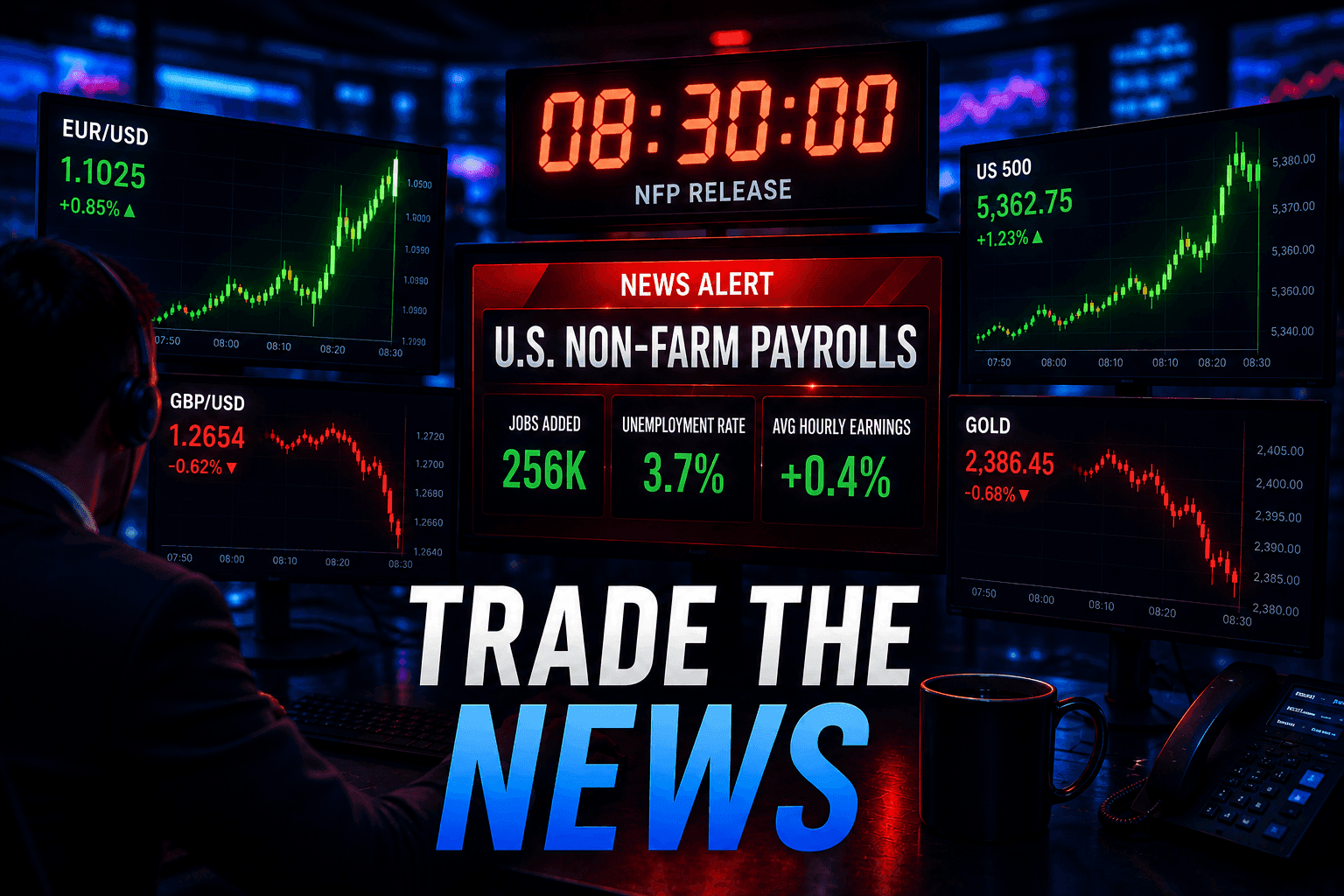
Employment reports are among the most influential economic indicators in the financial markets. For traders, they provide a crucial snapshot of an economy's health, often triggering significant price movements across forex, indices, and other assets. Understanding how to interpret and trade these reports can provide a distinct advantage.
This guide will walk you through the key employment reports, explain their market impact, and outline strategies for incorporating them into your trading plan. By mastering this aspect of fundamental analysis, you can make more informed decisions and capitalize on market volatility. We will cover what these reports are, why they matter, and how to approach them with a clear strategy.
Understanding Key Employment Reports
Several countries release regular employment data, but a few have an outsized impact on global markets. These reports detail job creation, unemployment rates, and wage growth, which are direct measures of economic vitality.
1. U.S. Non-Farm Payrolls (NFP)
The Non-Farm Payrolls report is arguably the most-watched economic release in the world. Issued on the first Friday of every month by the U.S. Bureau of Labor Statistics, it measures the change in the number of employed people in the U.S., excluding the farming sector, private households, non-profit organizations, and government employees.
What it includes:
-
The NFP Number: The headline figure showing the number of jobs added or lost.
-
Unemployment Rate: The percentage of the total labor force that is jobless and actively seeking employment.
-
Average Hourly Earnings: A measure of wage inflation, which is closely watched by central banks.
A strong NFP report (high job growth, low unemployment, rising wages) often signals a robust economy, which can lead the U.S. dollar to strengthen. Conversely, a weak report can have the opposite effect.
2. Other Important Employment Reports
While the NFP takes center stage, other countries' employment data also drive market movements, particularly in their respective currencies.
-
Canada's Labour Force Survey: Released monthly alongside the U.S. NFP, it has a significant impact on the Canadian dollar (CAD).
-
Australia's Employment Change: A monthly report that heavily influences the Australian dollar (AUD).
-
U.K. Claimant Count Change: A measure of the change in the number of people claiming unemployment-related benefits, affecting the British pound (GBP).
-
Germany's Unemployment Change: As the largest economy in the Eurozone, Germany's labor data can impact the euro (EUR).
Why Employment Data Moves the Markets
Employment reports are fundamental to economic health for several reasons, each with direct implications for traders.
Impact on Monetary Policy
Central banks, like the U.S. Federal Reserve, have a dual mandate: to maintain price stability (control inflation) and achieve maximum sustainable employment. Strong employment data, particularly rising wages, can lead to inflationary pressures. In response, a central bank might raise interest rates to cool the economy. Higher interest rates typically make a currency more attractive to foreign investors, causing its value to rise.
Indicator of Economic Growth
Employment is a direct reflection of economic activity. When businesses are confident in the economy, they hire more workers. This increased employment leads to higher consumer spending, which further fuels economic growth (GDP). A positive economic outlook can boost a country's stock market indices and strengthen its currency.
Source of Market Volatility
Due to their significance, employment reports often cause sharp and immediate price swings in the financial markets. The actual data is compared against the consensus forecast from economists.
-
Better-than-expected data can cause a rapid appreciation of the currency.
-
Worse-than-expected data can trigger a sharp depreciation.
-
Mixed data (e.g., strong job growth but stagnant wages) can lead to choppy, uncertain price action.
This volatility presents both opportunities and risks for traders.
A Step-by-Step Guide to Trading Employment Reports
Trading during major data releases is not for the faint of heart. The extreme volatility requires a disciplined approach. Here are three common strategies.
1. Trading Before the Release (Directional Bias)
This strategy involves taking a position based on your analysis and forecast of the report's outcome.
-
Analyze Related Data: Look at leading indicators like weekly jobless claims, manufacturing PMI employment components, and business confidence surveys to form a directional bias.
-
Set Entry and Exit Points: Enter a position a few minutes before the release with pre-defined stop-loss and take-profit levels.
-
High Risk: This is a high-risk strategy. If the data comes out contrary to your expectation, the market can move against your position very quickly.
2. Trading the Initial Reaction (Straddle Strategy)
This approach aims to capture the initial volatility spike, regardless of the direction.
-
Place Pending Orders: A few minutes before the release, place a buy-stop order above the current market price and a sell-stop order below it.
-
Capture the Move: When the report is released, the market will likely surge in one direction, triggering one of your pending orders. The goal is to ride this initial momentum.
-
Manage the Trade: Once one order is triggered, you must immediately cancel the other. Because volatility can be extreme, "slippage" (where your order is filled at a worse price than expected) is a major risk.
3. Trading After the Release (Fading the Move)
Often, the market's initial reaction to a report is exaggerated. This strategy involves waiting for the initial volatility to subside and trading a potential reversal.
-
Wait and Observe: Do not trade in the first 15-30 minutes after the release. Watch for the price to reach a key support or resistance level and show signs of exhaustion.
-
Identify a Reversal: Look for price action signals, such as candlestick patterns, that indicate the initial move is losing steam.
-
Enter the Trade: Place a trade in the opposite direction of the initial spike, with a tight stop-loss. This is often a lower-risk approach, as it avoids the most chaotic period.
Risk Management is Non-Negotiable
Trading employment reports without a solid risk management plan is a recipe for disaster.
-
Use Stop-Loss Orders: Always use a stop-loss to define your maximum acceptable loss on a trade.
-
Reduce Your Position Size: The increased volatility means you should consider trading with a smaller position size than usual to limit your potential losses.
-
Be Aware of Spreads and Slippage: During major news events, brokerage spreads can widen significantly, and slippage can occur. Factor these into your trading plan.
Your Path Forward
Trading employment reports can be a powerful addition to your strategy, offering opportunities to profit from significant market movements. However, it demands careful preparation, a deep understanding of the reports' implications, and an unwavering commitment to risk management.
Start by following the economic calendar and observing how markets react to different employment data releases. Use a demo account to practice your chosen strategy without risking real capital. As you build confidence and refine your approach, you can begin to incorporate news trading into your live portfolio.
At MY MAA MARKETS, we provide the tools, educational resources, and secure trading environment you need to navigate the markets with confidence.
Risk Disclosure: Trading in financial markets carries a high level of risk. You should only trade with money you can afford to lose. The information in this article is for educational purposes and should not be considered investment advice.