


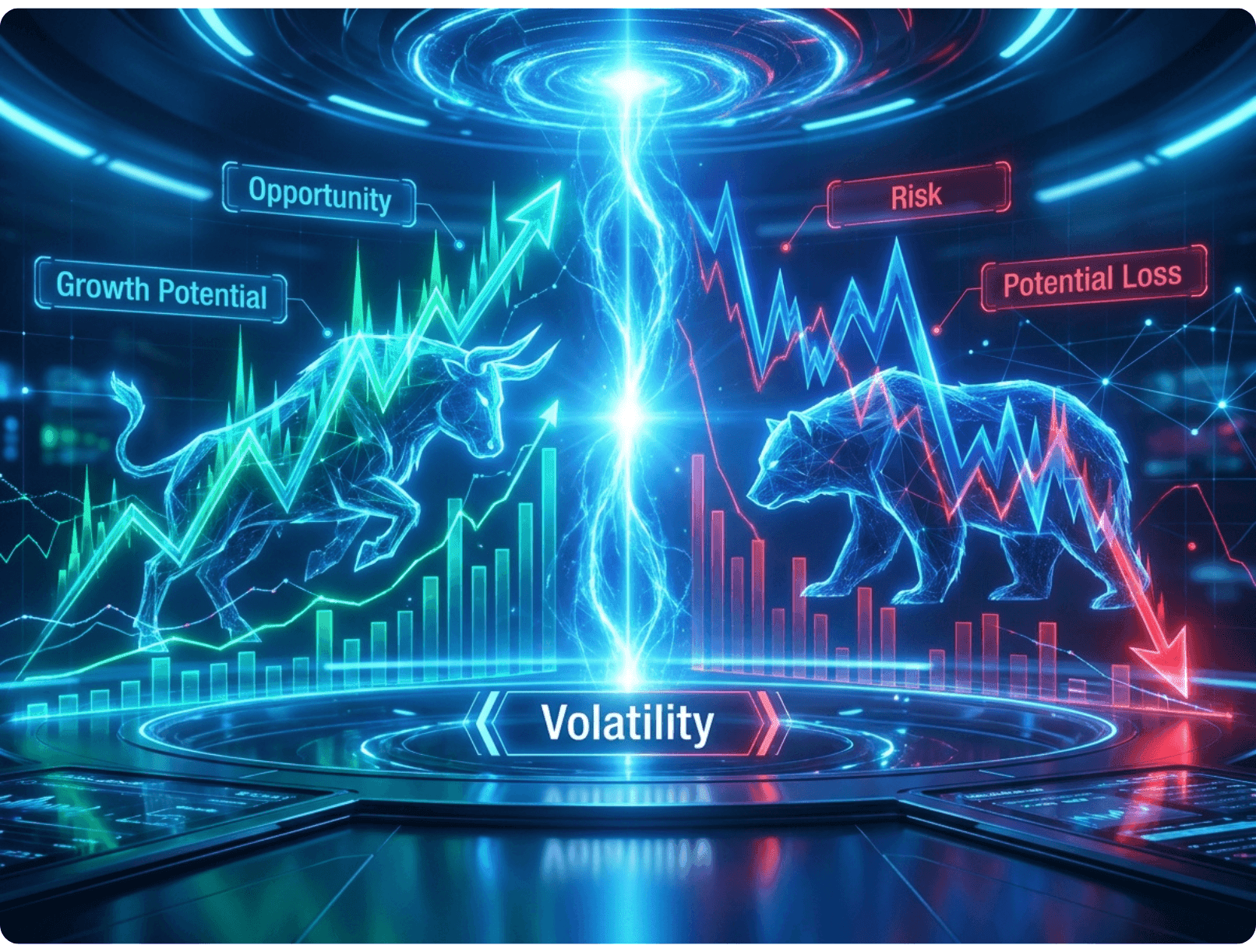
Market volatility can make or break a trading career. For new traders entering the financial markets, price swings represent both the greatest opportunity for profit and the most dangerous threat to capital. Understanding how to navigate these turbulent waters separates successful traders from those who quickly burn through their accounts.
Volatility presents a paradox that every trader must master. The same rapid price movements that create spectacular profit opportunities can wipe out unprepared accounts in minutes. This dual nature makes volatility neither purely beneficial nor inherently harmful—it's a tool that rewards those who understand it and punishes those who don't.
The key to success lies in developing the right mindset, strategies, and risk management techniques. New traders who approach volatility with respect, preparation, and the right tools can transform market uncertainty into consistent profits. Those who ignore its power often discover why 80% of retail traders fail within their first year.
Understanding Market Volatility
Trading volatility refers to the degree of variation in a security's price over a specific time period. When markets experience significant price swings—whether up or down—they're considered volatile. This measurement helps traders assess market conditions and adjust their strategies accordingly.
Volatility is typically measured using several key metrics. Standard deviation calculates how much prices deviate from their average over a given period. The higher the standard deviation, the more volatile the market. Beta measures how much an individual stock moves relative to the broader market, with a beta above 1 indicating higher volatility than the market average.
Several factors drive market volatility. Economic news releases, such as employment reports or GDP announcements, can trigger immediate price reactions. Political events, including elections or policy changes, create uncertainty that translates into price swings. Earnings reports cause individual stock volatility, while geopolitical tensions can affect entire markets.
Central bank decisions represent another major volatility driver. When the Federal Reserve announces interest rate changes or policy shifts, currencies, stocks, and commodities often experience dramatic price movements. These events create trading opportunities for those positioned correctly.
Market sentiment also plays a crucial role. Fear and greed drive collective investor behavior, leading to periods of extreme volatility. During market crashes, fear dominates and prices fall rapidly. Conversely, during bull markets, greed can push prices to unsustainable levels before corrections occur.
The Upsides of Volatility
High volatility creates exceptional profit opportunities for skilled traders. When prices move rapidly and significantly, traders can capture substantial gains in short periods. A currency pair that typically moves 50 pips daily might move 200 pips during volatile conditions, multiplying profit potential.
Increased liquidity often accompanies volatile markets. More traders participate when significant price movements occur, creating deeper order books and tighter bid-ask spreads. This increased participation makes it easier to enter and exit positions at desired prices, improving execution quality for active traders.
Volatile markets provide accelerated learning experiences. New traders encounter various market conditions quickly, forcing them to develop and test their trading strategies under different scenarios. This real-time education helps build the experience that would normally take months or years to acquire.
Breakout opportunities multiply during volatile periods. When prices break through key support or resistance levels with high volume, they often continue moving significantly in the breakout direction. Traders who identify these breakouts early can ride substantial price moves for impressive returns.
Volatility also reveals market inefficiencies. Rapid price movements sometimes create temporary mispricings that alert traders can exploit. These inefficiencies exist for brief periods before the market corrects itself, providing profit windows for those quick enough to recognize them.
The Downsides of Volatility
The same price swings that create profit opportunities can generate devastating losses. New traders often underestimate how quickly volatile markets can move against their positions. A trade that appears profitable can turn into a significant loss within minutes, especially when proper risk management techniques aren't employed.
Emotional stress intensifies during volatile periods. Watching account balances fluctuate dramatically triggers psychological responses that lead to poor decision-making. Fear causes traders to exit winning positions prematurely, while greed encourages them to hold losing trades too long, hoping for reversals that may never come.
Price gaps represent another significant risk. During extremely volatile conditions, prices can "gap" from one level to another without trading at intermediate prices. These gaps can trigger stop-loss orders at much worse prices than intended, causing larger losses than anticipated.
Slippage becomes more common in volatile markets. When placing market orders, traders might receive execution prices significantly different from what they expected. This slippage can erode profits or magnify losses, making it difficult to implement precise trading plans.
Increased margin requirements often accompany volatile periods. Brokers may raise margin requirements or issue margin calls more frequently, forcing traders to add capital or close positions at unfavorable times. This pressure can disrupt carefully planned trading strategies.
Strategies for Managing Volatility
Risk Management Techniques
Stop-loss orders serve as the first line of defense against volatile markets. These orders automatically close positions when prices reach predetermined levels, limiting potential losses. New traders should place stop-losses before entering any trade, treating them as insurance policies rather than suggestions.
Position sizing becomes critical during volatile periods. The appropriate position size depends on account balance, risk tolerance, and the specific trade's risk profile. A common rule suggests risking no more than 1-2% of account capital on any single trade, but this percentage should decrease further during highly volatile conditions.
Leverage management requires special attention in volatile markets. While leverage can amplify profits, it equally amplifies losses. New traders should use conservative leverage ratios, especially when starting out. Many successful traders use no more than 10:1 leverage, regardless of what their broker offers.
Diversification across different markets, timeframes, and strategies helps reduce overall portfolio volatility. Instead of concentrating all capital in one trade or market, spreading risk across multiple positions can smooth out returns and reduce the impact of any single losing trade.
Trading Strategies for Volatile Markets
Breakout trading capitalizes on price movements that break through established support or resistance levels. During volatile periods, these breakouts often continue further than usual, providing extended profit opportunities. Successful breakout traders wait for confirmation through volume increases and sustained price movement beyond key levels.
Range trading works well when volatility occurs within defined boundaries. This strategy involves buying near support levels and selling near resistance levels, profiting from price oscillations within the range. Traders must be prepared to exit quickly if prices break out of the established range.
Momentum trading follows the direction of strong price movements, attempting to profit from continued movement in the same direction. This strategy requires quick decision-making and strict risk management, as momentum can reverse rapidly during volatile conditions.
Technical Analysis Tools for Volatility
Bollinger Bands help identify potential reversal points during volatile markets. When prices touch the upper band, it may indicate overbought conditions, while touches of the lower band might suggest oversold conditions. The width of the bands also indicates volatility levels—wider bands suggest higher volatility.
Average True Range (ATR) measures market volatility by calculating the average range of price movements over a specific period. Traders use ATR to set appropriate stop-loss distances and position sizes. During high-volatility periods, ATR values increase, suggesting wider stop-losses and smaller position sizes.
Relative Strength Index (RSI) helps identify overbought and oversold conditions that often precede reversals. In volatile markets, RSI can signal when momentum is becoming extreme, providing potential entry and exit signals for contrarian trades.
Case Studies and Learning Experiences
Successful Volatility Trading
Professional traders often cite the 2020 COVID-19 market crash as a period when prepared traders made exceptional profits. Those who maintained discipline, used proper risk management, and stayed patient during the initial panic were able to capitalize on the subsequent recovery.
George Soros's famous bet against the British pound in 1992 demonstrates how understanding volatility drivers can create massive profits. By recognizing the unsustainable nature of Britain's currency peg, Soros positioned for the inevitable breakdown and earned over $1 billion when volatility spiked.
Common Mistakes to Avoid
Many new traders increase their position sizes during winning streaks, often just before markets turn volatile against them. This overconfidence leads to devastating losses when volatility strikes their overleveraged positions.
Ignoring economic calendars represents another frequent mistake. New traders often enter positions without awareness of upcoming news events that could trigger significant volatility, leading to unexpected losses when announcements move markets dramatically.
Emotional trading during volatile periods destroys many accounts. Traders who panic during drawdowns often sell at the worst possible times, then re-enter positions at higher prices, creating a cycle of losses that compounds over time.
Leveraging My Maa Markets for Volatility Management
My Maa Markets provides comprehensive tools designed specifically for managing volatile market conditions. The MetaTrader 5 platform offers advanced charting capabilities with over 80 technical indicators, enabling traders to analyze volatility patterns and identify optimal entry and exit points.
Real-time market analytics help traders stay informed about developing volatility conditions. Access to live economic calendars, market news feeds, and expert analysis ensures traders can prepare for potentially volatile events before they impact markets.
The platform's risk management features include customizable stop-loss and take-profit orders, position sizing calculators, and margin requirement displays. These tools help new traders implement proper risk management techniques essential for surviving volatile markets.
Multiple account types cater to different experience levels and risk tolerances. The Standard Account offers an ideal starting point for new traders with competitive spreads starting from 0.30 pips, while the VIP Account provides spreads from 0.0 pips for more experienced traders seeking optimal execution during volatile periods.
Educational resources include comprehensive guides on volatility trading, risk management techniques, and technical analysis. These materials help new traders build the knowledge foundation necessary for successfully navigating volatile market conditions.
Building Your Volatility Trading Foundation
Success in volatile markets requires more than understanding concepts—it demands practical experience and continuous learning. Start with demo accounts to practice volatility trading without risking real capital. This approach allows you to test different strategies and develop confidence before transitioning to live trading.
Maintain detailed trading journals documenting your decisions, reasoning, and outcomes during volatile periods. This practice helps identify patterns in your decision-making and reveals areas needing improvement. Regular journal review accelerates the learning process and helps avoid repeating costly mistakes.
Develop and strictly follow a comprehensive trading plan that addresses position sizing, risk management, and strategy selection for different volatility environments. Successful traders treat their plans as contracts with themselves, refusing to deviate regardless of emotional impulses.
Consider starting with smaller position sizes than you think appropriate. New traders consistently underestimate the psychological impact of watching positions move against them during volatile periods. Beginning conservatively allows you to gradually increase position sizes as experience and confidence grow.
Frequently Asked Questions
How can new traders identify when volatility is about to increase?
Economic calendars provide advance warning of potentially market-moving events. High-impact news releases, central bank meetings, and earnings announcements often trigger increased volatility. Additionally, technical indicators like Bollinger Bands contracting or ATR reaching low levels may signal impending volatility increases.
What's the biggest mistake new traders make regarding volatility?
The most common error is treating volatility as either purely good or purely bad. Successful traders recognize volatility as a market condition requiring specific strategies and risk management approaches. Attempting to use the same techniques in all market conditions leads to inconsistent results.
Should new traders avoid volatile markets entirely?
Avoiding volatile markets entirely limits learning opportunities and potential profits. Instead, new traders should approach volatile conditions with appropriate caution, smaller position sizes, and heightened attention to risk management. Gradual exposure builds experience and confidence over time.
How do professional traders protect themselves during volatile periods?
Professional traders use sophisticated risk management techniques including dynamic position sizing, correlation analysis, and advanced order types. They also maintain detailed risk budgets that automatically reduce exposure when volatility exceeds predetermined levels.
What role does psychology play in volatility trading?
Psychology dominates volatility trading outcomes. Fear and greed intensify during volatile periods, leading to impulsive decisions that destroy accounts. Successful traders develop emotional discipline through meditation, exercise, proper rest, and maintaining perspective on individual trade outcomes.
Master Volatility With the Right Tools and Support
Volatility represents neither friend nor foe—it's simply a market condition that rewards prepared traders and punishes the unprepared. Success requires understanding volatility's dual nature, implementing robust risk management techniques, and maintaining emotional discipline during turbulent periods.
The path to volatility mastery begins with proper education, continues with disciplined practice, and develops through experience with appropriate trading strategies. New traders who approach this journey with respect for market forces, commitment to continuous learning, and proper risk management can transform volatility from a source of fear into a generator of consistent profits.
Your trading success depends on the tools, education, and support you choose. My Maa Markets provides the comprehensive platform and resources necessary for navigating volatile markets successfully.
Ready to master volatility trading? Take these next steps:
-
Sign up for a free demo account to practice volatility trading without risk and experience our advanced risk management tools firsthand
-
Download our comprehensive e-book on mastering trading strategies and technical analysis to deepen your understanding of volatility management
-
Explore our MetaTrader 5 platform with real-time analytics, 275+ trading instruments, and expert support available 24/7
-
Open a live trading account and enjoy spreads from 0.0 pips, instant withdrawals, and leverage up to 1:500 with FSC regulation ensuring your funds remain secure
Transform market volatility from your greatest fear into your most powerful profit generator. Your trading journey toward consistent success starts with the right foundation.