

In financial markets, success often hinges on understanding subtle yet powerful indicators. Two of the most fundamental concepts every trader must grasp are trading volume and liquidity. These metrics provide deep insights into market dynamics, confirming trends, signaling potential reversals, and ultimately shaping your trading decisions. Without a firm understanding of them, you are essentially navigating the markets with one eye closed.
This guide provides a comprehensive overview of trading volume and liquidity. We will explore what these terms mean, why they are so important, and how you can use them to develop a more effective Forex volume strategy and improve your overall trading performance. By the end, you will have the knowledge needed to analyze these key indicators and make more informed, confident trades.
Understanding Trading Volume
Trading volume is one of the most straightforward yet powerful indicators available. It provides a clear picture of the market's activity and conviction behind price movements.
What is Trading Volume and How is it Measured?
Trading volume represents the total number of shares, contracts, or lots of a specific asset that have been traded during a given period. This period can be a minute, an hour, a day, a week, or any other timeframe you choose to analyze. For instance, if 1 million shares of a particular stock are bought and sold within a single trading day, the daily volume for that stock is 1 million.
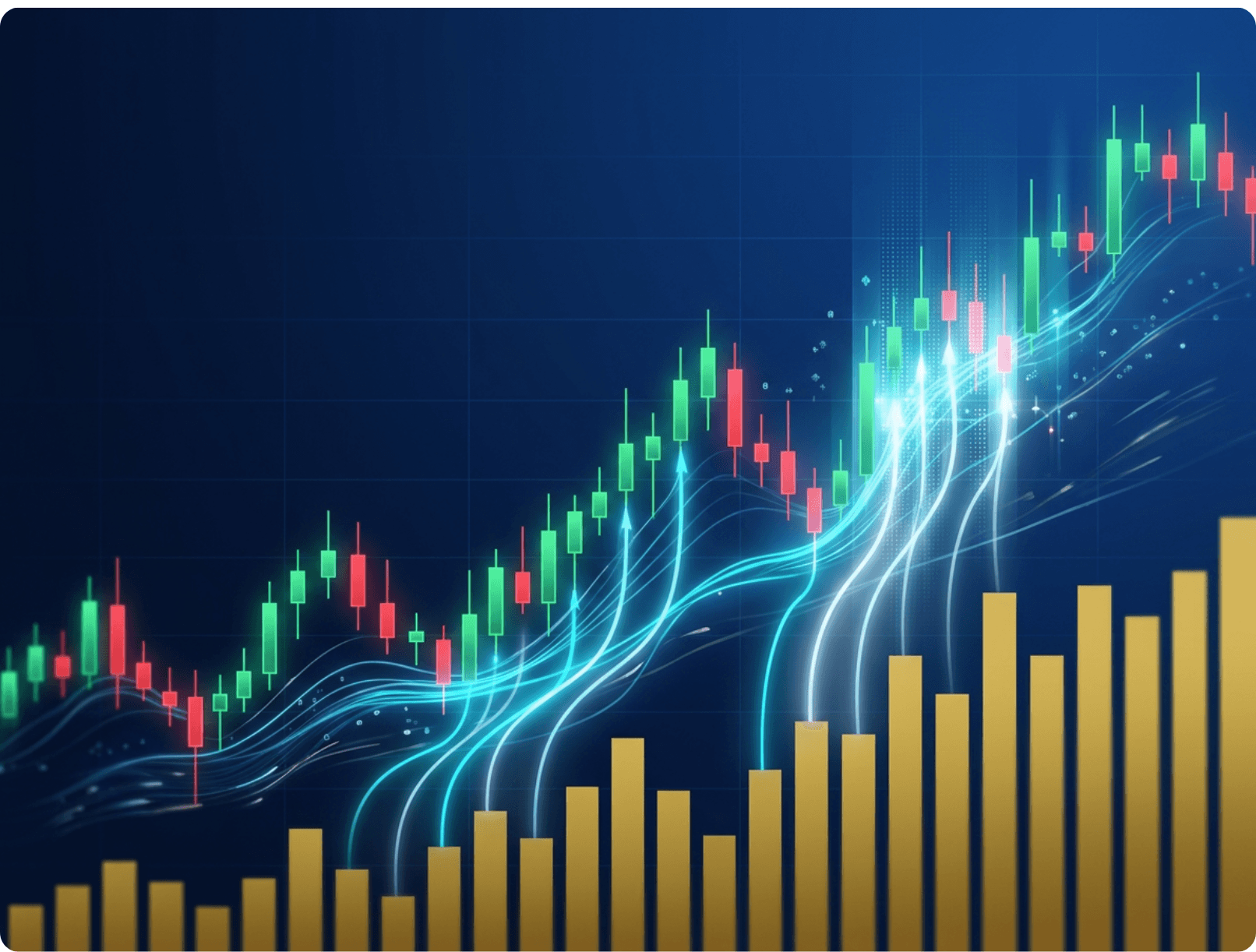
Volume is typically displayed as a histogram or bar chart at the bottom of a price chart, with each bar corresponding to the volume for that period. Green bars often indicate that the closing price was higher than the opening price (a bullish period), while red bars suggest the closing price was lower (a bearish period).
The significance of volume lies in what it reveals about the level of interest and participation in an asset. High volume indicates that many traders are actively buying and selling, suggesting strong interest and conviction. Low volume, on the other hand, signals limited participation and weaker conviction.
The Significance of Volume in Confirming Price Trends
A core principle of trading volume analysis is that volume should confirm the trend. A healthy, sustainable trend is typically accompanied by corresponding volume patterns:
-
In an Uptrend: Volume should ideally increase as prices rise and decrease during price pullbacks. Rising volume on upswings shows strong buying pressure and enthusiasm, confirming the strength of the uptrend. When prices correct downwards on low volume, it suggests that the selling pressure is weak and the primary trend remains intact.
-
In a Downtrend: Conversely, volume should increase as prices fall and decrease during upward rallies. High volume on downswings indicates strong selling pressure and conviction among bears. When the price rallies on low volume, it signals a lack of buying interest, suggesting the rally is temporary and the downtrend is likely to continue.
When volume and price move out of sync, it can be a warning sign. For example, if a price is making new highs but the volume is declining, it suggests that the buying enthusiasm is waning. This divergence can be an early indicator that the trend is losing momentum and may be poised for a reversal.
Understanding Volume Surges and Their Implications
A sudden, dramatic increase in trading volume is known as a volume surge or spike. These events are significant because they signal a major shift in market sentiment and participation, often preceding a significant price move.
Volume surges are typically associated with:
-
Breakouts: A breakout from a key price level (like support, resistance, or a chart pattern) is much more reliable if it occurs on high volume. A high-volume breakout indicates strong conviction from traders and suggests the new price direction has enough momentum to be sustained. A breakout on low volume is often a "false breakout" or "fakeout," as it lacks the participation needed to fuel a new trend.
-
Trend Reversals: A volume surge at the end of a long trend can signal a climax or exhaustion point. For example, after a prolonged downtrend, a sharp price drop accompanied by a massive volume spike (known as a selling climax) can indicate that panicked sellers are finally capitulating. This exhaustion of selling pressure can pave the way for a bottom and a potential trend reversal.
-
News Events: Major economic news releases, earnings reports, or geopolitical events often trigger significant volume surges as traders react to the new information. Analyzing the price action during these high-volume periods can provide valuable clues about the market's interpretation of the news.
Understanding Market Liquidity
While closely related to volume, liquidity is a distinct concept that is equally critical for traders to understand. It directly affects the ease and cost of executing your trades.
What is Liquidity and Why is it Important?
In its simplest form, market liquidity explained is the degree to which an asset can be bought or sold quickly without causing a significant change in its price. It refers to the availability of active buyers and sellers in a market. A market with many participants actively trading is considered highly liquid.
Liquidity is crucial for several reasons:
-
Ease of Execution: In a liquid market, you can enter and exit positions quickly and easily because there is almost always someone on the other side of your trade.
-
Price Stability: High liquidity helps absorb large orders without causing drastic price fluctuations. This stability reduces the risk of slippage, where your trade is executed at a different price than intended.
-
Lower Transaction Costs: Liquid markets tend to have tighter bid-ask spreads, which translates to lower costs for traders.
High-Liquidity vs. Low-Liquidity Markets
Markets can be broadly categorized based on their level of liquidity:
-
High-Liquidity Markets: These markets are characterized by high trading volume, a large number of participants, and tight bid-ask spreads. Major forex pairs like EUR/USD, large-cap stocks like Apple (AAPL), and major stock indices like the S&P 500 are examples of highly liquid markets. Traders in these markets can execute large orders with minimal price impact.
-
Low-Liquidity (Illiquid) Markets: These markets have fewer participants, lower trading volume, and wider bid-ask spreads. Small-cap stocks, exotic currency pairs, and certain commodities can be illiquid. In these markets, it can be difficult to execute trades quickly, and even small orders can cause significant price swings. This makes them riskier and more expensive to trade.
The Role of the Bid-Ask Spread
The bid-ask spread is a direct measure of a market's liquidity and represents the cost of a transaction.
-
Bid Price: The highest price a buyer is willing to pay for an asset.
-
Ask Price: The lowest price a seller is willing to accept for an asset.
The spread is the difference between these two prices. When you buy an asset, you pay the ask price, and when you sell, you receive the bid price. The spread is essentially the broker's compensation for facilitating the trade.
In a highly liquid market, the intense competition between buyers and sellers forces the bid-ask spread to be very narrow—sometimes as low as a fraction of a pip. In an illiquid market, the lack of competition leads to a wider spread, making it more expensive to enter and exit trades.
How Volume and Liquidity Affect Your Trading Decisions
Understanding the theory behind volume and liquidity is only half the battle. The real value comes from applying this knowledge to your trading strategy.
Using Volume to Validate Breakouts
As mentioned earlier, volume is a powerful tool for confirming breakouts. Before entering a trade based on a price breaking through a key level, always check the volume.
-
A Valid Breakout: A breakout accompanied by a significant increase in volume is a strong signal. It shows that the market is decisively behind the move, increasing the probability that the new trend will continue.
-
A Potential Fakeout: If a price breaks out on average or low volume, be cautious. This suggests a lack of conviction and a higher risk that the price will quickly reverse and move back within its previous range. Waiting for a high-volume confirmation can save you from many losing trades.
The Impact of Liquidity on Order Execution
Liquidity directly affects the quality of your trade execution.
-
In Liquid Markets: You can generally expect your orders to be filled quickly and at or very near your desired price. Slippage is minimal, and you can trade larger position sizes without worrying about moving the market.
-
In Illiquid Markets: You may experience significant slippage, especially with market orders or during volatile periods. Your order might be filled at a much worse price than you anticipated, immediately putting you at a disadvantage. Furthermore, trying to exit a large position in an illiquid market can be challenging and may force you to accept a poor price.
How to Identify and Avoid Illiquid Markets
For most retail traders, especially those who are new to the markets, it is wise to stick to highly liquid instruments. Here’s how to identify them:
-
Check the Bid-Ask Spread: Platforms like MetaTrader 5 (MT5) display the live bid and ask prices. A consistently tight spread is a hallmark of a liquid market. At MY MAA MARKETS, we offer spreads starting from 0.0 pips on major assets.
-
Look at the Volume Histogram: A healthy, consistent level of volume indicates good liquidity. Avoid assets where the volume is sporadic or extremely low.
-
Focus on Major Assets: Major currency pairs (e.g., EUR/USD, GBP/USD, USD/JPY), major stock indices, and blue-chip stocks are typically the most liquid. If you are starting out, focusing on these markets is a prudent approach.
Enhance Your Strategy with Trading Tools and Analytics
To effectively apply trading volume analysis and monitor liquidity, you need the right tools. Modern trading platforms like MT5 provide a wealth of built-in indicators and analytical features. MY MAA MARKETS equips traders with:
-
Advanced Charting Tools: Customize your charts with various volume indicators and drawing tools to identify key patterns and levels.
-
Live Market Analytics: Access real-time data and analytics to stay ahead of market movements and make informed decisions.
-
A Wide Range of Instruments: Trade on over 275+ instruments across four asset classes—Forex, Indices, Metals, and Stocks—allowing you to choose markets with the liquidity and volatility that suit your strategy.
Master the Markets with Knowledge
Understanding trading volume and liquidity is not optional; it is a fundamental requirement for consistent success in the financial markets. Volume provides insight into the strength and conviction behind price moves, while liquidity determines the efficiency and cost of your trades. By integrating the analysis of these two powerful forces into your strategy, you can significantly improve your ability to identify high-probability opportunities and avoid costly mistakes.
Are you ready to take your trading to the next level?
-
Sign up for a demo account to practice these concepts in a risk-free environment.
-
Download our comprehensive e-book to master the art of trading with in-depth insights and practical strategies.
-
Start trading with MY MAA MARKETS and gain access to advanced tools, low spreads from 0.0 pips, and the live market analytics you need to succeed.