

In the world of financial trading, success often hinges on understanding the fundamental mechanics of the market. Three of the most critical concepts for any trader to master are the bid price, the ask price, and the spread. While they may seem like simple terms, they form the foundation of how every trade is priced and executed. Understanding these concepts is not just academic; it directly impacts your trading costs and overall profitability.
This guide will break down what bid, ask, and spread mean, how they function, and why they are essential for making informed trading decisions. By grasping these principles, you can navigate the markets more effectively and strategically manage your trading expenses.
Understanding the Bid Price
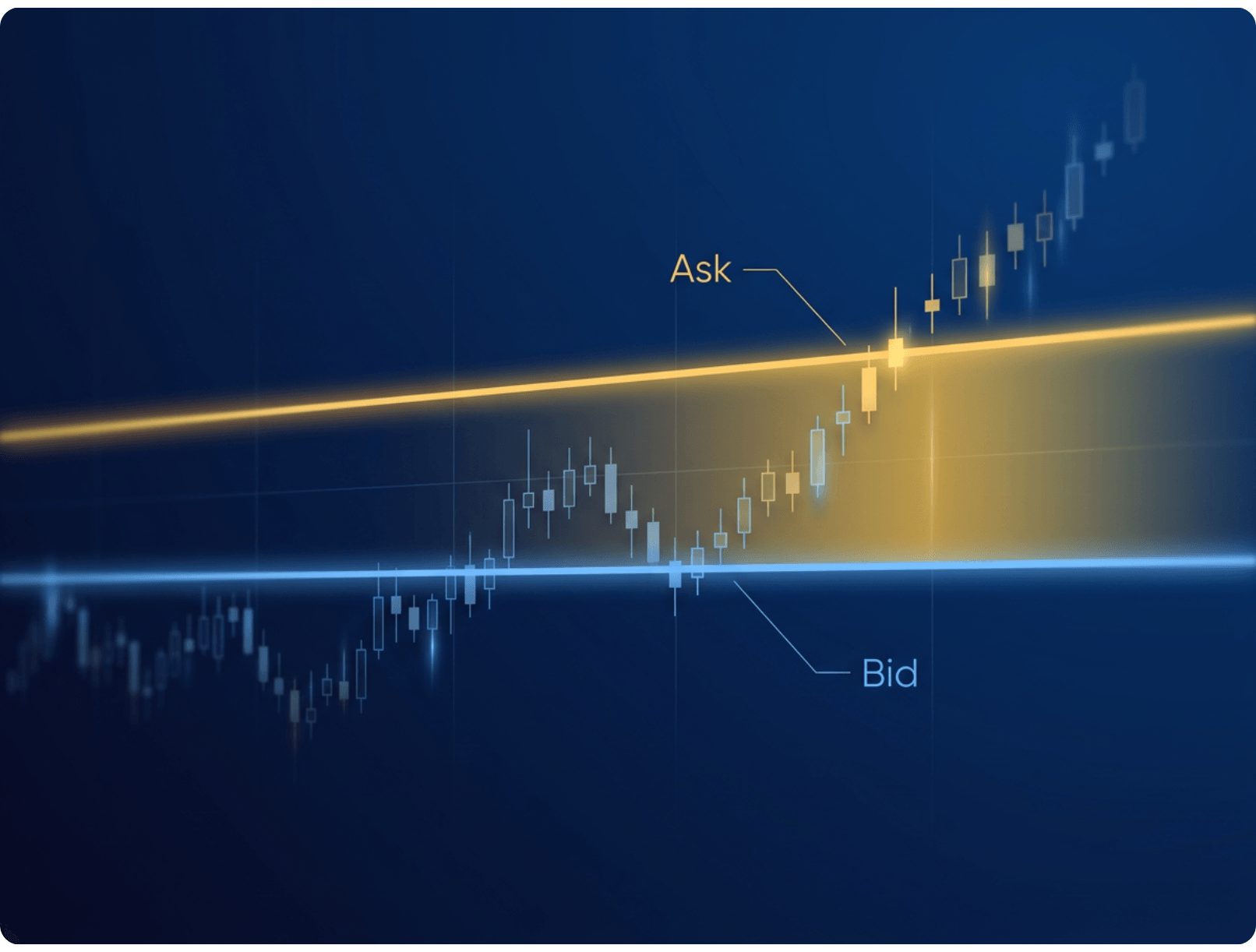
The bid price represents the highest price a buyer is willing to pay for a financial instrument at a given moment. When you want to sell an asset, whether it's a currency pair, a stock, or a commodity, the price you will receive is the bid price. Think of it as the "demand" side of the market equation. If you are a seller, you are looking for buyers. The bid price reflects the most that any buyer in the market is prepared to offer for your asset right now. Therefore, to execute an immediate sale, you must accept the current bid price.
Understanding the Ask Price
Conversely, the ask price (also known as the offer price) is the lowest price a seller is willing to accept for that same financial instrument. If you are looking to buy an asset, the price you will pay is the ask price.
The ask price represents the "supply" side. As a buyer, you need to find someone willing to sell the asset to you. The ask price is the minimum price that sellers are currently demanding. To execute an immediate purchase, you must agree to pay the current ask price.
What is the Spread?
The spread is the difference between the bid price and the ask price. It is a fundamental component of trading and represents the primary cost of executing a trade on most platforms.
Spread = Ask Price - Bid Price
This small difference is how brokers and market makers facilitate trades and earn revenue. Because the ask price (the price you buy at) is always slightly higher than the bid price (the price you sell at), a newly opened position will start with a small, unrealized loss equal to the value of the spread. For a trade to become profitable, the market price must move in your favor by an amount greater than the spread.
This is why traders seek out brokers with tight spreads. A smaller spread means a lower transaction cost and a quicker path to profitability. At My Maa Markets, we offer some of the tightest spreads in the market, starting from as low as 0.0 pips on our VIP accounts, allowing you to cut your trading costs significantly.
Factors Affecting the Spread
The size of the spread is not static; it fluctuates based on several market conditions. Understanding these factors can help you choose when and what to trade.
Liquidity
Liquidity refers to the volume of buying and selling activity in a market. In highly liquid markets, like the EUR/USD forex pair, there are many participants, and spreads are typically very tight. In less liquid markets, there are fewer buyers and sellers, which leads to wider spreads.
Volatility
Market volatility measures the degree of price fluctuation. During periods of high volatility, such as after major economic news releases, spreads tend to widen. This is because increased uncertainty makes it riskier for market makers to facilitate trades, so they increase the spread to compensate.
News and Events
Scheduled economic announcements, geopolitical events, and unexpected news can all cause spreads to widen temporarily. Traders should be mindful of events on the economic calendar, as entering or exiting trades around these times can be more expensive.
Types of Spreads
Brokers typically offer two main types of spreads, each with its own characteristics.
Fixed Spreads
Fixed spreads remain constant regardless of market conditions. Their primary advantage is predictability; you always know your trading cost in advance. This can be beneficial for traders who prefer cost consistency, especially when developing automated trading strategies. However, fixed spreads are often wider than variable spreads under normal market conditions.
Variable Spreads
Variable (or floating) spreads fluctuate continuously based on market liquidity and volatility.
-
Advantages: During periods of high liquidity and low volatility, variable spreads can be extremely tight—sometimes even zero. This makes them highly cost-effective for active traders.
-
Disadvantages: During volatile periods or times of low liquidity, variable spreads can widen significantly, increasing transaction costs unexpectedly.
My Maaa Markets offers variable spreads, which allows our clients to benefit from the tightest possible pricing available in the market.
How Spreads Affect Your Trading Costs
The spread is a direct cost that can eat into your profits. Every time you open a trade, you are immediately "paying" the spread.
For example, imagine the EUR/USD currency pair has a bid price of 1.0750 and an ask price of 1.0751. The spread is 1 pip. If you buy one standard lot (100,000 units), your position is instantly down by $10 (1 pip movement value). The price must rise to at least 1.0752 for your position just to break even. If the spread were wider, say 3 pips, your initial loss would be $30, and you would need a larger market move to become profitable.
Strategies to Minimize the Impact of Spreads
While spreads are an unavoidable part of trading, you can use several strategies to minimize their impact on your bottom line.
-
Choose Assets with High Liquidity: Major currency pairs (like EUR/USD, GBP/USD) and popular indices generally have tighter spreads than exotic pairs or less-traded stocks.
-
Trade During Optimal Market Hours: Spreads are usually tightest when market activity is highest, such as during the London and New York trading session overlaps for forex.
-
Use Limit Orders: Instead of buying or selling at the current market price (market order), a limit order allows you to set a specific price at which you are willing to trade. This can help you avoid executing trades at unfavorable prices when spreads widen suddenly.
-
Select a Broker with Low Spreads: Your choice of broker has a direct impact on your trading costs. By partnering with a platform like My Maaamarkets, which offers spreads from 0.0 pips and zero commissions on certain accounts, you can significantly reduce your expenses and enhance your potential returns.
A Foundation for Smarter Trading
Understanding the bid, ask, and spread is fundamental to your success as a trader. These concepts govern the price of every trade and directly influence your profitability. By being mindful of spread costs and the factors that affect them, you can make more strategic decisions and optimize your trading strategy.
At My Maa Markets, we are committed to providing a superior trading environment. As an FSC-regulated broker, we offer a secure platform with over 275 trading instruments, powerful educational tools, and some of the most competitive spreads in the industry. Combined with features like $0 deposit fees and fast withdrawals, we provide the tools you need to trade with confidence.