


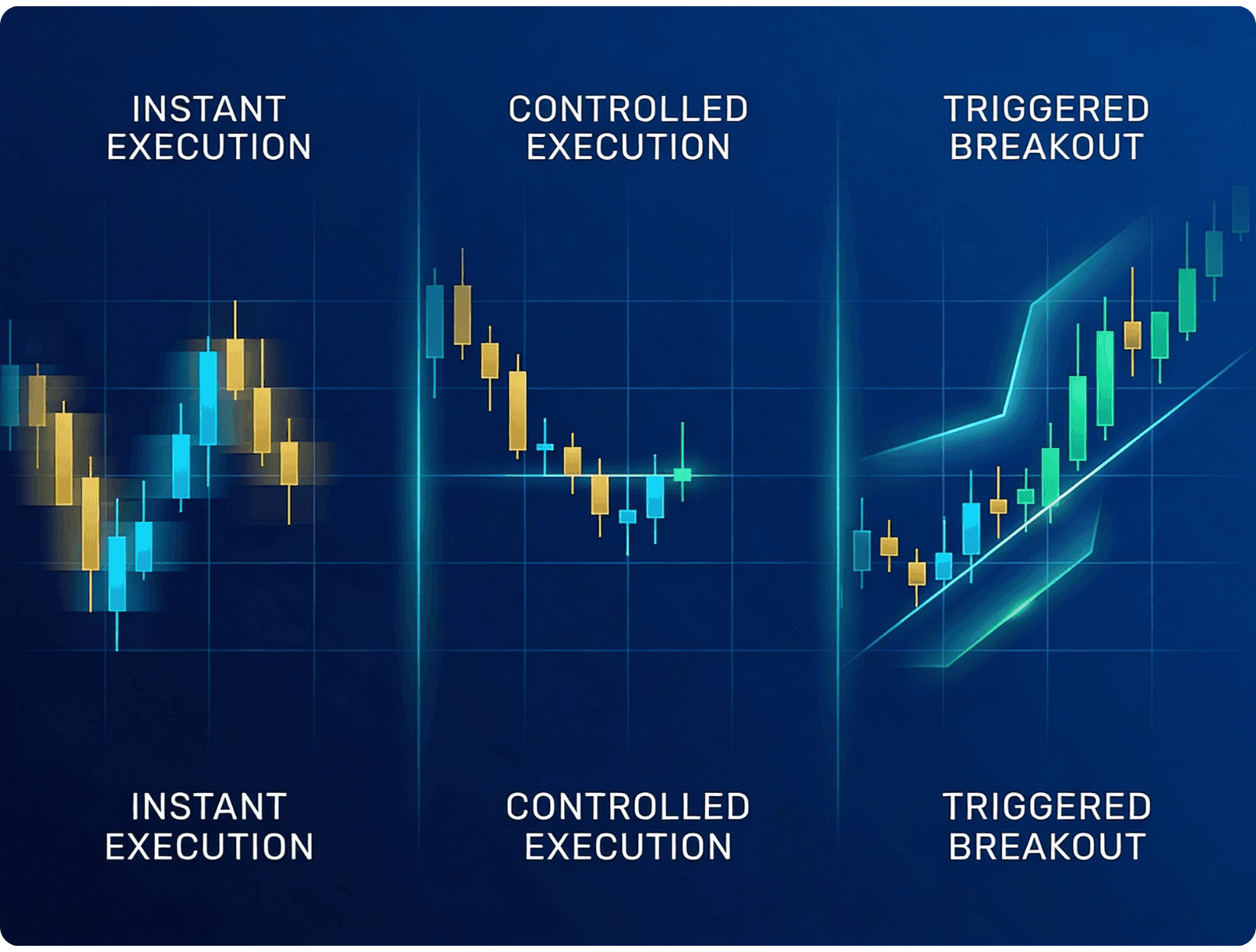
Placing a trade is the foundational action of any market participant. However, the way you enter or exit a trade can significantly impact your results. Understanding the different types of trading orders is not just a technicality; it's a crucial component of effective risk management and strategic execution. By mastering these tools, you can gain greater control over your trades, protect your capital, and improve your chances of success.
This guide will explain the three fundamental order types: market, limit, and stop orders. We will explore how each one functions, its advantages and disadvantages, and the specific scenarios where it is most effective. Equipping yourself with this knowledge is a vital step in becoming a more disciplined and confident trader.
Market Orders: For Speed and Certainty of Execution
A market order is the simplest type of trade order. It is an instruction to buy or sell a financial instrument immediately at the best available price in the current market. When you place a market order, you prioritize the speed of execution over the exact price.
Your broker will fill the order instantly at the prevailing bid price (for a sell order) or ask price (for a buy order). This certainty of execution makes it a popular choice for traders who want to enter or exit a position without delay.
When to Use a Market Order
Market orders are most suitable when your primary goal is to get into or out of a trade quickly. This is often the case in highly liquid markets, where the difference between the bid and ask price (the spread) is minimal.
Advantages:
-
Immediate Execution: Your order is filled almost instantly, ensuring you don't miss a trading opportunity.
-
Guaranteed Fill: As long as there is a market for the asset, your order will be executed.
Disadvantages:
-
Price Slippage: In volatile or less liquid markets, the price at which your order is executed may differ from the price you saw when you placed the order. This is known as slippage and can result in a less favorable entry or exit price.
-
Lack of Price Control: You have no control over the exact execution price.
Limit Orders: For Precision and Price Control
A limit order is an instruction to buy or sell an asset at a specific price or better. A buy limit order can only be executed at the limit price or lower, while a sell limit order can only be executed at the limit price or higher.
This order type gives you complete control over the execution price, ensuring you don't pay more than you want for an asset or sell it for less than your target.
When to Use a Limit Order
Limit orders are ideal when you have a specific entry or exit price in mind and are willing to wait for the market to reach that level. They are particularly useful for:
-
Buying an asset after its price has dipped to a level you consider a good value.
-
Selling an asset once it has reached your profit target.
Advantages:
-
Price Control: You determine the maximum price you'll pay or the minimum price you'll accept.
-
Avoids Slippage: Since the order will only execute at your specified price or better, you are protected from negative slippage.
Disadvantages:
-
No Guaranteed Execution: If the market never reaches your limit price, your order will not be filled, and you may miss a trading opportunity.
-
Partial Fills: In some cases, only part of your order may be filled if there isn't enough liquidity at your desired price.
Stop Orders: For Protection and Risk Management
A stop order is an instruction to buy or sell an asset once its price reaches a specified level, known as the stop price. When the stop price is reached, the stop order becomes a market order and is executed at the next available price. Stop orders are a cornerstone of risk management.
There are two primary types of stop orders:
Stop-Loss Orders
A stop-loss order is designed to limit your potential losses on an open position. For a long (buy) position, you would place a sell stop-loss order below the current market price. If the market moves against you and hits the stop price, the order is triggered, and your position is closed, preventing further losses. Based on the information from our e-book, this order attempts to limit a trader's losses if the market moves against them.
Stop-Limit Orders
A stop-limit order combines the features of a stop order and a limit order. It uses two price points: the stop price, which converts the order into a limit order, and the limit price, which is the price at which the order will be executed (or better). This gives you more control over the execution price after the stop is triggered, but it also means the order may not be filled if the market moves too quickly past your limit price.
Advantages:
-
Risk Management: They are an essential tool for protecting your capital and limiting downside risk.
-
Automation: They work automatically, so you don't need to constantly monitor your positions.
Disadvantages:
-
Slippage on Stop-Loss: Because a stop-loss order becomes a market order when triggered, it is susceptible to slippage in volatile markets.
-
Execution Risk on Stop-Limit: A stop-limit order is not guaranteed to execute if the price gaps past the limit price.
Master Your Trading Strategy
Understanding and correctly using market, limit, and stop orders is fundamental to successful trading. These orders are not just commands to your broker; they are strategic tools that allow you to implement your trading plan with discipline and precision. By integrating them into your strategy, you can manage risk effectively, control your entry and exit points, and protect your hard-earned capital. A well-placed order can be the difference between a profitable trade and a significant loss.
Are you ready to apply this knowledge? At My Maa Markets, our regulated platform provides the tools and security you need to trade with confidence.
-
Start trading with spreads from 0.0 pips on over 275+ instruments, including Forex, Indices, and Metals.
-
Sign up for a demo of our advanced MT5 trading platform to explore its powerful features firsthand.
-
Download our comprehensive e-book to master advanced trading strategies and deepen your market knowledge.