


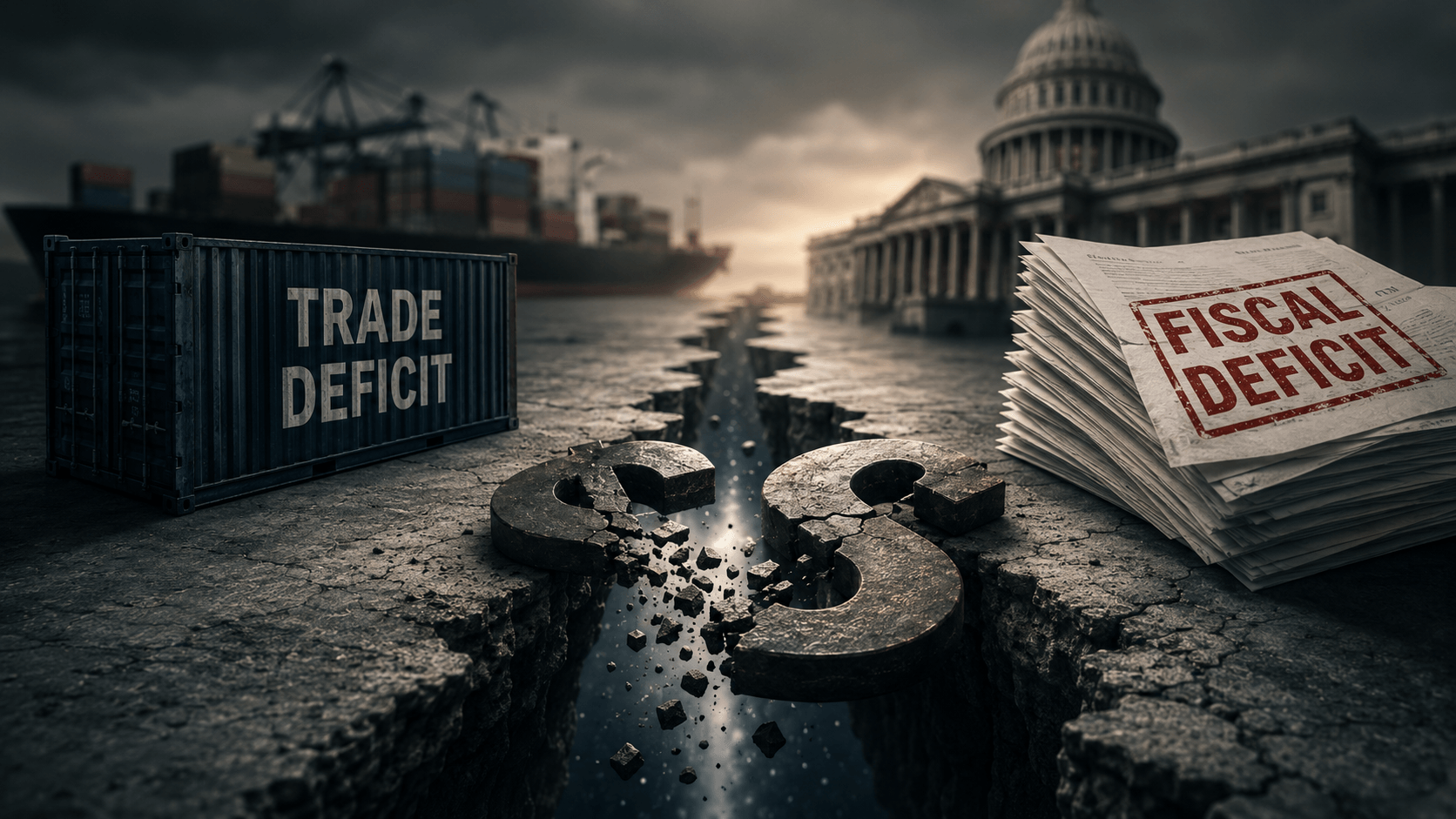
Every country can survive one imbalance for a while. Two large imbalances feeding each other at the same time is different. That combination a fiscal deficit and a current account deficit together has historically been one of the clearest long-term warning signs for currency weakness.
In 1980, Ronald Reagan entered the White House with a plan built around tax cuts, military expansion, and aggressive fiscal stimulus. Government spending surged faster than tax revenues. The budget deficit widened sharply. At the same time, stronger domestic demand pushed Americans to consume more imported goods cars, electronics, industrial equipment widening the trade deficit alongside it.
By the mid-1980s, the United States was running both deficits simultaneously. Economists began referring to them as the twin deficits.
Paradoxically, the dollar strengthened through much of this period because foreign investors poured capital into US government bonds to finance the borrowing. The currency stayed elevated not because the structure was healthy, but because foreign capital was temporarily masking the imbalance.
Then came the 1985 Plaza Accord. Major economies coordinated to weaken the dollar deliberately. Once the foreign-capital support shifted direction, the dollar fell sharply. The twin deficits had built the pressure for years. The policy shift simply released it.
What the Two Deficits Actually Mean
Current account deficit
A country imports more than it exports
When a country buys more goods, services, and energy from abroad than it sells overseas, it must continuously exchange its own currency for foreign currencies to pay the difference. That creates persistent structural selling pressure on the domestic currency.
Fiscal deficit
The government spends more than it collects in taxes
The government finances the gap by borrowing — usually through issuing bonds. If domestic savings are insufficient to absorb that borrowing, foreign investors must step in and buy the debt.
That creates dependence on external capital.
The danger begins when both deficits exist simultaneously.
One side of the economy is sending money abroad through imports. The other side is borrowing heavily and relying on foreign investors to fund it. The currency becomes dependent on continuous foreign confidence to stay stable.
How Twin Deficits Create Currency Fragility
- Government borrowing pulls in foreign capital
Large fiscal deficits require financing. Foreign investors buy government bonds, creating capital inflows that can actually strengthen the currency temporarily.
This is why twin deficit currencies often look stable during the early stages of the problem.
- Domestic demand rises — imports surge
Government stimulus boosts incomes and spending. Consumers buy imported goods, companies import equipment, and the current account deficit widens further.
The country consumes more from abroad than it earns from abroad.
- The currency becomes dependent on investor confidence
The exchange rate now relies on foreign investors continuing to buy domestic bonds and assets. That support is conditional.
If interest rates elsewhere become more attractive, political stability weakens, inflation rises, or growth slows, capital can reverse direction quickly.
- Foreign capital exits — the currency adjusts violently
Once foreign investors begin selling local bonds and repatriating capital, the currency loses its support structure.
The exchange rate weakens sharply.
Imported goods become more expensive. Inflation rises. Borrowing costs increase. Fiscal pressure worsens. Both deficits begin reinforcing each other in the wrong direction.
The adjustment that had been delayed suddenly arrives all at once.
Turkey 2018: A Modern Twin Deficit Crisis
In 2018, Turkey was running a large current account deficit funded primarily through foreign capital inflows. Domestic growth had been fuelled by credit expansion and government stimulus, while inflation pressures were already building. Foreign investors were increasingly concerned about political interference in monetary policy and the central bank’s independence.
Then external pressure arrived.
US sanctions on Turkish steel and aluminium became the catalyst that triggered a broader reassessment of Turkish assets. Investors rapidly reduced exposure to the lira.
The currency collapsed.
The Turkish lira lost roughly 45% of its value within twelve months.
The sanctions themselves were not large enough to explain the magnitude of the move. The twin deficits had already built a structurally fragile currency system. The sanctions simply exposed it.
“Twin deficits do not guarantee a currency crisis. They guarantee vulnerability. The crisis arrives when confidence finally stops financing the imbalance.”
Why the United States Is the Exception
The biggest challenge to the twin deficit framework is obvious: the United States has run both deficits repeatedly without suffering the type of currency collapse seen in emerging markets. The reason is reserve currency status.
The US advantage
The US dollar is the world’s primary reserve currency. Global central banks, sovereign wealth funds, pension systems, and international institutions hold dollars regardless of US fiscal conditions because global trade and finance still revolve around the dollar system.
Demand for US Treasuries is structural.
That demand cushions the dollar from pressures that would destabilise almost any other currency.
The normal rule
Most countries do not have this privilege.
For emerging markets, twin deficits create genuine vulnerability because the currency depends heavily on foreign capital inflows that can reverse rapidly when global conditions change.
Without a reserve currency status, confidence matters far more.
Why GCC Economies Are Structurally Different
Countries like the UAE and Saudi Arabia operate differently because oil exports generate persistent current account surpluses during normal energy cycles.
Rather than relying on foreign capital to fund imports, energy exports bring foreign currency into the economy continuously.
Even during periods of fiscal deficit, sovereign wealth fund reserves provide an additional cushion most economies do not possess.
This is why the twin deficit framework is far less dangerous for major Gulf economies than it is for import-dependent emerging markets.
What Traders Should Watch
Read both deficits together
Looking at fiscal deficits without the current account or vice versa misses the interaction between the two. A country running both deficits above roughly 3% of GDP simultaneously deserves attention.
That combination creates structural dependence on foreign financing.
Watch bond yields carefully
Rising government bond yields in a twin deficit country often signal that investors are demanding more compensation for holding the debt.
That usually means confidence is weakening before the currency itself fully reflects the stress. Bond markets often recognise the danger earlier than FX markets do.
Understand the illusion of stability
Twin deficit currencies frequently remain stable for years while imbalances quietly worsen beneath the surface. Foreign capital inflows can support the exchange rate much longer than expected.
That stability is often misread as proof the imbalance does not matter.
In reality, it usually means the adjustment has simply not started yet.
When confidence finally reverses, the move is rarely gradual.
The Real Lesson of Twin Deficits
The Plaza Accord solved America’s twin deficit pressure cooperatively through coordinated policy action. Most countries do not get that kind of adjustment.
More often, the correction happens through the currency itself.
The exchange rate falls. Imports become expensive. Domestic demand weakens. Consumption contracts. The trade deficit narrows through reduced purchasing power rather than careful policy management.
Currencies ultimately adjust when economies consume more than they produce and borrow more than they can comfortably finance.
Twin deficits simply accelerate the moment that adjustment becomes unavoidable.
The names change. The countries change. The decade changes.
The mechanics almost never do.