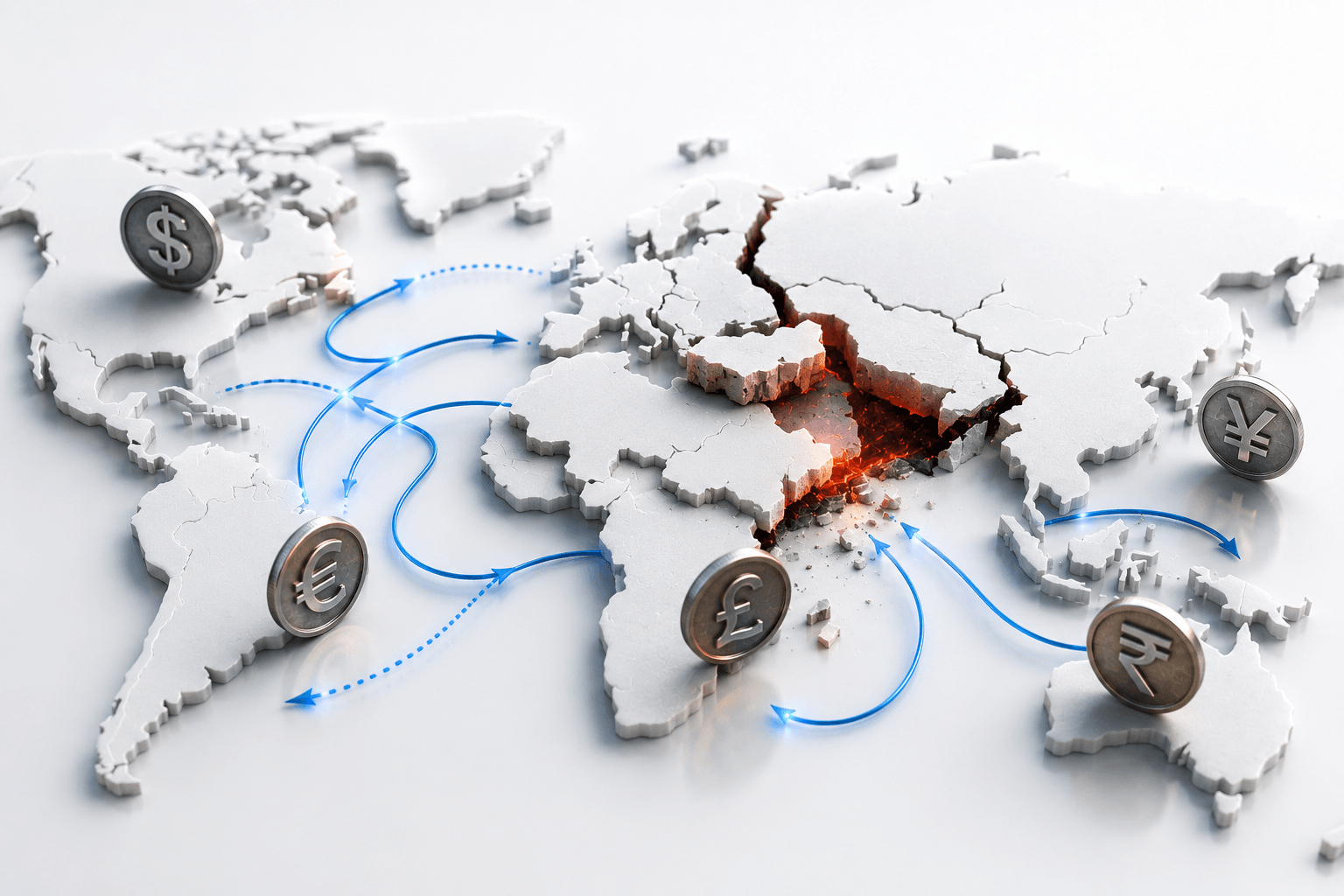


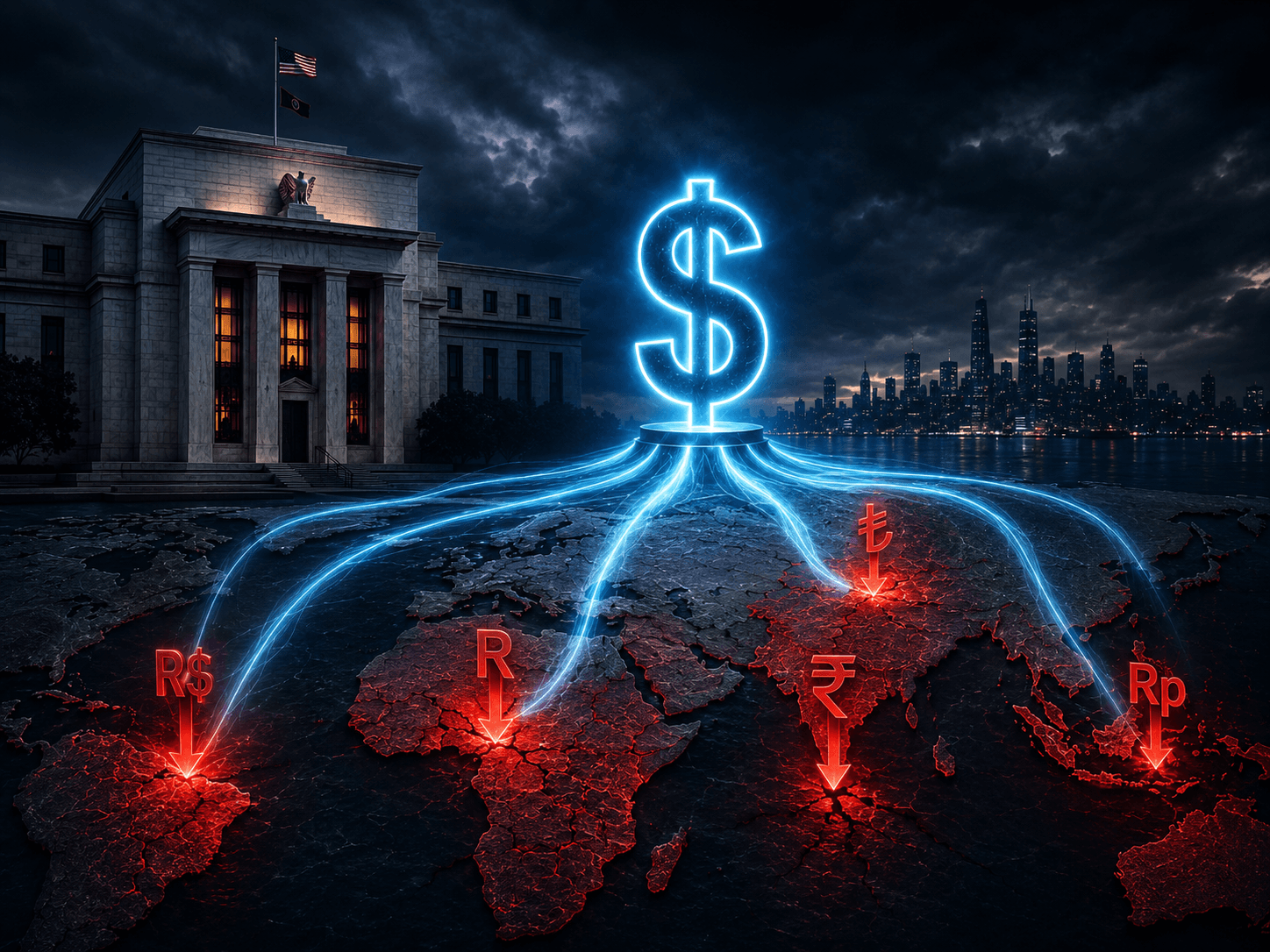
Every time the Federal Reserve raises interest rates, something predictable happens on the other side of the world. Currencies in Turkey, India, South Africa, Brazil, Indonesia, and dozens of other emerging economies come under pressure. Sometimes the pressure is manageable. Sometimes it is severe enough to trigger a full currency crisis. The mechanism that causes this is not complicated, but it is one of the most consequential forces in global forex markets and one that directly affects traders operating anywhere in the emerging market orbit, including the Gulf.
Why the Fed's decisions land everywhere, not just in America
The United States dollar is the world's reserve currency. Most international trade is invoiced in dollars. Most emerging market government and corporate debt is denominated in dollars. When the Federal Reserve raises rates, the return on holding dollar-denominated assets increases. Money that was sitting in Indonesian bonds, Brazilian equities, or South African real estate starts looking less attractive compared to a US Treasury paying a higher yield with none of the political or currency risk attached to an emerging market.
The result is capital outflow. Investors sell emerging market assets, convert the local currency proceeds back into dollars, and move the capital into US assets where the returns are now better. The selling of local currency and buying of dollars creates downward pressure on every emerging market exchange rate simultaneously. Not because anything changed in those economies. Because something changed in America.
This is the core of why Fed rate decisions are the single most-watched event in global forex markets. They affect not just dollar pairs but every currency in every country whose economy is connected to global capital flows, which is essentially every country.
The three channels through which Fed rate hikes hit emerging markets
Capital outflows are the most immediate channel. As described above, higher US rates attract capital away from emerging markets and toward dollar assets. This happens quickly, sometimes within hours of a rate decision, as large institutional investors rebalance portfolios toward the higher-yielding option.
Dollar debt becomes more expensive to service. Most emerging market governments and corporations borrow in dollars because international debt markets are dollar-denominated. When US rates rise, the cost of rolling over that debt increases. Countries with large dollar-denominated debt loads face a rising bill payable in a currency they must buy from the market. That buying pressure on the dollar adds to the selling pressure on the local currency from the capital outflow channel simultaneously.
Import costs rise. Emerging markets that import significant quantities of goods priced in dollars, which includes most of them, face higher costs as their local currency weakens against the dollar. This feeds domestic inflation, which creates pressure on local central banks to raise their own interest rates in response. Higher local rates slow economic growth. The Fed's decision in Washington triggers an economic chain that ends in slower growth in countries that had no vote in the original decision.
Which currencies feel it most
Not all emerging market currencies are equally vulnerable to Fed rate hikes. The most exposed are those running large current account deficits, meaning they import significantly more than they export and therefore need continuous foreign capital inflows to fund the gap. When the Fed raises rates and those capital inflows slow or reverse, currencies with current account deficits have less support and fall faster.
The Turkish lira has been one of the most consistently vulnerable currencies to Fed tightening cycles. Turkey runs a persistent current account deficit, has significant dollar-denominated corporate debt, and has a history of central bank decisions that reduce investor confidence in its policy independence. When the Fed raises rates, money exits Turkey quickly.
The South African rand is highly sensitive to global risk appetite, which tends to fall when the Fed is tightening. South Africa also depends heavily on commodity exports, and commodity prices often fall when dollar strength increases following Fed rate hikes, creating a double headwind.
The Indian rupee is exposed through its import dependency, particularly on oil. When Fed rate hikes strengthen the dollar and weaken the rupee simultaneously, India's oil import bill rises in rupee terms even if the dollar oil price stays constant. For traders in Dubai watching USD/INR, the Fed calendar is one of the most important inputs available.
Currencies with current account surpluses, large foreign exchange reserves, and lower dollar-denominated debt loads are more resilient. China, South Korea, and Taiwan generally weather Fed tightening cycles better than deficit-running peers, though none are completely immune.
What the 2022 Fed hiking cycle showed the world
Between March 2022 and July 2023, the Federal Reserve raised rates seventeen times in one of the most aggressive tightening cycles in its history. The dollar index surged to twenty-year highs. Across emerging markets, the damage was significant.
The Sri Lankan rupee lost more than eighty per cent of its value, and the country defaulted on its foreign debt. The Pakistani rupee halved in value. The Egyptian pound underwent multiple forced devaluations. The Turkish lira hit successive record lows. Countries that had borrowed heavily in dollars during the low-rate environment of the previous decade found themselves with debts that had effectively doubled in local currency terms.
The 2022 cycle was an extreme case, but it illustrated the mechanism at full force. Every element described above, capital outflows, rising debt servicing costs, and currency weakness feeding domestic inflation, played out simultaneously and visibly enough that anyone following the economic calendar through that period had a real-time education in how Fed policy travels through global currency markets.
What this means for traders in the Gulf
The Gulf currencies are pegged to the dollar, which means they do not weaken against the dollar when the Fed raises rates. In fact, Gulf central banks raise their own rates in lockstep with the Fed to maintain the peg, as described in the impossible trinity. This gives Gulf-based businesses and investors a degree of insulation that most emerging market economies do not have.
But the region is not unaffected. Gulf sovereign wealth funds hold significant investments in emerging markets. Gulf banks have exposure to emerging market debt. Gulf businesses trade with countries whose currencies weaken during Fed tightening cycles, which affects the real value of those trade relationships. And traders based in Dubai who trade USD/INR, USD/TRY, USD/ZAR, or any other emerging market pair are directly in the middle of the mechanism every time the Fed meets.
Checking the economic calendar before every Federal Reserve meeting and understanding what a rate hike, a hold, or a cut means for the emerging market pairs you trade is not advanced macro knowledge. It is the foundational context that makes every trade in those pairs more readable. My Maa Markets provides a full economic calendar with consensus forecasts inside the client platform so traders can see exactly what the market expects before any Fed decision lands.
Open a free demo account with My Maa Markets and practise trading around. Watch how emerging market currency pairs move in the days before and after the decision. Build the instinct for how Fed policy travels through global forex markets before you are managing real capital through the same mechanism.