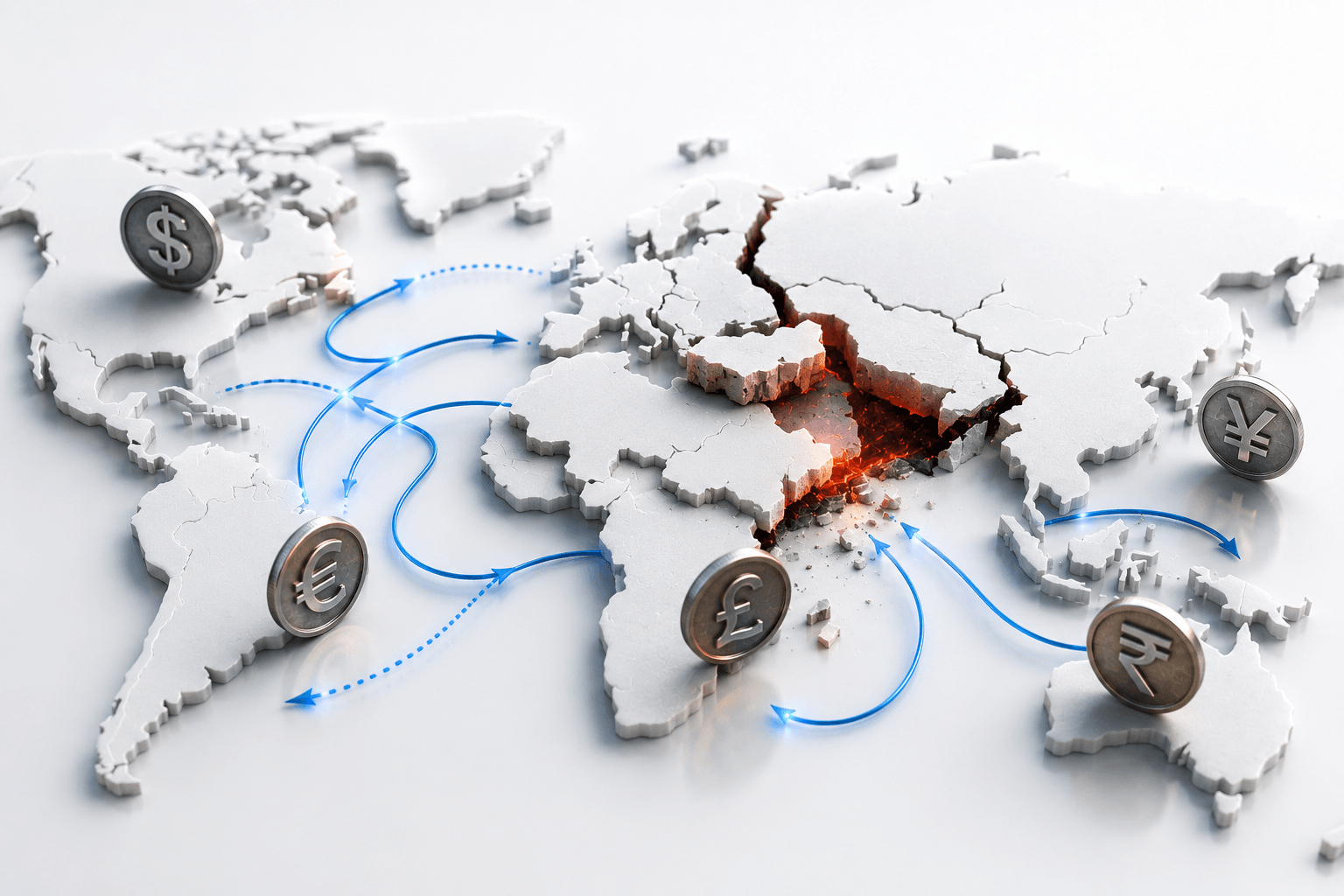



Most traders check the oil price after an OPEC meeting and move on. The more interesting question is what happens to the currencies of every country whose economy is shaped by that oil price, which is not a short list. OPEC decisions send shockwaves through forex markets that travel far beyond the commodity itself, touching currencies that never appear on a single barrel of crude oil.
What OPEC actually is and why it holds this kind of power
The Organization of the Petroleum Exporting Countries is a group of thirteen nations that collectively control a significant portion of the world's proven oil reserves. The founding members met in Baghdad in 1960. The expanded group today, sometimes called OPEC+, includes Russia and several other major producers alongside the original Gulf-dominated bloc.
When OPEC+ members agree to cut production, less oil enters the global market. Supply falls while demand stays relatively constant, and the price rises. When they agree to increase production, supply rises, and the price tends to fall. The mechanism is straightforward. The consequences for currency markets are considerably more layered.
The currencies that benefit when OPEC cuts production
An OPEC production cut pushes oil prices higher. For countries that export significant quantities of oil, higher prices mean more revenue flowing into their economies. That revenue arrives in dollars, gets converted into local currency, and creates demand that strengthens the local currency over time.
The Canadian dollar is the most traded oil-linked currency in the G10. Canada exports roughly four million barrels of oil per day, primarily to the United States. When oil prices rise after an OPEC cut, the Canadian dollar typically strengthens against the US dollar. Traders who understand this relationship position for CAD strength before the market consensus catches up.
The Norwegian krone follows a similar logic. Norway is one of Western Europe's largest oil exporters and runs a substantial sovereign wealth fund fed by oil revenues. A meaningful OPEC cut that drives oil prices higher is structurally positive for the krone, and the effect appears in USD/NOK and EUR/NOK often within hours of the announcement. The Russian ruble, before the sanctions landscape changed its dynamics in 2022, was one of the most oil-sensitive currencies in the world. Even now, within the constraints of sanctions-driven currency controls, oil price movements remain a primary driver of ruble direction.
For Gulf-based traders, the connection is direct and personal. The UAE dirham is pegged to the dollar and does not move against it. But the economic health of the Gulf region, government spending capacity, real estate activity, and business confidence all trace back to oil revenues. An OPEC cut that holds oil prices above eighty dollars per barrel has a fundamentally different economic backdrop than one where prices fall to fifty. Even if the dirham rate stays fixed, the economic environment surrounding every dirham-denominated business shifts with the oil price.
The currencies that suffer when OPEC cuts production
Higher oil prices are a cost for countries that import most of their energy. Japan imports virtually all of its oil. When OPEC cuts push energy costs higher, Japan's import bill rises, its trade balance worsens, and the yen comes under additional pressure beyond what interest rate differentials alone would produce.
India is one of the world's largest oil importers. Higher oil prices widen India's current account deficit and create persistent selling pressure on the rupee. For traders in Dubai who watch USD/INR, OPEC meeting outcomes are a meaningful input into that pair's direction.
South Korea, Taiwan, and most of Southeast Asia face the same dynamic. These are manufacturing-heavy economies with large energy import requirements. An OPEC-driven oil price spike is not neutral for their currencies. It is a headwind that shows up in the exchange rate within days of the announcement.
Why OPEC's surprise moves markets harder than expected decisions
Markets are forward-looking. By the time OPEC meets formally, traders have spent weeks reading statements from member nation energy ministers, satellite data on production levels, and internal OPEC documents leaked to the press. By meeting day, a significant portion of the expected decision is already priced into the oil market and the currency pairs most sensitive to it.
What moves markets hard is the surprise. When OPEC cuts more than expected, oil rallies sharply, and CAD, NOK, and Gulf-linked assets benefit beyond what pre-meeting positioning accounted for. When OPEC holds production despite widespread expectations of a cut, oil falls, and the same currencies reverse.
The practical implication is that checking the economic calendar before an OPEC meeting is not optional for traders running positions in oil-sensitive pairs. Knowing the meeting date and the market's prevailing expectation before the announcement tells you what is already priced and what a surprise in either direction would mean for the pairs you hold.
The second-order effects most traders ignore
The direct oil price reaction is the obvious move. The second-order effects take longer and are often more tradeable. When oil revenues surge for Gulf producers following an OPEC cut, sovereign wealth funds receive larger inflows. Those inflows get recycled into global assets, primarily US Treasuries, European equities, and global real estate. That recycling flow creates dollar demand and supports dollar-denominated asset prices in ways that are not immediately obvious from watching the oil chart.
When oil prices fall following an unexpected OPEC production increase, Gulf governments face reduced revenues. Budget pressures increase. Infrastructure spending slows. The regional economic effect ripples through every business operating in the Gulf, including those whose revenues are dirham-denominated but whose confidence is tied to regional economic activity.
Understanding OPEC as a forex input rather than just a commodity event is one of the more useful reframes available to traders operating in this region. The oil price is the headline. The currency consequences are the trade.
What this means for how you prepare before OPEC meetings
Mark every scheduled OPEC meeting on your economic calendar at the start of each month. In the week before the meeting, read what the member nations are signalling publicly about production intentions. Form a view on whether the market's expectations are accurate or whether a surprise in either direction is plausible.
If you hold positions in CAD, NOK, or any pair with a currency from a major oil-importing nation, assess how each position sits relative to the likely outcome before the meeting date arrives. An unhedged long CAD position heading into an OPEC meeting where a surprise production increase is possible carries risk that can be managed if you know the meeting is coming.
Open a free demo account with My Maa Markets and practise trading. Watch how oil-sensitive currency pairs behave in the days before and after an announcement. Build the instinct for how OPEC decisions travel through the forex market before you are managing those decisions with real capital.