

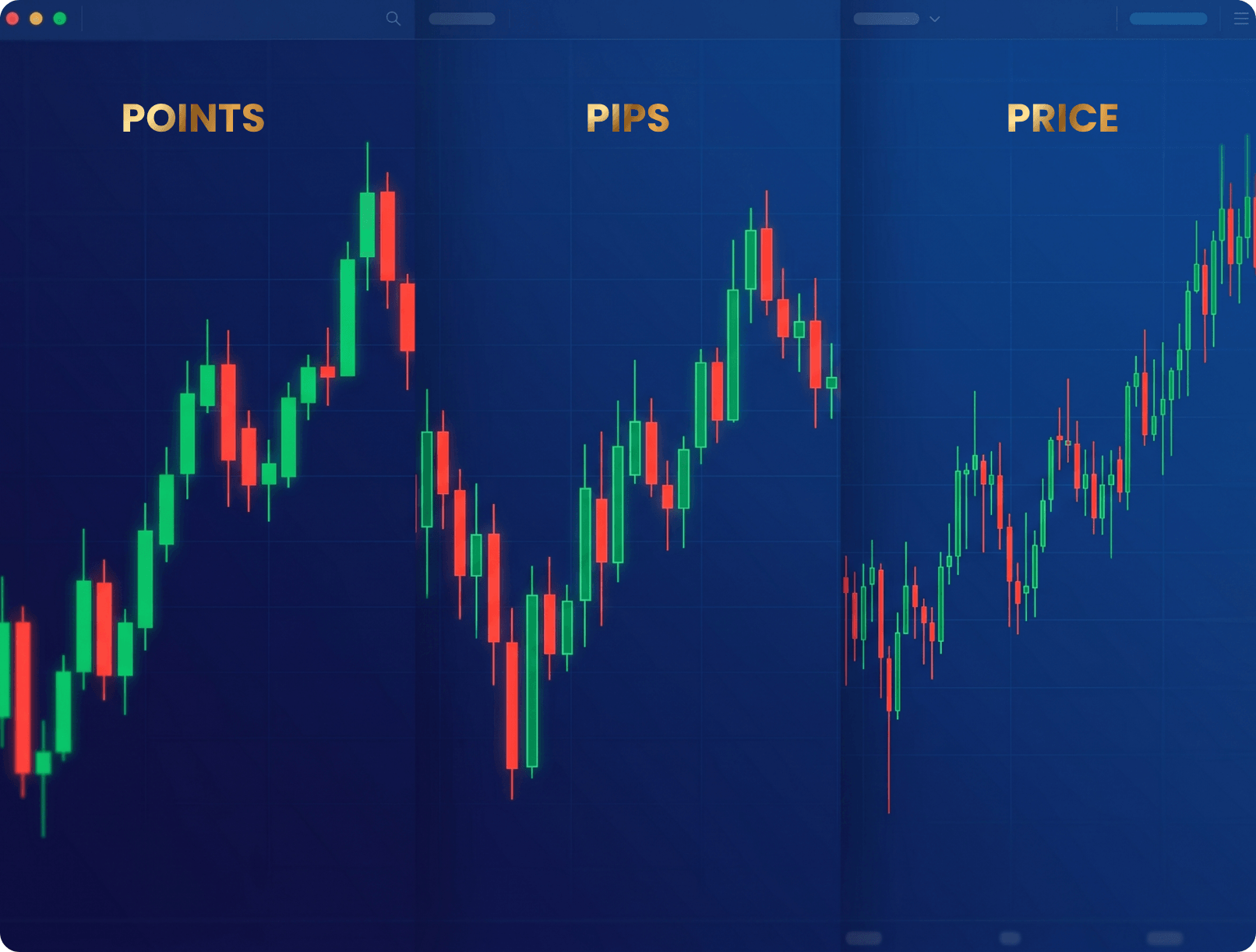
Mastering the language of price movement is the foundation of any successful trading strategy. Whether you are scalping the forex markets or holding long-term positions in commodities, understanding how price changes are measured—and how they impact your profit and loss—is essential. Without a grasp of pips, points, and spreads, calculating risk and potential reward becomes a guessing game.
In this guide, we break down the mechanics of price measurement across different asset classes. You will learn how to calculate value changes accurately, understand the impact of leverage, and navigate spreads to trade with confidence.
1. Introduction to Pips, Points, and Price Movements
In global financial markets, asset prices are constantly fluctuating. However, the way these fluctuations are measured depends entirely on the instrument you are trading. A currency pair moves in "pips," an index moves in "points," and a stock moves in cents or dollars.
Understanding these units of measurement is critical because they determine the monetary value of a market move. A 50-point move in the NASDAQ 100 does not carry the same financial weight as a 50-pip move in EUR/USD, even if the position sizes appear similar. By distinguishing between these units, traders can manage their exposure and align their strategies with market volatility.
2. What is a Pip in Forex?
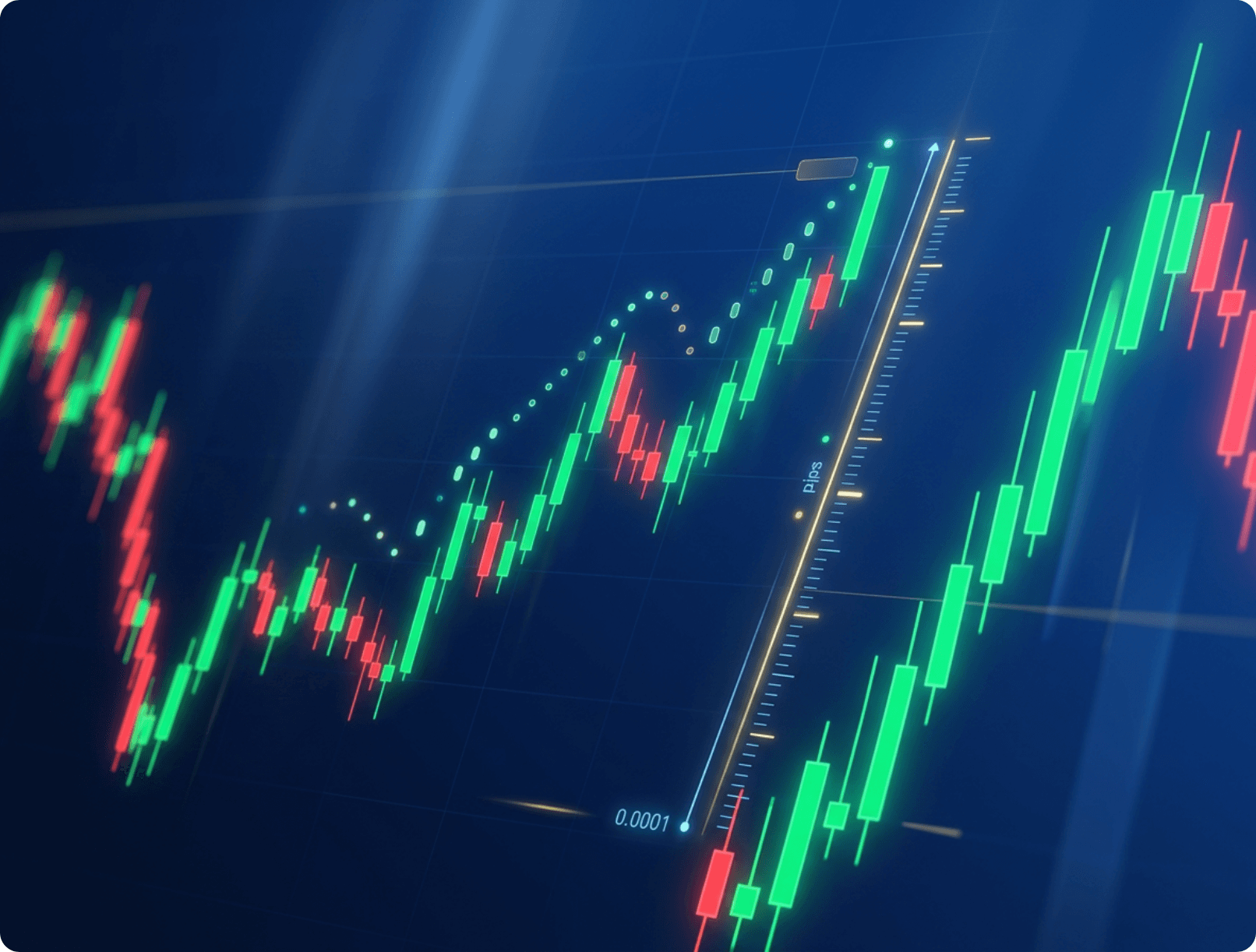
In the foreign exchange (Forex) market, a "pip" stands for "percentage in point" or "price interest point." It is the standardized unit of change in a currency pair. For most major currency pairs, such as EUR/USD or GBP/USD, a pip is the fourth decimal place (0.0001).
For example, if the EUR/USD moves from 1.1750 to 1.1751, that is a one-pip movement. However, there is a notable exception: currency pairs involving the Japanese Yen (JPY). In pairs like USD/JPY, a pip is represented by the second decimal place (0.01).
-
Standard Pairs (e.g., EUR/USD): 0.0001 movement = 1 Pip
-
Yen Pairs (e.g., USD/JPY): 0.01 movement = 1 Pip
Many advanced platforms, including MT5, also use "pipettes," which are fractional pips (the 5th decimal place for standard pairs), offering even greater precision for traders utilizing tight spreads.
3. How to Calculate Pip Value
Knowing how many pips the market has moved is only half the battle; you must also know what that movement is worth in your account currency. The value of a pip depends on the lot size (volume) you are trading.
For a Standard Lot (100,000 units of currency), one pip is typically worth $10 USD in pairs where the USD is the quote currency (the second currency in the pair).
Here is a simple breakdown for EUR/USD:
-
Standard Lot (1.00): 1 pip = $10
-
Mini Lot (0.10): 1 pip = $1
-
Micro Lot (0.01): 1 pip = $0.10
If you buy 1.00 lot of EUR/USD at 1.1750 and sell at 1.1760, you have gained 10 pips. At $10 per pip, your profit would be $100. Calculating this precisely ensures you adhere to proper risk management principles before entering a trade.
4. Points in Indices and Commodities
While Forex uses pips, indices (like the US30 or UK100) and commodities (like Gold or Oil) generally move in "points" or "ticks." The value of a point can vary significantly depending on the contract specifications of the broker.
For Gold (XAU/USD), price is quoted in US Dollars per ounce. A movement from 1800.00 to 1801.00 is a $1.00 change in price. However, traders often refer to changes in the cents (0.01) as ticks or pips depending on their terminology.
For Indices, a move from 34,000 to 34,001 on the Dow Jones Industrial Average represents one point. It is vital to check your broker's contract specifications, as the monetary value of that single point will differ based on your leverage and contract size. At MY MAA MARKETS, we offer clear specifications on over 275+ instruments, ensuring you always know the value of your exposure.
5. Understanding Price Movements in Stocks
Stock trading is perhaps the most straightforward when it comes to price measurement. Price movements are typically quoted in the local currency of the stock exchange. For US stocks, this is dollars and cents.
If you purchase a share of a company at $150.00 and the price rises to $152.50, the price has moved $2.50. To calculate your profit or loss, you simply multiply this currency movement by the number of shares you hold.
Unlike Forex or Indices where standardized lots are used, stock trading allows for varied volume. Whether you are trading high-frequency strategies on blue-chip stocks or investing for the long term, the calculation remains linear:
- (Sell Price - Buy Price) x Number of Shares = Profit/Loss.
6. Leverage and its Impact on Pips
Leverage allows traders to control larger positions with a smaller amount of capital. While this can magnify profits, it significantly impacts the monetary value of every pip or point movement relative to your account balance.
For instance, using 1:500 leverage means for every $1 in your account, you can control $500 in the market. If you have a $1,000 account and open a large position, a movement of just 20 or 30 pips could result in a significant percentage gain—or a substantial loss.
High leverage makes each pip "expensive" in terms of margin used. It is crucial to adjust your lot size according to your leverage. At MY MAA MARKETS, we offer leverage up to 1:500, giving you the flexibility to capitalize on small price movements, provided it is managed with disciplined risk protocols.
7. Spreads and How They Affect Your Trading
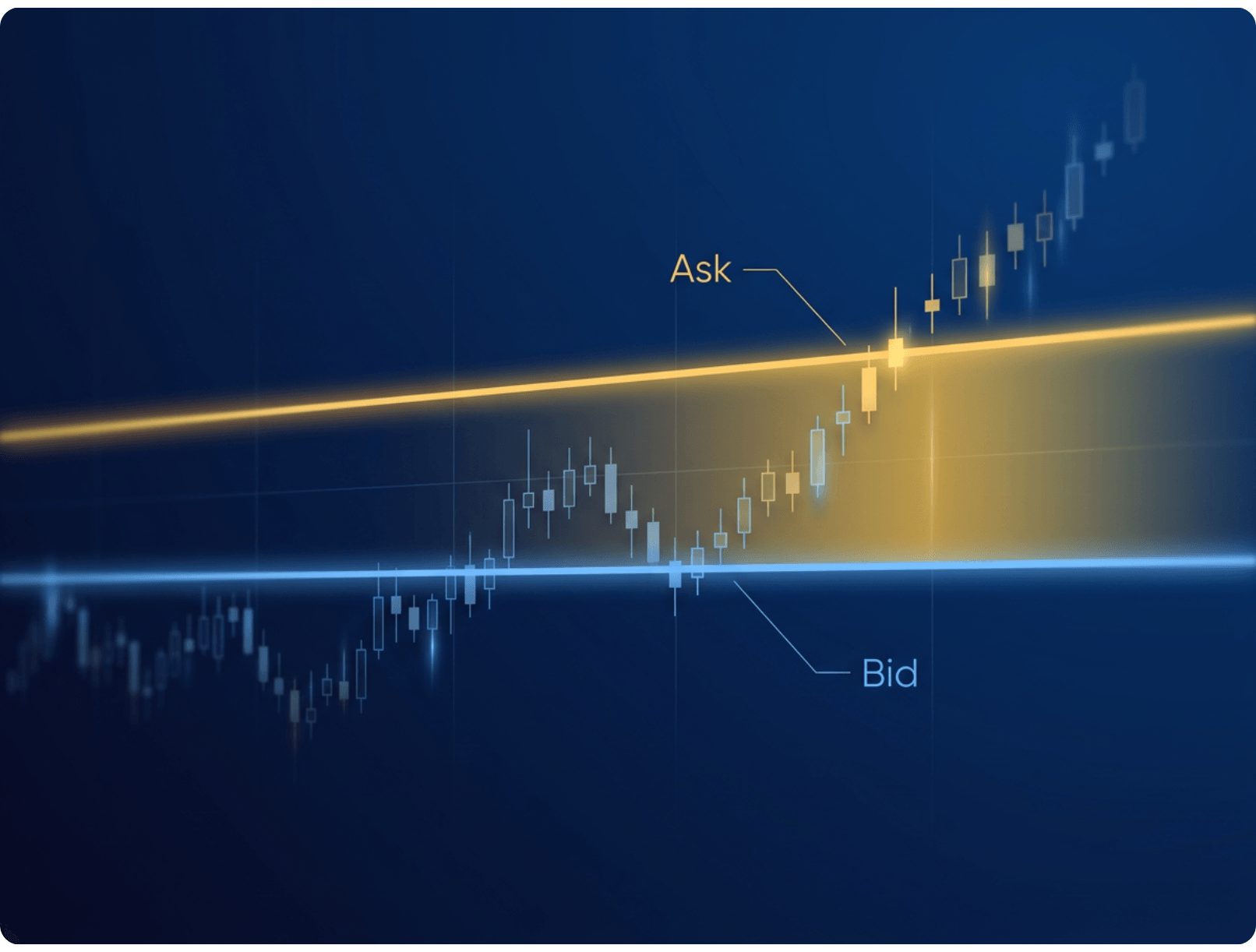
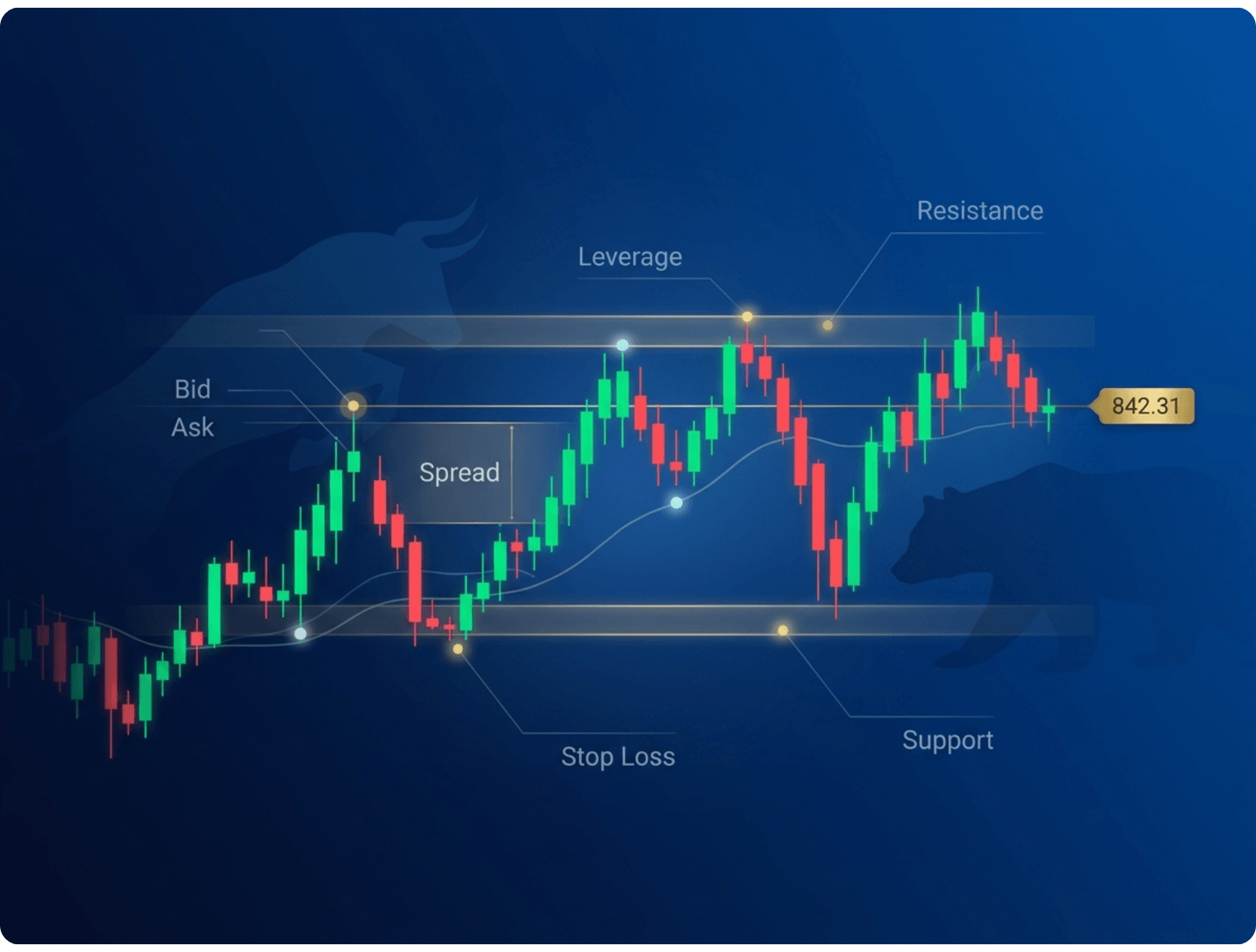
The spread is the difference between the Buy (Ask) price and the Sell (Bid) price. It is effectively the cost of entering a trade. Spreads are measured in pips or points and must be factored into your price targets.
If the EUR/USD spread is 1 pip, and you enter a long position (buy), the market must move 1 pip in your favour just for you to break even.
-
Wide Spreads: Can eat into profits, especially for scalpers looking for small gains.
-
Tight Spreads: Allow for faster breakeven and better entry prices.
Traders should seek brokers that offer competitive spreads to minimize these costs. Our trading accounts, such as the VIP Account, offer spreads starting from 0.0 pips, ensuring that you keep more of the pips you capture.
8. Conclusion: Mastering Price Measurement for Successful Trading
Understanding pips, points, and spreads is not just about vocabulary; it is about protecting your capital. By accurately calculating the value of price movements, you can set precise stop-losses, define realistic profit targets, and utilize leverage responsibly. Whether you are trading Forex, commodities, or indices, clarity on these metrics leads to disciplined and informed decision-making.
Ready to test your knowledge on the live markets? Access 275+ instruments with spreads from 0.0 pips and robust execution speeds.