

Navigating the financial markets for the first time can feel like learning a new language. You will encounter a host of specialized terms that are essential for understanding market behavior, executing trades, and managing risk. To trade with confidence, you must first build a solid foundation of knowledge, and that begins with mastering the core vocabulary.
This guide provides a clear and structured overview of the fundamental trading terms every beginner needs to know. Understanding these concepts is the first step toward making informed decisions and developing effective trading strategies. As you read, you will gain the clarity needed to interpret market data and interact with trading platforms effectively.
Disclaimer: Investing in financial markets carries a high level of risk. You should carefully consider your investment objectives, risk tolerance, and financial situation before making any trading decisions. This content is for educational purposes only and should not be considered investment advice.
Basic Market Concepts
These terms describe the fundamental state of the market and the core components of a trade.
Bull Market vs. Bear Market
Understanding the overall market trend is crucial for positioning your trades.
-
Bull Market: A market characterized by a sustained period of rising prices. During a bull market, sentiment is generally positive, and traders are optimistic that the upward trend will continue.
-
Bear Market: The opposite of a bull market, a bear market is defined by consistently falling prices. Negative sentiment prevails as traders anticipate further declines in value.
Bid Price vs. Ask Price
Every trade involves two prices, and understanding the difference is key to execution.
-
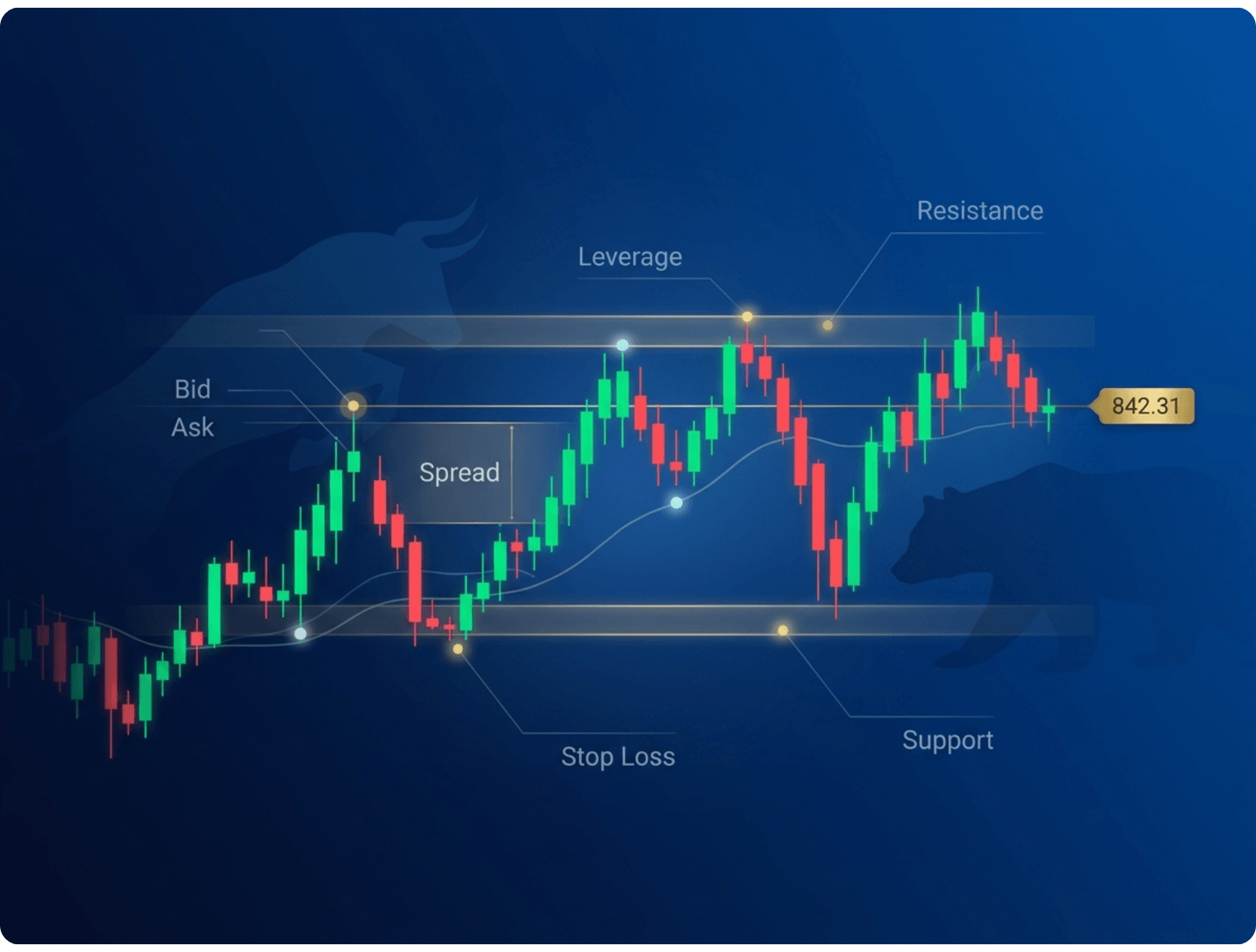
Bid Price: The highest price a buyer is willing to pay for an asset at a given moment. When you sell an asset, you do so at the bid price.
-
Ask Price: The lowest price a seller is willing to accept for that same asset. When you buy an asset, you do so at the ask price.
Spread
The spread is a direct cost of trading and can impact your profitability.
- Spread: This is the difference between the bid and ask price. Brokers earn revenue from the spread, so traders often seek platforms with the tightest spreads possible to minimize costs. At MY MAA MARKETS, we offer spreads starting from 0.0 pips, ensuring cost-effective trading.
Leverage
Leverage allows you to control a larger position with a smaller amount of capital.
- Leverage: This is the use of borrowed funds to increase your trading position beyond what would be available from your cash balance alone. For example, with 1:500 leverage, you can control a $50,000 position with just $100 of your own capital. While leverage can amplify your gains, it's important to remember that it also magnifies your losses. It should be used with a clear understanding of the risks involved.
Types of Trading Orders
Orders are the instructions you give your broker to buy or sell an asset. Different order types give you greater control over your trades.
Market Order
- Market Order: This is an instruction to execute a trade immediately at the best available current price. It prioritizes speed of execution over a specific price.
Limit Order
- Limit Order: A limit order is an instruction to buy or sell an asset at a specific price or better. A buy limit order is executed at the limit price or lower, while a sell limit order is executed at the limit price or higher. This gives you control over the price but does not guarantee execution if the market never reaches your specified price.
Stop-Loss Order
- Stop-Loss Order: This is a crucial risk management tool. A stop-loss order is an instruction to close out a losing position automatically once the asset reaches a certain price. Its purpose is to limit your potential losses on a single trade.
Key Technical Analysis Terms
Technical analysis involves studying price charts and market statistics to forecast price movements.
Support and Resistance
-
Support: A price level where a downtrend can be expected to pause due to a concentration of demand. It's a level that an asset's price has had difficulty falling below.
-
Resistance: The opposite of support, a resistance level is a price point where an uptrend is likely to pause temporarily. It's a level that the asset's price has struggled to break above.
Moving Average
- Moving Average (MA): This is a widely used technical indicator that smooths out price data by creating a constantly updated average price. It helps to identify the direction of the trend over a specific period. There are different types, like the Simple Moving Average (SMA) and the Exponential Moving Average (EMA), with the latter giving more weight to recent prices.
Relative Strength Index (RSI)
- RSI: This is a momentum oscillator that measures the speed and change of price movements. The RSI fluctuates between 0 and 100. Traditionally, an asset is considered overbought when the RSI is above 70 and oversold when it is below 30.
Essential Risk Management Terms
Protecting your capital is just as important as growing it. These terms are central to a sound risk management strategy.
Margin
- Margin: This is the amount of money required in your account to open a leveraged trading position. It is not a fee but a portion of your account equity set aside as a deposit. Understanding margin requirements is essential to avoid a "margin call," where your broker asks you to deposit more funds or close positions.
Pips
- Pips (Percentage in Point): A pip is the smallest price move that a given exchange rate can make. For most currency pairs, one pip is equivalent to 0.0001. Pips are used to measure the profit or loss on a trade.
Empower Your Trading Journey
Mastering these essential terms is a non-negotiable first step in your trading career. A solid understanding of this vocabulary will enable you to interpret market analysis, use trading platforms confidently, and, most importantly, manage your risk effectively.
However, learning doesn't stop here. The financial markets are dynamic, and continuous education is the key to long-term success. At MY MAA MARKETS, we are committed to empowering our clients with the knowledge they need to thrive. Explore our Education Central for high-quality instructional videos and download our free E-Book to deepen your understanding of the markets.